Osumi-class
Summary
| Origin country | 🇯🇵 Japan |
| Category | Aircraft carrier |
| Subtype | Tank landing ship |
| Manufacturer | Mitsui |
| Year commissioned | 1998 |
| Units | Ōsumi, Shimokita, Kunisaki |
Operators
Technical specifications
| Displacement | 8900 tons |
| Crew | 137 members |
| Width | 25.8 m (84.6 ft) |
| Length | 178.0 m (584.0 ft) |
| Air Park |
|
| Propulsion | 2 × Mitsui 16V42M-A Diesel, 26,000 bhp (19,000 kW), 2 shafts, 1 × bow thruster |
| Armament |
|
| Maximum speed | 22 knots |
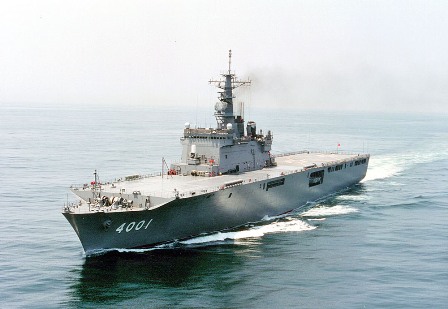
Description
The Ōsumi class is a series of three tank landing ships operated by the Japan Maritime Self-Defense Force (JMSDF). Developed to succeed the Miura class, the program originated as a proposal for a small carrier intended for defensive and mine countermeasure roles. This was subsequently reworked into an amphibious ship designated as a Maritime Operational Transport. This concept focused on delivering Japan Ground Self-Defense Force (JGSDF) reinforcements to Japanese territory where an enemy landing is possible or has occurred. Mitsui and Hitachi constructed the vessels between 1993 and 1999.
While classified as tank landing ships, the vessels lack traditional bow doors and beaching capabilities. The inclusion of a well deck in the rear of the hull, which houses Landing Craft Air Cushion (LCAC), makes the class functionally similar to a dock landing ship. The design features a flat-top upper vehicle parking deck and an island superstructure offset to the starboard side. Aviation facilities consist of a stern flight deck capable of landing helicopters such as the CH-47, though the ships lack an enclosed hangar. Two elevators connect the upper deck to a lower vehicle deck, which provides access to the well deck. These elevators are sized for vehicles rather than aircraft. The forward section contains additional vehicle storage.
The lead ship, Ōsumi, entered service in 1998, followed by Shimokita in 2002 and Kunisaki in 2003. All three vessels remain active. The class provides transport for ground troops and participates in civilian rescue during natural disasters. Ōsumi and Kunisaki conducted search and rescue operations following the 2011 Tōhoku earthquake and tsunami. In 2014, the Japanese Ministry of Defence initiated research for refitting the class to accommodate MV-22 Ospreys and Assault Amphibious Vehicles (AAV7). Subsequent upgrades enabled the ships to land MV-22 aircraft and transport AAV7A1 vehicles.