Permit-class (SSN-594)
Summary
| Origin country | 🇺🇸 United States |
| Category | Submarine |
| Subtype | Nuclear submarine |
| Manufacturer | Portsmouth Naval Shipyard |
| Year commissioned | 1961 |
| Units | USS Thresher, USS Permit, USS Plunger, USS Barb, USS Pollack, USS Haddo, USS Jack, USS Tinosa, USS Dace, USS Guardfish, USS Flasher, USS Greenling, USS Gato, USS Haddock |
Operators
Technical specifications
| Displacement | 3810 tons |
| Displacement submerged | 4369 tons |
| Range | Unlimited, except by food supplies |
| Crew | 112 members |
| Width | 9.63 m (31.6 ft) |
| Length | 84.86 m (278.4 ft) |
| Max. depth | 400 m (1312.3 ft) |
| Propulsion | 1 S5W PWR, 2 steam turbines, 15,000 shp (11 MW), 1 shaft |
| Armament |
|
| Maximum speed | 15 knots |
| Max. speed submerged | 28 knots |
Description
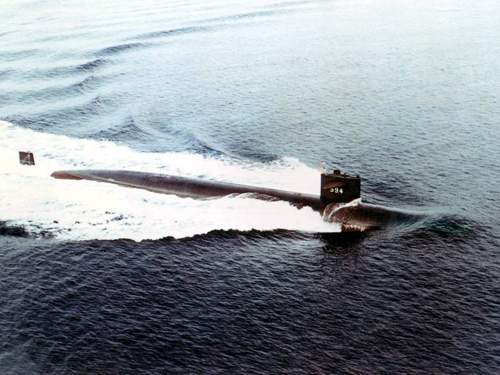
The Permit class, originally designated the Thresher class, consisted of 14 nuclear-powered fast attack submarines operated by the United States Navy. Developed from Project Nobska, a 1956 study commissioned by the Chief of Naval Operations, the design integrated findings from experimental platforms to enhance anti-submarine warfare capabilities. The class succeeded the Skipjack class and remained in service from 1961 until 1996.
The design utilized the S5W reactor plant and introduced several architectural changes to accommodate advanced sensors. A large sonar sphere was positioned in the bow, necessitating the relocation of the torpedo tubes to an angled, amidships configuration. The pressure hull, constructed from HY-80 steel, utilized a design that increased the test depth compared to previous classes. For acoustic quieting, engineering spaces were redesigned with turbines mounted on isolated "rafts" to reduce noise transmission to the hull.
Internal variations occurred during the production run. The lead boat, USS Thresher, was built with a small sail to reduce drag. Later units, including Flasher, Greenling, and Gato, were constructed under project SCB 188M with longer hulls and larger sails to house additional masts and electronics. While Thresher utilized a five-bladed screw, subsequent vessels were equipped with seven-bladed skewback screws to mitigate blade-rate noise. USS Jack served as an experimental platform for a direct-drive propulsion system using counter-rotating propellers and polymer ejection tests for noise reduction.
Following the loss of the lead boat in 1963, the class was renamed after the second ship, USS Permit. This event led to the establishment of the SUBSAFE program, which implemented quality control and manufacturing standards for all critical submarine systems. This program included requirements for welded seawater joints and remote hydraulic closure mechanisms for hull penetrations. Several units were rebuilt to meet these standards. In the late 1970s and 1980s, the class underwent mid-life modernizations, receiving the AN/BQQ-5 sonar suite and updated fire-control systems. The submarines were decommissioned throughout the 1990s as the Sturgeon and Los Angeles classes entered service.