Los Angeles-class (SSN-688)
United States nuclear attack submarine, introduced in 1976, displaced 6,082 tons. Key figures: displacement 6,082 tons, length 110 m, top speed 15 knots, crew 129, unit cost $900M, built 62. In service with 1 navy — United States (18).
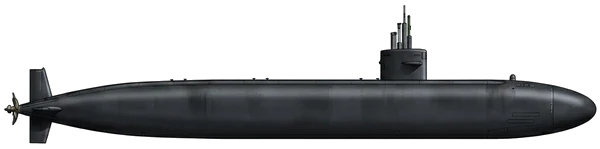
| Subtype | Nuclear-powered attack submarine |
| Displacement | 6082 tons |
| Displacement submerged | 6927 tons |
| Crew | 129 members |
| Width | 10.0 m (32.8 ft) |
| Length | 110.0 m (360.9 ft) |
| Max. depth | 450 m (1476.4 ft) |
| Propulsion | 1 × S6G nuclear reactor (150–165 MW), 2 × steam turbines (30,000–33,500) shp, 1 × shaft, 1 × secondary propulsion motor 325 hp (242 kW) |
| Range | Unlimited, except by food supplies |
| Endurance | 90 days |
| Maximum speed | 15 knots |
| Max. speed submerged | 32 knots |
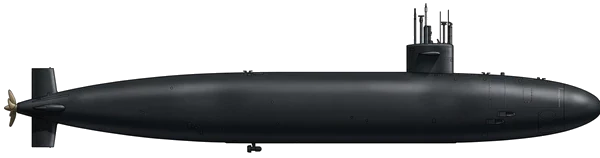
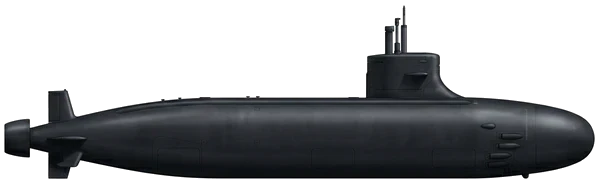
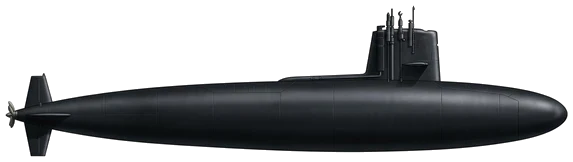
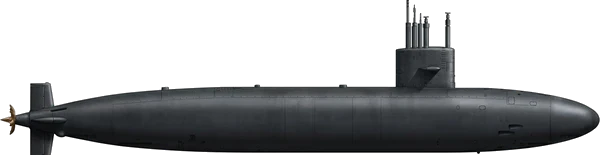
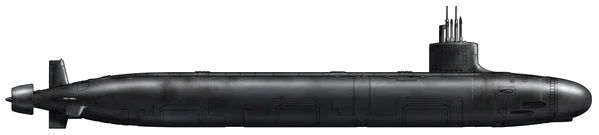
Description
The Los Angeles class, also designated the 688 class, is a series of nuclear-powered fast attack submarines operated by the United States Navy. Development began in 1967 as a response to Soviet submarine technology. The class succeeded the Sturgeon class and was designed with increased speed and stealth to maintain pace with carrier battle groups. Construction was shared between Newport News Shipbuilding and General Dynamics Electric Boat between 1972 and 1996. This class transitioned the naming convention for attack submarines from marine life to American cities.
The class consists of three production flights. Flight I vessels established the baseline design. Flight II introduced a dedicated vertical launch system (VLS) for cruise missiles and an updated reactor core. The final group, designated 688i, featured noise-reduction technology and relocated diving planes from the sail to the bow to facilitate under-ice operations. Internally, the vessels use two watertight compartments: a forward compartment for living and control spaces, and an aft compartment for engineering systems.
Propulsion is provided by an S6G pressurized water reactor powering steam turbines. Control systems transitioned from the analog-digital hybrid Mk 113 to the digital Mk 2 Combat Control System. The sensor suite initially utilized the AN/BQQ-5 sonar system, later replaced by the AN/BQQ-10, which uses an open architecture to integrate commercial hardware. Some units were configured to carry Dry Deck Shelters or the Advanced SEAL Delivery System for special operations.
The lead boat entered service in 1976. Operational lifespans have varied; some hulls exceeded 40 years of service, while others were retired due to the cancellation of midlife reactor refuelings. One vessel, USS Miami, was lost during an overhaul because of arson. Retired vessels are processed through the Ship-Submarine Recycling Program, with two units currently serving as moored training ships for the Nuclear Power School. Retirements accelerated in 2026, with Newport News withdrawn in January, Boise in April, Alexandria in June and San Juan in August, as the Virginia class replaces the type.
Frequently Asked Questions
What type of ship is the Los Angeles-class?
What is the displacement of the Los Angeles-class?
What is the maximum speed of the Los Angeles-class?
What is the range of the Los Angeles-class?
How many crew members serve on the Los Angeles-class?
How many Los Angeles-class ships have been built?
Which countries operate the Los Angeles-class?
How much does a Los Angeles-class cost?
- AUG 102026 Updated Description updated
- JUL 242026 Updated Type updated
- APR 72026 Updated Description updated in a site-wide editorial pass
- JAN 242026 Updated Max speed and submerged speed updated
- JAN 182026 Updated Manufacturer, units and 7 more fields updated