Sheffield-class (Type 42)
Summary
| Origin country | 🇬🇧 United Kingdom |
| Category | Destroyer |
| Subtype | Guided-missile destroyer |
| Manufacturer | Vickers |
| Year commissioned | 1975 |
| Units | Sheffield, Birmingham, Newcastle, Coventry, Glasgow, Cardiff, Exeter, Southampton, Liverpool, Nottingham, Manchester, York, Gloucester, Edinburgh, Hércules, Santísima Trinidad |
Operators
Technical specifications
| Displacement | 4200 tons |
| Range | 4200 km at 18 knots |
| Crew | 253 members |
| Width | 14.3 m (46.9 ft) |
| Length | 125.6 m (412.1 ft) |
| Air Park |
|
| Propulsion | 2 shafts COGOG; 2 × Rolls-Royce Olympus TM3B high-speed gas turbines (50,000 shp); 2 × Rolls-Royce Tyne RM1C cruise gas turbines (5,340 shp) |
| Armament | |
| Maximum speed | 30 knots |
Description
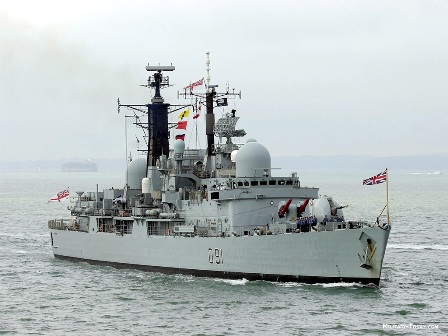
The Type 42, or Sheffield class, is a guided-missile destroyer developed for the Royal Navy and the Argentine Navy. Conceived in the late 1960s following the cancellation of the Type 82 class, the design focused on fleet air defense. The class was intended to provide area protection for naval task groups using the Sea Dart missile system.
Construction occurred in three production batches. To remain within budget constraints, Batch 1 and 2 vessels were designed with a shorter hull, while Batch 3 ships were lengthened to improve seakeeping and accommodate future upgrades. The class utilized a Combined Gas or Gas (COGOG) propulsion system, featuring gas turbines for both cruise and high-speed requirements. For its primary air defense role, the class carried a twin launcher for surface-to-air missiles, supported by fire-control and surveillance radars. Other equipment included a naval gun, anti-submarine torpedo tubes on British vessels, and a flight deck with a hangar for a helicopter. Argentine ships were equipped with anti-ship missile launchers. Following operations in 1982, the remaining fleet received modifications including the installation of close-in weapon systems and enhanced electronic warfare equipment.
Sixteen ships were completed. The class served as the primary air defense platform for British naval operations during the Cold War and subsequent periods. During the 1982 Falklands War, five British Type 42s were deployed, recording seven aircraft intercepts. Two vessels, HMS Sheffield and HMS Coventry, were lost during the conflict. This war was the first instance of ships of the same class being operated by opposing navies. In the 1991 Gulf War, the class provided air defense for coalition forces, including the successful interception of a land-based anti-ship missile.
Beyond combat operations, the class performed task group deployments, counter-drug patrols, and NATO exercises. British service concluded in 2013 as the vessels were replaced by the Type 45 class. The Argentine Navy retired its vessels between 2004 and 2024. One Argentine ship was converted for use as a multi-purpose transport before being taken out of service, while the other was utilized for spare parts and eventually sank at its berth.