Westland Lynx
British multi-purpose military helicopter, notable for naval, combat, utility roles, significantly deployed in the Falklands War. Key figures: top speed 300 km/h, range 528 km, service ceiling 3,200 m, max takeoff weight 4,760 kg, unit price $10M, built 450. In service with 9 air forces as of 2026 — South Korea (24), Germany (22), Oman (13) and 6 others.
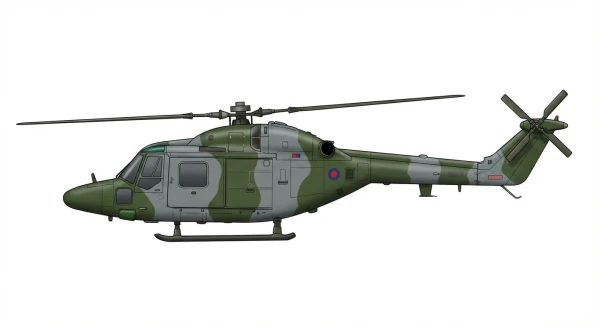
| Crew | 3 |
| Length | 15 m (49.2 ft) |
| Wingspan | 12.8 m (42.0 ft) |
| Height | 3.6 m (11.8 ft) |
| Empty weight | 2,740 kg (6,041 lbs) |
| Max. takeoff weight | 4,760 kg (10,494 lbs) |
| Powerplant | 2 × turboshafts Rolls-Royce Gem 2 671 kW each |
| Maximum speed | 300 km/h (186 mph) |
| Operational range | 528 km (328 mi) |
| Service ceiling | 3,200 m (10,499 ft) |
-
 South Korea
24
South Korea
24
-
 Germany
22
Germany
22
-
 Oman
13
Oman
13
-
 Algeria
10
Algeria
10
-
 Brazil
5
Brazil
5
-
 Malaysia
5
Malaysia
5
-
 South Africa
4
South Africa
4
-
 Portugal
3
Portugal
3
-
 Thailand
2
Thailand
2
Recent Events — Westland Lynx
1 event →
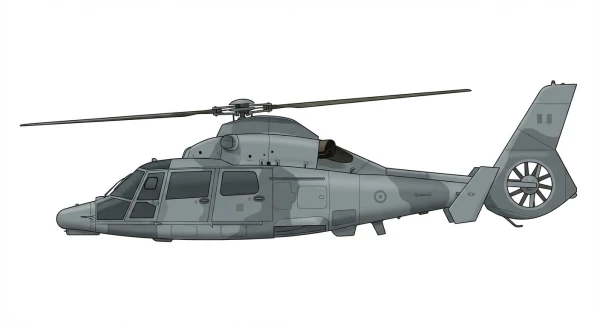
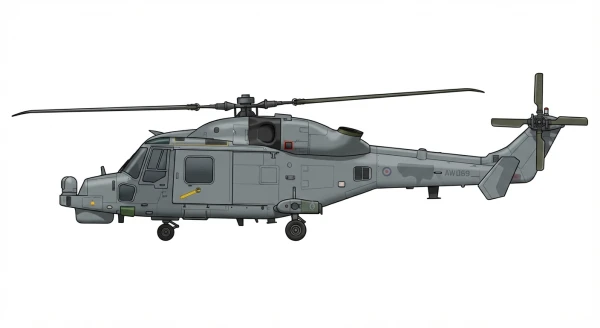
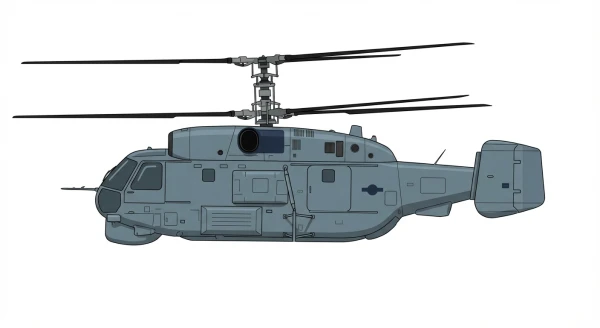
Description
The Westland Lynx is a British twin-engined multi-purpose military helicopter designed and built by Westland Helicopters at Yeovil. Developed in both battlefield and naval forms, it entered operational service in 1977 and was adopted by the armed forces of more than a dozen nations for utility transport, anti-armour, search and rescue and anti-submarine warfare. It is fully aerobatic, capable of loops and rolls, and holds the FAI absolute helicopter speed record of 400.87 km/h (249.09 mph), set on 11 August 1986 by Trevor Egginton in the modified demonstrator G-LYNX.
Development
Design work on the Westland WG.13 began in the mid-1960s as a replacement for the Westland Scout and Wasp. Under the Anglo-French helicopter agreement of February 1967, Sud Aviation held a 30 per cent production share; the French Army cancelled its requirement in October 1969, ending the armed reconnaissance variant. The first prototype flew on 21 March 1971 and thirteen were built. The first production Lynx AH.1 flew on 11 February 1977, with 113 delivered to February 1984. The Lynx-3, announced in 1984, was cancelled in 1987 after one prototype. By 2002 more than 40 variants were in service and almost 400 aircraft had been built.
Design
The Lynx uses a four-blade main rotor on a rigid titanium monobloc head, with composite honeycomb-sandwich blades; rotor and tail fold for shipboard stowage. Early aircraft used Rolls-Royce Gem turboshafts; the Super Lynx 200 introduced LHTEC T800/CTS800 engines with FADEC. BERP blades improved rotor efficiency and top speed. The cockpit seats pilot and observer side by side, with a cabin for up to ten troops. Sensors include Seaspray surveillance radar, nose-mounted FLIR and, on the Super Lynx 300, a glass cockpit derived from the EH101.
Armament
Naval fits comprise two Sting Ray torpedoes, four Sea Skua missiles (AS.12 on French aircraft) or two depth charges. Land variants carry eight BGM-71 TOW missiles on two four-round pylons, a 20 mm Oerlikon cannon, CRV7 rocket pods, door-mounted 7.62 mm GPMGs (AH.7/AH.9) or 0.50 in AN/M3M machine guns. Algerian aircraft carry eight Mokopa air-to-surface missiles. Maximum underslung load is 3,000 lb (1,361 kg).
Operational History
The AH.1 entered Army Air Corps service in 1979 and the HAS.2 joined the Fleet Air Arm in 1981. During the Falklands War a Lynx made the first combat firing of a Sea Skua against the patrol boat ARA Alférez Sobral on 3 May 1982. In the 1991 Gulf War 25 Sea Skuas were fired by 2 February, 18 confirmed hits, and on 26 February a 654 Squadron Lynx destroyed two MT-LB APCs and four T-55s with TOW. An AH.7 was brought down by an IRA mortar at Crossmaglen in 1994; another was shot down over Basra on 6 May 2006, killing five. Export operators included Brazil (first foreign customer, 1978), France, the Netherlands, Germany, Denmark, Norway, Portugal and South Korea. The Royal Navy retired the type on 23 March 2017 and the Army Air Corps in 2018.
Variants
- Lynx AH.1: Initial Army Air Corps production version with Gem 2 engines and skid undercarriage, 113 built.
- Lynx AH.7: Upgraded army variant with Gem 41-1 engines, uprated gearbox and larger composite tail rotor; 12 new-build and 107 conversions.
- Lynx AH.9A: Wheeled utility variant re-engined with LHTEC CTS800-4N turboshafts; all 22 AH.9 upgraded.
- Lynx HAS.3: Royal Navy anti-submarine variant with Gem 42-1 engines; 30 new-build plus 53 HAS.2 conversions.
- Lynx HMA.8: Maritime attack version with under-nose 360-degree radar and nose-turret FLIR, based on Super Lynx 100.
Frequently Asked Questions
What type of aircraft is the Westland Lynx?
What is the maximum speed of the Westland Lynx?
What is the range of the Westland Lynx?
When did the Westland Lynx first fly?
How many Westland Lynx have been built?
Which countries operate the Westland Lynx?
How much does a Westland Lynx cost?
What is the service ceiling of the Westland Lynx?
- AUG 302026 Updated Description updated
- AUG 52026 Updated Powerplant updated in a site-wide editorial pass
- JUL 272026 Updated Name updated
- JUL 232026 Updated Sources and cross-references refreshed
- APR 72026 Updated Sources and cross-references refreshed
- FEB 72026 Updated WG-13 Lynx: ceiling added; WG-13 Lynx: range added; WG-13 Lynx: wingspan added
- JAN 242026 Updated Top speed updated