Skipjack-class (SSN-585)
Summary
| Origin country | 🇺🇸 United States |
| Category | Submarine |
| Subtype | Nuclear-powered fast attack submarine |
| Manufacturer | General Dynamics Electric Boat |
| Year commissioned | 1959 |
| Approx. unit cost | $40 million |
| Units | Skipjack, Scamp, Scorpion, Sculpin, Shark, Snook |
Operators
Technical specifications
| Displacement | 3124 tons |
| Displacement submerged | 3569 tons |
| Range | Unlimited, except by food supplies |
| Crew | 93 members |
| Width | 9.6457 m (31.6 ft) |
| Length | 76.71 m (251.7 ft) |
| Max. depth | 210 m (689.0 ft) |
| Propulsion | 1 S5W reactor, geared steam turbines (15,000 shp (11,000 kW)), 1 shaft |
| Armament |
|
| Maximum speed | 15 knots |
| Max. speed submerged | 33 knots |
Description
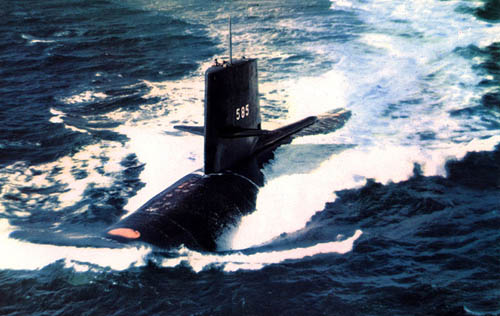
The Skipjack class consisted of six nuclear-powered fast attack submarines (SSNs) built for the United States Navy between 1956 and 1961. Developed under project SCB 154, the class was based on the hydrodynamic research of the experimental USS Albacore. These vessels succeeded the Skate class and preceded the Permit class in the US Navy's submarine development lineage.
The design utilized a fully streamlined "body-of-revolution" teardrop hull constructed from HY-80 high-strength steel. This hull form was optimized for underwater performance, necessitating a single screw located aft of the rudders and stern planes. The class introduced sail-mounted diving planes, or fairwater planes, to move flow-induced noise away from the bow-mounted sonar arrays. Internally, the class adopted an arrangement that combined the conning tower, control room, and attack center into a single space. This layout was facilitated by a ballast control system that replaced manual piping valves with hydraulic operators controlled by electrical toggle switches. The vessel was divided into five primary compartments: the torpedo room, operations compartment, reactor compartment, auxiliary machinery space, and engine room.
Propulsion was provided by the S5W pressurized water reactor, a design that was subsequently utilized in 98 US submarines and the British Royal Navy's first nuclear submarine, HMS Dreadnought. The Skipjack hull and internal arrangement also served as the basis for the first 41 US ballistic missile submarines (SSBNs), with the lead vessel of the George Washington class being constructed from a modified Skipjack hull.
The lead ship, USS Skipjack, entered service in April 1959. The class remained the fastest nuclear-powered submarines in the US inventory until the commissioning of the Los Angeles class in 1974. Service history included deployments throughout the Vietnam War and the Cold War. Five of the six vessels were decommissioned and recycled through the Ship and Submarine Recycling Program between 1986 and 1990. One vessel, USS Scorpion, was lost with all 99 crew members in May 1968 while returning from a deployment in the Mediterranean. Internationally, the Royal Netherlands Navy evaluated the Skipjack design in the 1960s as a potential basis for a domestic nuclear submarine program, though the project did not proceed to construction.