Slava-class
Summary
| Origin country | 🇨🇳 Ex-USSR |
| Category | Cruiser |
| Subtype | Guided-missile cruiser |
| Manufacturer | 61 Communards Shipyard |
| Year commissioned | 1982 |
| Units |
011 Varyag 055 Admiral Nevelskoy 055 Kasimov 055 Marshal Ustinov |
Technical specifications
| Displacement | 11490 tons |
| Range | 6800 km at 18 knots |
| Crew | 485 members |
| Width | 20.8 m (68.2 ft) |
| Length | 186.4 m (611.5 ft) |
| Air Park | |
| Propulsion | COGOG: GTU M21 2 × M70 cruise gas turbines and 4 × M90 boost gas turbines, 2 cruise steam turbines, 2 exhaust gas boilers, 4 × M8KF gas turbines, 2 shafts |
| Thrust | 8250 hp |
| Armament |
|
| Maximum speed | 32 knots |
Description
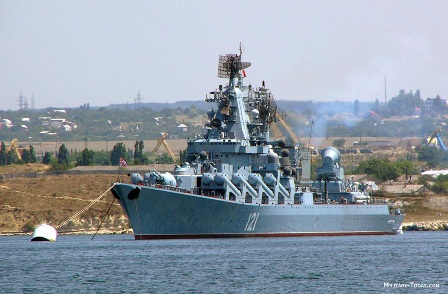
The Slava class, Soviet designation Project 1164 Atlant, was developed starting in the late 1960s. The design was intended as a conventionally powered alternative to the nuclear-powered Kirov-class battlecruisers and served as a follow-up to the Kara class. Constructed at the 61 Communards Shipyard in Mykolaiv, the vessels utilize a stretched version of the Kara-class hull. Initially designated BLACKCOM 1 and later the Krasina class, the ships were designed to carry the P-500 Bazalt missile system. Western observers noted the class may have been developed as a hedge against the potential failure of the more radical Kirov class. Of the ten units planned, three were completed between 1976 and 1990.
The vessels utilize COGOG propulsion consisting of gas and steam turbines. Sensor suites include long-range air search radars, hull-mounted sonar, and variable depth sonar. For air defense, the ships employ long-range and short-range surface-to-air missile systems. Anti-ship capabilities are centered on Vulkan missiles, which replaced the original Bazalt missiles. These are housed in fixed launchers facing forward at an eight-degree elevation with no reloads available. Secondary armament includes a twin dual-purpose gun mount, close-in weapon systems, anti-submarine mortars, and torpedo tubes. The class carries a single Kamov helicopter, with a hangar located a half deck below the landing pad and connected by a ramp. Ship protection includes splinter plating.
The class entered service in 1982. Following the dissolution of the Soviet Union, the three completed ships were operated by the Russian Navy. The first vessel, Moskva, served as a flagship and participated in the 2008 South Ossetia war, military exercises in the Indian Ocean and Sea of Okhotsk in 2010, and operations in Syria in 2013. Moskva sank in April 2022 during the Russian invasion of Ukraine following an explosion. Ukrainian military officials stated the sinking resulted from a Neptune missile strike, while Russian officials claimed the vessel suffered an ammunition depot explosion and sank during towing.
Marshal Ustinov is assigned to the Northern Fleet and completed an overhaul in 2016. Varyag serves with the Pacific Fleet and conducted a port visit to San Francisco in 2010. A fourth hull, Ukraina, remains incomplete at a Ukrainian shipyard. Ownership of this vessel was transferred to Ukraine after the collapse of the Soviet Union. Although Russia and Ukraine discussed completing the vessel in 2010, no agreement was reached by 2011, and the hull remains uncompleted.