Ka-25 Hormone
Soviet anti-submarine helicopter, recognized for Cold War naval usage, efficient in search and rescue, transportation, and assault operations. Key figures: top speed 220 km/h, range 400 km, service ceiling 3,350 m, max takeoff weight 7,500 kg, unit price $6M, built 460.
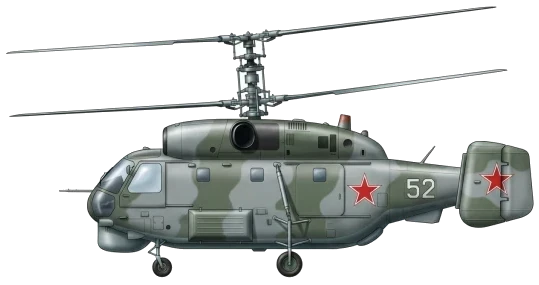
| Crew | 4–5 |
| Length | 9.8 m (32.0 ft) |
| Wingspan | 15.7 m (51.6 ft) |
| Height | 5.4 m (17.6 ft) |
| Empty weight | 4,765 kg (10,505 lbs) |
| Max. takeoff weight | 7,500 kg (16,535 lbs) |
| Powerplant | 2 × turboshafts Glushenkov GTD-3F 671 kW each |
| Maximum speed | 220 km/h (137 mph) |
| Operational range | 400 km (249 mi) |
| Service ceiling | 3,350 m (10,991 ft) |
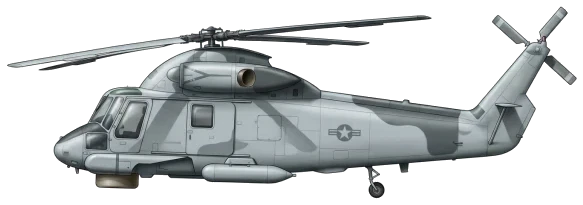
Description
In the late 1950s, the Soviet Navy required anti-submarine helicopters for deployment on new ships equipped with helicopter platforms. Kamov's compact design was selected for production in 1958. To expedite development, Kamov designed and built the Ka-20 prototype, displayed at the 1961 Tushino Aviation Day, to demonstrate the cabin and dynamic components layout. Definitive Ka-25 prototypes subsequently incorporated mission equipment and structural corrosion protection. Construction primarily utilized stressed skin duralumin, incorporating flush-riveting, bonding, and honeycomb sandwich panels.
Design
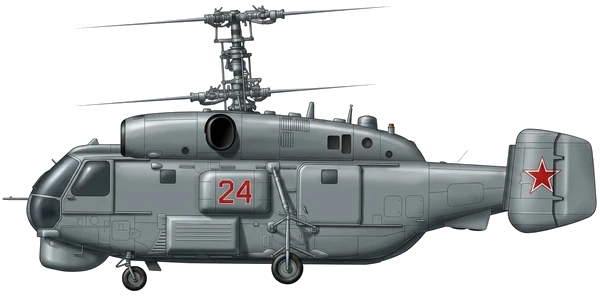
The Ka-25's rotor system incorporated aluminum alloy blades, pressurized with nitrogen for crack detection, and featured lubricated hinges, hydraulic powered controls, alcohol de-icing, and automatic blade folding. Power was provided by two free-turbine engines situated atop the cabin, equipped with electrically de-iced inlets and lateral exhausts. These engines drove the main gearbox directly, along with a cooling fan positioned aft of the main gearbox for the gearbox and hydraulic oil coolers. The cabin measured 1.5m × 1.25m × 3.94m and featured a sliding door on the port side, forward of the cabin, with fuel tanks positioned under the floor, accessible via a pressure refueling nozzle on the port side. At the rear, a short boom included a central fin and twin toed-in fins at the ends of the tailplane. The undercarriage consisted of non-castoring mainwheels with sprag brakes attached to the fuselage by parallel 'V' struts with a single angled shock absorber and two castoring nosewheels on straight shock absorbing legs. Flying controls acted on the co-axial rotors, managing pitch, roll, and collective inputs, while yaw was controlled through differential collective.
Armament
The Ka-25BSh variant is specifically configured for anti-submarine warfare, integrating a comprehensive suite of sensors and weaponry. It features radar, a dipping sonar for underwater detection, and a towed Magnetic Anomaly Detector (MAD). For offensive capabilities, the Ka-25BSh can be armed with torpedoes for direct engagement of submarines and either nuclear or conventional depth charges for anti-submarine missions. The aircraft has a total of 1,900 kg (4,189 lb) of disposable stores. The Ka-25F, a proposed assault version, was modified with an under-fuselage turret mounting a GSh-23L cannon, and had provisions for up to six 9M17 Phalanga anti-tank missiles or six UB-16 rocket launchers, each carrying 16 S-5 rockets, or bombs.
Operational History
The Ka-25 served extensively with the Soviet Navy and with the navies of Bulgaria, India, Syria, Ukraine, Vietnam, and Yugoslavia. Its primary role was anti-submarine warfare, deployed on various classes of Soviet warships. The Ka-25's operational strengths included its compact size, allowing operation from relatively small platforms, and its coaxial rotor system, which provided maneuverability and stability. Weaknesses included limited range and payload capacity, as well as reliability issues with early engines.
Variants
Main Variants:
-
Ka-25BSh (NATO reporting name 'Hormone-A'): Utilized in anti-submarine warfare, this variant features radar, dipping sonar, and a towed MAD, and is armed with torpedoes and nuclear or conventional depth-charges.
-
Ka-25BShZ: This is a mine-sweeping version, with only eight units built.
-
Ka-25Ts (NATO reporting name 'Hormone-B'): This version serves as an Over The Horizon targeting platform, relaying data to cruise missiles launched from surface warships and submarines; it is characterized by a larger radar scanner/reflector in a bulged radome under the nose.
-
Ka-25K: This civilian flying crane helicopter includes a gondola under the lengthened nose for controlling slung loads up to 2,000 kilograms (4,400 lb).
-
Ka-25PS (NATO reporting name 'Hormone-C'): A search and rescue and transport variant, it lacks a weapons bay but includes seats for 12, a rescue winch, and provision for stretchers and auxiliary tanks.
Frequently Asked Questions
What type of aircraft is the Ka-25 Hormone?
What is the maximum speed of the Ka-25 Hormone?
What is the range of the Ka-25 Hormone?
When did the Ka-25 Hormone first fly?
How many Ka-25 Hormone have been built?
Which countries operate the Ka-25 Hormone?
How much does a Ka-25 Hormone cost?
What is the service ceiling of the Ka-25 Hormone?
- AUG 52026 Updated Powerplant and thrust updated
- JUL 232026 Updated Sources and cross-references refreshed
- APR 72026 Updated Sources and cross-references refreshed
- FEB 72026 Updated Ceiling added
- JAN 122026 Updated Range updated in a site-wide editorial pass