Project 956 Sarych-class (Sovremenny)
Summary
| Origin country | 🇨🇳 Ex-USSR |
| Category | Destroyer |
| Subtype | Guided-missile destroyer |
| Manufacturer | Zhdanov Shipyard |
| Year commissioned | 1980 |
| Approx. unit cost | $600 million |
| Units |
136 Hangzhou 137 Fuzhou 138 Taizhou 139 Ningbo 610 Nastoychivyy |
Technical specifications
| Displacement | 8000 tons |
| Range | 3920 km at 1345 knots |
| Crew | 350 members |
| Width | 17.3 m (56.8 ft) |
| Length | 156.0 m (511.8 ft) |
| Air Park |
|
| Propulsion | 2 shaft steam turbines, 4 boilers, 75,000 kW (100,000 hp), 2 fixed propellers, 2 turbo generators, and 2 diesel generators |
| Armament | |
| Maximum speed | 32 knots |
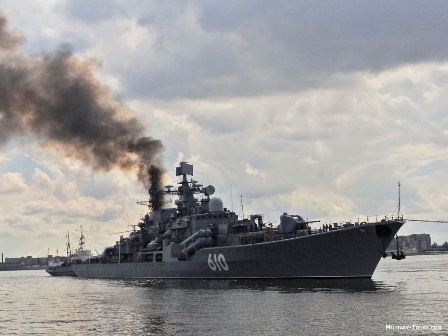
Description
Project 956 Sarych, designated by NATO as the Sovremenny class, is a series of guided-missile destroyers developed for the Soviet Navy. The project originated in the late 1960s to fulfill a requirement for naval gun support during amphibious landings, as existing cruisers and destroyers were aging. The Severnaya design bureau received authorization for the design in 1971. During development, the design was updated to include a surface-to-air missile suite and anti-ship missiles to counter the United States Navy's Spruance-class destroyers. The lead vessel was laid down in 1976 at the Zhdanov Shipyard and entered service in 1980.
The class is tasked with anti-ship warfare and the provision of sea and air defense for escorted warships and transports. It was designed to complement the Udaloy-class destroyers, which focused on anti-submarine operations. Propulsion is provided by two steam turbines and four high-pressure boilers; steam was selected because production of naval gas turbines was insufficient for the entire program at the time of construction. The design evolved through three primary iterations: the original Project 956, the 956A with extended missile launching tubes, and the 956EM developed for the People's Liberation Army Navy.
The primary armament consists of Moskit anti-ship missiles and the Shtil surface-to-air missile system. Naval gunfire is provided by AK-130 twin-barrel guns, supported by electronic and television sighting systems. Close-in defense is managed by AK-630 auto-cannons or the Kashtan gun-missile system on later variants. Anti-submarine systems include torpedo tubes and RBU-1000 rocket launchers. The ships feature a telescopic hangar and helipad for a single Ka-27 series helicopter. Sensor systems include 3D target acquisition radars, the Mineral missile guidance system, and the Platina integrated sonar suite.
A total of 21 vessels were completed out of 25 planned. The Russian Navy commissioned 17 ships, but the majority were retired by the late 1990s and early 2000s due to propulsion plant issues and limited funding. As of 2025, one vessel remains in the ranks of the Russian Navy. The Bespokoyny was converted into a museum ship in 2018.
The People’s Liberation Army Navy of China acquired four vessels: two Project 956E ships delivered between 1999 and 2000, and two Project 956EM ships delivered in 2005 and 2006. All four are commissioned in the East Sea Fleet. Starting in 2014, these vessels began a midlife modernization program to replace Russian sensors and armament with domestic Chinese systems, including vertical launch systems and supersonic anti-ship missiles.