Tourville-class
Summary
| Origin country | 🇫🇷 France |
| Category | Frigate |
| Subtype | Guided-missile frigate |
| Manufacturer | Arsenal de Lorient |
| Year commissioned | 1974 |
| Units | D610 TOURVILLE, D612 DE GRASSE |
Operators
Technical specifications
| Displacement | 5745 tons |
| Range | 5000 km at 18 knots |
| Crew | 292 members |
| Width | 15.3 m (50.2 ft) |
| Length | 152.8 m (501.3 ft) |
| Air Park |
|
| Propulsion | 2 shafts; 2 steam turbines; 4 water-tube boilers; 54,400 shp |
| Armament | |
| Maximum speed | 32 knots |
Description
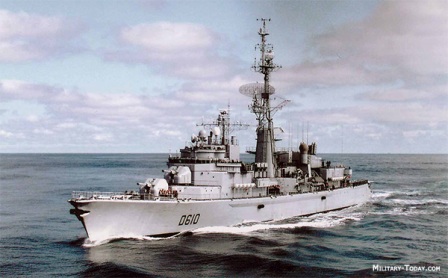
The Tourville class, designated as the F67 type, consisted of three guided-missile frigates built for the French Navy by Arsenal de Lorient. Developed during the Cold War, these vessels were designed as anti-submarine warfare (ASW) escorts for convoys in the North Atlantic. The class succeeded the Aconit and was followed by the Georges Leygues class.
The design is an enlargement of the preceding Aconit class, modified to accommodate Westland Lynx helicopters and Exocet anti-ship missiles. These were the first French Navy ships of destroyer size or larger designed with aviation facilities for helicopter operations, featuring a double hangar at the stern. Propulsion is provided by geared steam turbines and water-tube boilers driving two shafts.
The primary anti-submarine armament includes a Malafon missile launcher positioned between the superstructures and launchers for L5 torpedoes. Surface armament consists of Exocet MM38 missiles in box launchers located aft of the bridge and Modèle 1968 guns in single turrets. While Tourville and Duguay-Trouin were completed with three gun turrets, De Grasse was built with two to accommodate the installation of a Crotale anti-aircraft missile system. Defensive equipment includes autocannons, machine guns, and Syllex chaff launchers.
Electronic systems include search radar, early-warning radar, and fire-control radar. For submarine detection, the ships utilize hull-mounted sonar and towed variable depth sonar. Sensor data and combat operations are coordinated by the SENIT 3 tactical data system.
The French Navy commissioned three vessels: Tourville (D610), Duguay-Trouin (D611), and De Grasse (D612). Construction took place between 1970 and 1977. The vessels entered service between 1974 and 1977. Duguay-Trouin was decommissioned in 1999 and was subsequently used as a breakwater. Tourville was decommissioned in 2011, followed by De Grasse in 2013. Both remaining vessels were placed in laid-up status following their retirement from active service.