Vanguard-class
Summary
| Origin country | 🇬🇧 United Kingdom |
| Category | Submarine |
| Subtype | Nuclear-powered ballistic missile submarine |
| Manufacturer | Vickers Shipbuilding and Engineering |
| Year commissioned | 1993 |
| Approx. unit cost | $4800 million |
| Units | Vanguard, Victorious, Vigilant, Vengeance |
Operators
Technical specifications
| Displacement | 15900 tons |
| Displacement submerged | 15900 tons |
| Range | Unlimited, except by food supplies |
| Crew | 135 members |
| Width | 12.8 m (42.0 ft) |
| Length | 149.9 m (491.8 ft) |
| Max. depth | 300 m (984.3 ft) |
| Propulsion | 1 × Rolls-Royce PWR2 nuclear reactor, 2 × GEC turbines; 27,500 shp (20.5 MW), 1 × shaft, pump jet propulsor, 2 × auxiliary retractable propulsion motors, 2 × Allen turbo generators (6 MW), 2 × Paxman diesel alternators; 2,700 shp (2.0 MW) |
| Thrust | 3520 hp |
| Armament |
|
| Maximum speed | 15 knots |
| Max. speed submerged | 25 knots |
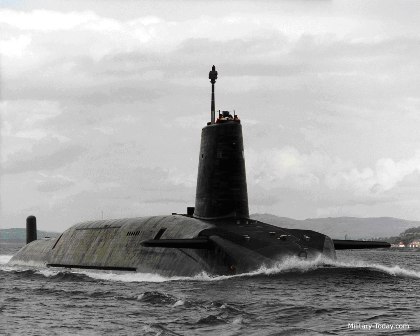
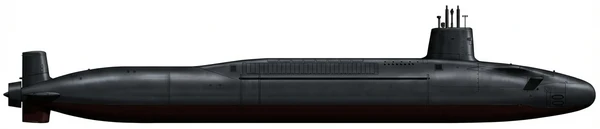
Description
The Vanguard class was developed in the 1980s to replace the Resolution-class submarines and the Polaris missile system. Following a 1980 parliamentary decision to maintain an independent nuclear deterrent, the British government evaluated several options, including indigenous missile designs and European alternatives. The government eventually reached an agreement with the United States to procure the Trident II strategic weapon system. Design work was conducted by the Ministry of Defence, with detailed development and construction assigned to Vickers Shipbuilding and Engineering at Barrow-in-Furness. To accommodate the size of the vessels, the Devonshire Dock Hall was constructed specifically for the project.
These nuclear-powered ballistic missile submarines (SSBNs) utilize a missile compartment design derived from the United States Navy’s Ohio class. Propulsion is provided by a Rolls-Royce PWR2 nuclear reactor, which was designed with a service life intended to exceed previous generations. During major refit periods, the vessels receive "Core H" reactors to ensure no further refueling is required for the remainder of their service lives. The class utilizes a specialized Submarine Command System and a composite sonar suite that integrates hull-mounted active and passive search capabilities with a towed array. Recent electronics refits have introduced open-architecture processing using commercial off-the-shelf technology. For navigation and target engagement, the submarines are equipped with search and attack periscopes featuring television and thermal imaging sensors.
The class consists of four vessels: Vanguard, Victorious, Vigilant, and Vengeance. All four are based at HM Naval Base Clyde in Scotland. Since the 1998 decommissioning of the Royal Air Force's free-fall thermonuclear weapons, these submarines have served as the sole platforms for the United Kingdom’s nuclear weapons. Operational policy requires at least one vessel to be at sea at all times to maintain a continuous deterrent.
While the boats were originally designed for a 25-year service life, they remain in active service and are scheduled for replacement by the Dreadnought class starting in the early 2030s. Deployed warhead and missile quantities have been adjusted according to various government reviews. Following the 2021 Integrated Review, the government moved to a policy of deliberate ambiguity regarding specific numbers of deployed missiles and warheads, while raising the overall cap on the total nuclear stockpile.