Visby-class
Summary
| Origin country | 🇸🇪 Sweden |
| Category | Corvette |
| Subtype | Corvette |
| Manufacturer | Kockums |
| Year commissioned | 2009 |
| Approx. unit cost | $184 million |
| Units |
K31 HSwMS Visby K32 HSwMS Helsingborg K33 HSwMS Härnösand K34 HSwMS Nyköping K35 HSwMS Karlstad |
Operators
Technical specifications
| Displacement | 640 tons |
| Range | 2500 km |
| Crew | 43 members |
| Width | 10.4 m (34.1 ft) |
| Length | 72.7 m (238.5 ft) |
| Air Park |
|
| Propulsion | CODOG: 2 × 125SII Kamewa Waterjets, 4 × Vericor TF50A gas turbines (16 MW), 2 × MTU Friedrichshafen 16 V 2000 N90 diesel engines (2.6 MW) |
| Thrust | 810 hp |
| Armament |
|
| Maximum speed | 35 knots |
Description
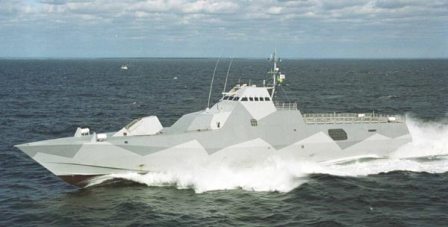
The Visby class is a series of corvettes operated by the Swedish Navy, succeeding the Göteborg and Stockholm classes. Designed by the Swedish Defence Materiel Administration (FMV) and constructed by Saab Kockums AB, the development of the class incorporated experiences from the experimental ship HSwMS Smyge. Of the six planned units, five were completed and one was canceled. The lead ship was launched in 2000, and the final unit was delivered in 2015.
The class is characterized by its emphasis on low radar cross-section and reduced infrared and magnetic signatures. The hull is constructed from a non-magnetic composite sandwich consisting of a PVC core with carbon fiber and vinyl laminate. This material provides thermal insulation and reduces structural weight compared to steel. The hull utilizes an angular tumblehome design to minimize radar detection range. To maintain signature control, the main gun barrel can be retracted into its turret. The vessels are equipped with a helicopter pad for landing and refueling, though an internal hangar was omitted from the final design.
Operational implementation occurred in phases. Initial deliveries, known as Standard 4, focused on sensor integration. The subsequent Standard 5 upgrade introduced mine clearance systems, anti-ship missiles, and full helicopter landing capabilities, with HSwMS Visby reaching this standard in 2012. A mid-life upgrade program was initiated in 2021 to maintain the relevance of the class through 2040. This program includes the addition of the Common Anti-air Modular Missile (CAMM) via the Extensible Launching System (ExLS), as well as the integration of the Torped 47 and RBS 15 Mk3. Air-defense modifications are scheduled to commence in 2026. A planned second generation of the class was canceled in 2023 following a revision of Swedish naval requirements, leading to the development of the larger Luleå-class design.