Arjun
Summary
| Origin country | 🇮🇳 India |
| Category | Main Battle Tank |
| Sub-type | Heavy Main Battle Tank |
| Manufacturer | CVRDE / DRDO |
| Number built | 10 units |
| Est. avg unit price | $7.8 million |
Technical specifications
| Crew | 4 personnels |
| Range | 200 km |
| Mass | 58.8 tons |
| Height | 2.32 m (7.6 ft) |
| Width | 3.84 m (12.6 ft) |
| Length | 9.99 m (32.8 ft) |
| Max. speed | 72 km/h (45 mph) |
| Engine | MTU MB 838 Ka-Sol V-12 Diesel Engine with 1400 hp |
| Weapon 1 | 1 120mm smoothbore barrel (39 shells) gun |
| Weapon 2 | 1 PKT 7.62mm machine gun (3000 rounds) |
| Weapon 3 | 1 12.7mm NVST machine gun (1,000 rounds) |
Historical operators
Profile of Arjun
Description
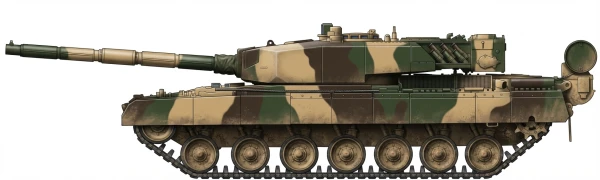
The Arjun is a third-generation main battle tank developed by the Combat Vehicles Research and Development Establishment (CVRDE) for the Indian Army. The programme was authorized in 1974 following the 1971 Bangladesh Liberation War to establish an indigenous tank capability. Formal design work commenced in 1983 under a consultancy agreement with Krauss-Maffei and concluded in 1996. The first prototype was delivered in 1989, resembling the German Leopard 2A4, and the vehicle entered service in 2004.
Protection is provided by Kanchan composite armour, which consists of ceramic tiles and composite panels sandwiched between rolled homogeneous armour (RHA) plates. The vehicle also utilizes DMR-1700 ultra-high strength steel plates. The MK1A variant features a redesigned turret with improved Kanchan armour, explosive reactive armour (ERA MK-II) panels, and non-explosive reactive armour (NERA) on the hull glacis and side skirts. Active protection is supplied by the Advanced Laser Warning Countermeasure System (ALWCS), which integrates laser warning receivers, infrared jammers, and aerosol-based smoke grenades.
Primary armament consists of a 120 mm rifled gun capable of firing armour-piercing fin-stabilized discarding sabot (APFSDS), high-explosive squash head (HESH), penetration-cum-blast (PCB), and thermobaric rounds. It is also configured to launch the SAMHO gun-launched guided missile, which features tandem-charge warheads to defeat reactive armour. Secondary armament includes a 7.62 mm coaxial machine gun and a 12.7 mm heavy machine gun. On the MK1A variant, the heavy machine gun is mounted on a remote-controlled weapon station. Target acquisition is managed by an Integrated Fire Control System (IFCS) with a digital ballistic computer and a gunner’s main sight featuring a laser rangefinder and thermal imaging.
The vehicle is powered by a multi-fuel diesel engine and utilizes a hydropneumatic suspension system with seven roadwheels per side. While the MK1 uses a liquid-cooled turbocharged engine, the MK1A is designed to integrate the DATRAN 1500 engine. An auxiliary power unit allows for the operation of subsystems in silent watch mode. The MK1A variant also incorporates an Advanced Land Navigation System and a track-width mine plough.
The Indian Army is the sole operator of the Arjun. The 43rd Armoured Regiment was the first unit to receive the tank in 2004, followed by the 75th Armoured Regiment. The vehicle has participated in annual winter exercises and underwent comparative trials against the T-90 in the Thar Desert in 2010 and 2013. A number of MK1 units are currently in service, and a subsequent order has been placed for the MK1A variant. Between 2013 and 2015, a large portion of the fleet was grounded due to spare parts shortages, a condition rectified by 2016. Several other countries have expressed interest in the platform, though no export contracts have been finalized.