Arjun vs T-90
Arjun vs T-90 at a glance — weight 58,800 vs 48,000 kg, top speed 72 vs 60 km/h, range 200 vs 550 km, crew 4 vs 3.
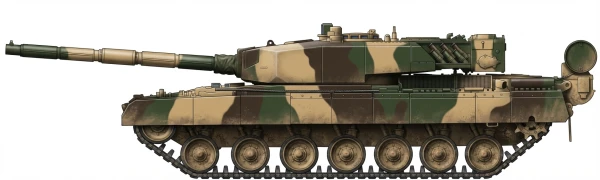
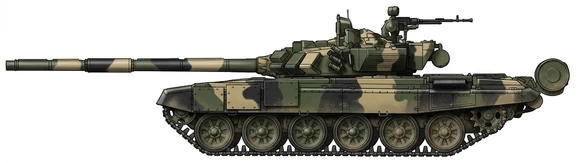
| Arjun | T-90 | |
|---|---|---|
| Origin country | 🇮🇳 India | 🇷🇺 Russia |
| Category | Main Battle Tank | Main Battle Tank |
| Type | Heavy Main Battle Tank | Medium Main Battle Tank |
| Manufacturer | CVRDE / DRDO | Malyshev HMB Plant |
| Number produced | 10 units | 4,000 units |
| Estimated unit price | $7.8 million | $4.5 million |
| Combat weight | 58.8 tons | 48.0 tons |
| Maximum speed | 72 km/h | 60 km/h |
| Operational range | 200 km | 550 km |
| Length | 9.99 m | 9.63 m |
| Width | 3.84 m | 3.78 m |
| Height | 2.32 m | 2.22 m |
| Crew | 4 | 3 |
Detailed Comparison
The Indian Arjun and the Russian T-90 serve as the primary armored platforms for the Indian Army, representing divergent design lineages: the Arjun is a heavy, indigenous system influenced by Western engineering, while the T-90 is a compact, mass-produced evolution of the Soviet T-72. While the Arjun prioritizes heavy armor and crew comfort via hydropneumatic suspension, the T-90 emphasizes a low profile, strategic mobility, and reduced crew requirements through autoloader integration.
Development and Design
Authorized in 1974 to establish indigenous capability, the Arjun underwent a protracted development cycle. Design work began in 1983 with consultancy from Krauss-Maffei, resulting in a 1989 prototype visually resembling the Leopard 2A4. It accommodates a four-man crew in a 58.8-ton chassis. Conversely, the T-90 entered Russian service in 1992 as the Object 188, a cost-effective upgrade of the T-72B. The T-90 utilizes a carousel autoloader to reduce the crew to three, maintaining a lighter combat weight of 48.0 tons.
Protection and Firepower
The Arjun utilizes indigenous Kanchan composite armour, reinforced in the MK1A variant with ERA and NERA panels. Unusually for modern MBTs, the description indicates a 120 mm rifled gun (though the spec sheet notes smoothbore, the rifled design supports HESH ammunition usage). It fires APFSDS, thermobaric rounds, and the SAMHO gun-launched missile. The T-90 relies on a layered defense of composite armor and heavy ERA (Kontakt-5 or Relikt) alongside the Shtora active protection system. Its 125 mm 2A46M-5 smoothbore gun launches laser-guided AT-11 Sniper missiles capable of engaging low-flying helicopters. The T-90's fire control system integrates thermal imaging, enabling day/night engagements.
Mobility and Logistics
Powered by a 1400 hp MTU diesel engine (MK1), the Arjun achieves a higher top speed of 72.0 km/h compared to the T-90's 60.0 km/h. Its hydropneumatic suspension offers stability in cross-country terrain. However, the Arjun's weight complicates transport, and the provided data indicates a restricted operational range of 200 km. The T-90 offers superior logistical flexibility with an operational range of 550 km and a smaller footprint. The Arjun fleet faced availability issues between 2013 and 2015 due to spare parts shortages, whereas the T-90 benefits from a massive global supply chain established by over 4,000 produced units.
Deployment and Combat Record
The Indian Army is the sole operator of the Arjun (approx. 124 MK1 units), which has participated in comparative trials against the T-90 in the Thar Desert but has seen no combat. The T-90 has been exported to nations including Algeria, Vietnam, and India (producing the T-90S Bhishma). It has seen active combat in Dagestan, Syria, Nagorno-Karabakh, and extensively in the 2022 invasion of Ukraine. In Ukraine, T-90M variants have sustained documented losses to anti-tank weaponry, providing data on the platform's survivability limits.
Conclusion
The Arjun functions as a specialized heavy tank optimized for defensive operations in specific Indian terrain, offering superior power-to-weight ratios and suspension performance. The T-90 remains a general-purpose maneuver asset, favored for its operational range, missile integration, and lower unit cost ($4.5 million). While the Arjun exceeds the T-90 in raw automotive speed, the T-90 provides a combat-tested platform with a significantly larger production and support ecosystem.