BTR-90
Summary
| Origin country | 🇷🇺 Russia |
| Category | Armored Personnel Carrier |
| Sub-type | Infantry Fighting Vehicle |
| Manufacturer | Arzamas |
| Number built | None units |
Technical specifications
| Crew | 3 personnels |
| Range | 800 km |
| Mass | 20.9 tons |
| Height | 3.0 m (9.8 ft) |
| Width | 3.2 m (10.5 ft) |
| Length | 8.0 m (26.2 ft) |
| Max. speed | 100 km/h (62 mph) |
| Engine | Diesel Engine with 510 hp |
| Weapon 1 | 1 Shipunov 24A2 30mm gun |
| Weapon 2 | 1 PKTM 7.62mm coaxial machine gun |
| Weapon 3 | 1 anti-tank missile launcher 9K113M Konkurs-M / AT-5 |
Historical operators
Profile of BTR-90
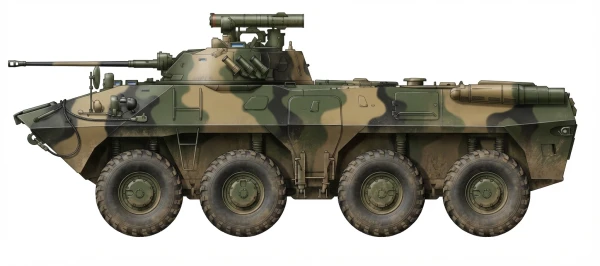
Description
The BTR-90 (GAZ-5923) is a Russian 8x8 wheeled armored personnel carrier developed by the Arzamas Machine Building Plant (AMZ), a subsidiary of the Military Industrial Company. Development commenced in the early 1990s to produce a larger successor to the BTR-80, with the first prototype displayed publicly in 1994. The vehicle was designed for fire support, personnel transport, surveillance, and reconnaissance for mechanized army units and naval infantry. Although limited production took place between 2004 and 2011, the Russian Ministry of Defence declined to include the vehicle in its state armament program in 2011, opting instead for the BTR-82A and eventually the VPK-7829 Bumerang.
The hull is constructed of welded steel armor plates, providing protection against 14.5 mm projectiles over the frontal arc and large-caliber machine gun fire and shrapnel on the sides. Protection can be enhanced through optional explosive reactive armor (ERA) modules and additional steel plates. The vehicle features a centralized tire pressure control system and collective NBC protection against shock waves, radiation, and chemical agents. It is equipped with an automatic firefighting system and a remote smoke screen system consisting of six smoke grenade launchers.
Primary armament is housed in a turret identical to that of the BMP-2, consisting of a 30 mm Shipunov 2A42 autocannon and a coaxial 7.62 mm PKT machine gun. Anti-armor capability is provided by four 9M113 Konkurs anti-tank guided missiles, while fire support is further augmented by an AGS-17D 30 mm automatic grenade launcher. The fire control system enables weapon operation while the vehicle is in motion, utilizing gunner and commander optical sights with an optional thermal imaging sight. Variants include the BTR-90M, featuring a BMP-3 turret with a 100 mm rifled gun and a 30 mm 2A72 cannon, and a version equipped with a 120 mm 2S9 Nona system.
The BTR-90 utilizes a turbocharged multi-fuel diesel engine and an automatic reversible hydro-mechanical transmission. This transmission provides different speeds to each side of the vehicle to assist maneuverability. The vehicle is fully amphibious, using dual water jet propellers for propulsion, and features an Onboard Information Control System (OICS) for automated monitoring of the engine and transmission.
The BTR-90 entered service in 2008 and is operated in limited numbers by the National Guard of Russia. During the Russo-Ukrainian War, the vehicle was deployed in the Donetsk Oblast. In October 2023, units were observed operating near Avdiivka, and visual evidence confirmed the first loss of a BTR-90 in the same sector in December 2023.