FV214 Conqueror
Summary
| Origin country | 🇬🇧 United Kingdom |
| Category | Main Battle Tank |
| Sub-type | Heavy Main Battle Tank |
| Manufacturer | Royal Ordnance Factory |
| Number built | 200 units |
Technical specifications
| Crew | 4 personnels |
| Range | 153 km |
| Mass | 66.0 tons |
| Height | 3.35 m (11.0 ft) |
| Width | 4.0 m (13.1 ft) |
| Length | 11.58 m (38.0 ft) |
| Max. speed | 34 km/h (21 mph) |
| Engine | Rover Meteor M120 Mk-1 V-12 Diesel Engine with 810 hp |
| Weapon 1 | 1 L1 120mm gun |
| Weapon 2 | 1 MAG 7.62mm coaxial machine gun |
| Weapon 3 | 1 7.62mm MAG machine gun |
Historical operators
Profile of FV214 Conqueror
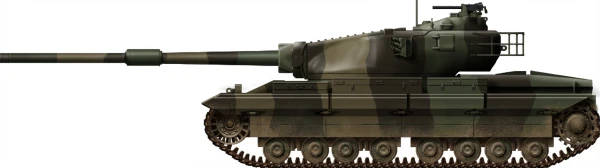
Description
The FV214 Conqueror, also designated Tank, Heavy No. 1, 120 mm gun, was developed by the United Kingdom as a heavy gun tank to counter the Soviet IS-3. Development originated in 1944 under the A45 program for a heavy infantry tank intended to complement the A41 Centurion. The project was redesignated as the FV200 universal tank project in 1946. Following the cancellation of the universal chassis concept in 1949, the project was repurposed to meet a requirement for a 120 mm armament. To facilitate crew training while the final turret was under development, the FV221 Caernarvon was produced using the chassis fitted with a Centurion turret. The Royal Ordnance Factory in Dalmuir manufactured the Conqueror between 1955 and 1959.
The Conqueror was designed to provide long-range anti-tank support for the Centurion. Its primary armament was the L1 120 mm rifled gun, which utilized two-piece ammunition with brass cartridges. An automated chain-drive system ejected spent cartridges through the rear of the turret. The gun fired Armor-Piercing Discarding Sabot (APDS) and High Explosive Squash Head (HESH) rounds. Secondary armament consisted of two L3A1 7.62 mm machine guns, one mounted coaxially and one on the commander's cupola. The vehicle featured a rotating commander's cupola that functioned as the core of the fire control system, incorporating a coincidence rangefinder. This system allowed the commander to locate and range a target independently of the gunner and then mechanically align the turret with the cupola's line of sight. Power was provided by a Rolls-Royce Meteor M120 engine. The hull and turret featured thick frontal armor plating. Due to the size of the armament and armor, the vehicle possessed a high mass, which resulted in a low top speed and mechanical reliability challenges, though it maintained terrain handling characteristics similar to the Churchill tank.
The British Army operated the Conqueror from 1955 until 1966, deploying it exclusively with the British Army of the Rhine in West Germany. Operational doctrine allocated nine Conquerors to each regiment, typically organized into three tank troops. The vehicle was phased out upon the introduction of the Chieftain main battle tank. Variants included the Mark 1 and the Mark 2, the latter featuring an improved exhaust system and a single periscope for the driver. The FV222 Conqueror Armoured Recovery Vehicle was also produced in two marks to support the heavy tank. Produced in limited numbers, the Conqueror was replaced once the Centurion was upgraded with the L7 105 mm gun.