M-80
Summary
| Origin country | 🇳🇱 Ex-Yugoslavia |
| Category | Main Battle Tank |
| Sub-type | Infantry Fighting Vehicle |
| Manufacturer | Industrie d'Etat Yougoslave |
| Number built | None units |
Technical specifications
| Crew | 3 personnels |
| Range | 500 km |
| Mass | 13.9 tons |
| Height | 2.5 m (8.2 ft) |
| Width | 2.59 m (8.5 ft) |
| Length | 6.4 m (21.0 ft) |
| Max. speed | 60 km/h (37 mph) |
| Engine | HS 115-2 V-8 Diesel Engine with 260 hp |
| Weapon 1 | 1 M-55 20mm gun |
| Weapon 2 | 1 7.62mm coaxial machine gun |
| Weapon 3 | 2 AT-3 Sagger anti-tank missiles (9M114 Maljutka) |
Historical operators
Profile of M-80
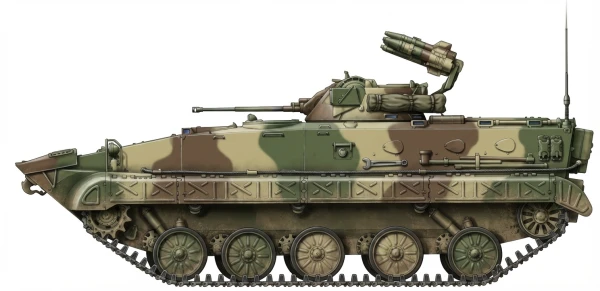
Description
Development of the BVP M-80 began in Yugoslavia in 1969 under the direction of the Military Technical Institute. Following the testing of a completed prototype in 1974 and a public presentation in 1975, the vehicle entered production in 1979. Full entry into service with the Yugoslav People's Army occurred in 1982. The initial production variant used a French-built engine, but subsequent M-80A models transitioned to a licensed Daimler-Benz engine produced at domestic FAMOS factories. Approximately 1,000 units were manufactured before the dissolution of the country.
The M-80 is a tracked, amphibious infantry fighting vehicle with five road wheels. Its hull is constructed using aluminum, aluminum oxide, and titanium boride. The design accommodates a crew of three—comprising a driver, commander, and gun operator—alongside an infantry squad of seven. The rear compartment provides space for six soldiers and a squad leader, who egress through two rear doors. This compartment includes six gun slits for personal armament. The vehicle is fully amphibious without prior preparation and is equipped with NBC protection, a fire suppression system, and a water ejecting system.
Armament for the standard M-80 and M-80A variants consists of a 20mm M-55 autocannon, a coaxial 7.62mm machine gun, and a twin launcher for AT-3 wire-guided anti-tank missiles. The autocannon has an effective range of 1,500 meters. Later developments introduced the Vidra turret, housing a 30mm autocannon, smoke grenade launchers, and SACLOS 9M14 Malyutka missiles. Modernized versions, such as the M-80AB1, incorporate advanced armor, improved optronics, and upgraded missile systems. Specialized variants were also developed for roles including tank destruction, medical evacuation, command and control, and self-propelled anti-aircraft defense.
The M-80 was used during the Yugoslav Wars and later saw service in the Russo-Ukrainian War. It is operated by several successor states of Yugoslavia, including Serbia and Croatia. Serbia maintains a fleet of standard and modernized variants, while Croatia has utilized the M-80A as its primary infantry fighting vehicle. The vehicle has been supplied to Ukraine through donations from Slovenia and Croatia. It has also been part of the inventories of Bosnia and Herzegovina, North Macedonia, and Slovenia.