C-23 Sherpa
British short takeoff and landing military transport aircraft, developed in the late 20th century, extensively used for transporting cargo and personnel in regional military operations. Key figures: top speed 467 km/h, range 2,195 km, service ceiling 8,500 m, max takeoff weight 10,387 kg, built 60.
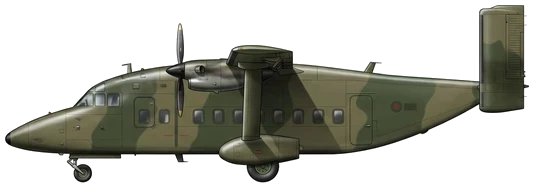
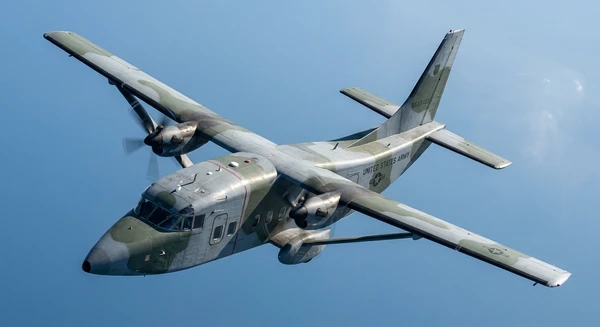
| Crew | 3 (2 pilots, cabin crew) |
| Length | 17.7 m (58.0 ft) |
| Wingspan | 22.8 m (74.7 ft) |
| Height | 5.0 m (16.2 ft) |
| Wing area | 42.1 m² (453.2 sqft) |
| Empty weight | 6,680 kg (14,727 lbs) |
| Max. takeoff weight | 10,387 kg (22,899 lbs) |
| Powerplant | 2 × Pratt & Whitney Canada PT6A-45-R 893 kW each |
| Maximum speed | 467 km/h (290 mph) |
| Operational range | 2,195 km (1,364 mi) |
| Service ceiling | 8,500 m (27,887 ft) |
| Climb rate | 6.0 m/s (19.7 ft/s) |
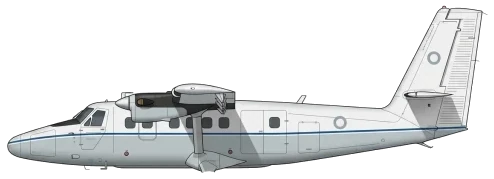


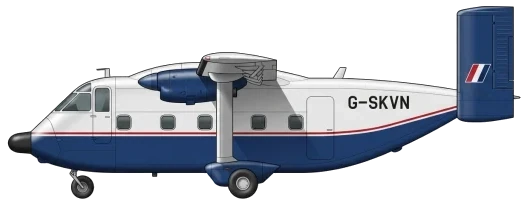
Description
The Short C-23 Sherpa is a twin-engine short takeoff and landing (STOL) military transport aircraft designed by Belfast-based Short Brothers, which was acquired by Bombardier in 1989. Developed from the Short SC.7 Skyvan, Short 330, and Short 360 family, the aircraft was produced from 1984 to 1997. The Sherpa won an early 1980s competition for a European Distribution System Aircraft (EDSA) to transport aviation parts in Western Europe. The first freighter variant flew on December 23, 1982. A total of 60 aircraft were procured for the U.S. armed forces.
Design
Featuring a square fuselage cross-section, the C-23 utilizes a twin tail and a full-width rear cargo door and ramp. The cabin measures 6.5 feet wide, 6.5 feet high, and 29 feet long, providing a cargo volume of 1,230 cubic feet and an 8,000 lb cargo capacity. Power is provided by two Pratt & Whitney Canada PT6A-45-R turboprop engines rated at 1,198 shp each, driving five-bladed Hartzell constant-speed propellers. The aircraft has a maximum takeoff weight of 22,900 lb, a maximum speed of 252 knots, a cruise speed of 228 knots, and a range of 1,185 nautical miles with a 7,000 lb payload.
Operational History
The C-23A entered U.S. Air Force service in 1985 with the Military Airlift Command at Zweibrücken Air Base, serving the EDSA role until retirement in November 1990. Retired aircraft were distributed to the USAF Test Pilot School, the U.S. Army, and the U.S. Forest Service. The U.S. Army and Army National Guard operated C-23B and C-23B+ variants, using them for intra-theater transport during the Iraq War (2003–2011). In 2001, a Florida Army National Guard C-23B crashed in Georgia due to a center-of-gravity shift, resulting in 21 fatalities. The U.S. Army retired the type in January 2014, transferring surplus airframes to the U.S. Forest Service, NASA, and international operators. Active international operators include the Philippine Army and the Djibouti Air Force. Estonia declined a proposed transfer in 2015 due to maintenance costs, while a planned purchase of eight upgraded aircraft by Brazil was canceled in 2020.
Variants
- C-23A Sherpa: Twin-engine transport built for the U.S. Air Force based on the Short 330-UTT, featuring a strengthened cabin floor, a portside cargo door, and a hydraulic rear cargo door and ramp.
- C-23B Sherpa: Twin-engine transport built for the Army National Guard, adding cabin windows, stronger landing gear, inward-opening rear paratroop doors, and an air-operable cargo ramp.
- C-23B+ Super Sherpa: Modified civil Short 360 aircraft fitted with the twin tail and rear cargo ramp of the Sherpa to replace the original single vertical stabilizer.
- C-23C: Upgraded C-23B and C-23B+ aircraft featuring modernized flightdeck avionics under the Avionics System Cockpit Upgrade program.
- C-23D: Upgraded C-23C aircraft featuring modernized avionics under the Safety Avionics Modification program, of which only four were completed.
Frequently Asked Questions
What type of aircraft is the C-23 Sherpa?
What is the maximum speed of the C-23 Sherpa?
What is the range of the C-23 Sherpa?
When did the C-23 Sherpa first fly?
How many C-23 Sherpa have been built?
Which countries operate the C-23 Sherpa?
What is the service ceiling of the C-23 Sherpa?
- JUL 232026 Updated Sources and cross-references refreshed
- JUL 12026 Created Page created: C-23 Sherpa