Short Skyvan
British utility aircraft, prominent during the mid-20th century, extensively utilized for freight, skydiving operations, and military purposes. Key figures: top speed 325 km/h, range 1,115 km, service ceiling 6,858 m, max takeoff weight 5,670 kg, built 149. In service with 1 air force as of 2026 — Guyana (2).
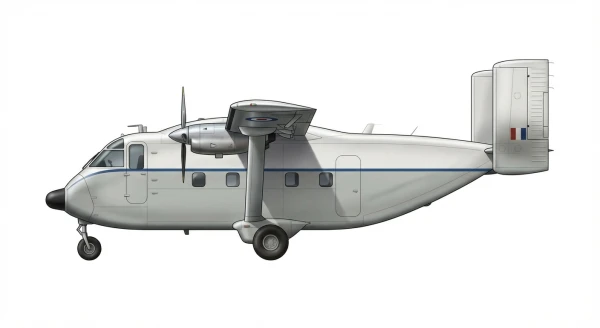
| Length | 12.2 m (40.1 ft) |
| Wingspan | 19.8 m (64.9 ft) |
| Height | 4.6 m (15.1 ft) |
| Wing area | 35.1 m² (378.0 sqft) |
| Empty weight | 3,331 kg (7,344 lbs) |
| Max. takeoff weight | 5,670 kg (12,500 lbs) |
| Powerplant | 2 × turboprops Garrett TPE331-201 533 kW each |
| Maximum speed | 325 km/h (202 mph) |
| Operational range | 1,115 km (693 mi) |
| Service ceiling | 6,858 m (22,500 ft) |
| Climb rate | 8.33 m/s (27.3 ft/s) |


Description
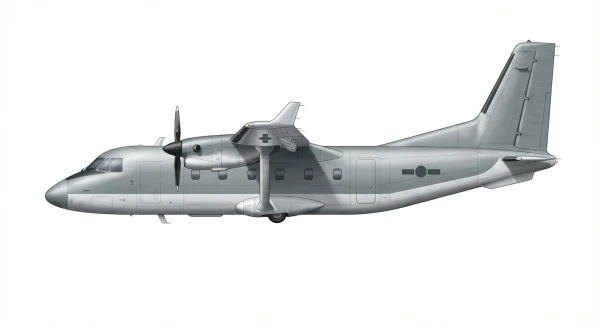
The Short SC.7 Skyvan is a British 19-seat twin-turboprop utility transport aircraft manufactured by Short Brothers of Belfast, Northern Ireland. Designed with short takeoff and landing (STOL) capability, the aircraft entered service in the mid-1960s for both civilian and military operators. It is known for its unpressurised, square-section fuselage, earning it the nickname "Flying Shoebox".
Development
Programme origins date to 1958 when Short was approached by F.G. Miles Ltd to develop a design based on the HDM.106 Caravan. Short acquired test data from the Miles Aerovan-based HDM.105 prototype but rejected the proposal, choosing instead to develop an all-metal utility monoplane designated the SC.7 Skyvan. Construction began at Sydenham Airport in 1960, and the first prototype made its maiden flight on 17 January 1963 powered by Continental piston engines. The prototype was re-engined later that year with Turbomeca Astazou II turboprops, followed by initial production of the Series 2 using Astazou XII engines. Due to high-altitude temperature limitations with the Astazou, production switched in 1968 to the Series 3 equipped with Garrett AiResearch TPE331 turboprops. A total of 149 Skyvans were produced before manufacturing concluded in 1986.
Design
The Skyvan is an all-metal, high-wing monoplane featuring a braced, high aspect ratio wing and twin fins and rudders. Its unpressurised fuselage has a square cross-section shaped like a railroad boxcar and incorporates a large rear door for loading freight. Standard Series 3 production models are powered by two 533 kW (715 shp) Garrett AiResearch TPE331 turboprop engines driving three-bladed Hartzell variable-pitch propellers. The aircraft has a maximum takeoff weight of 5,670 kg (12,500 lb), a maximum speed of 324 km/h at 3,050 m altitude, and a range of 1,115 km.
Operational History
Skyvans served in civil and military roles, including short-haul freight transport, aerial spraying, skydiving, geological surveys, and NASA parachute payload recoveries. Military operators used the aircraft for troop transport, casualty evacuation, supply dropping, search and rescue, and maritime patrol. Export customers included the air forces of Oman, Guyana, Mauritania, Singapore, and Yemen, as well as the Argentine Coast Guard. The Argentine Coast Guard acquired five Skyvans in 1971, two of which were written off during the Falklands War in 1982.
Variants
-
Skyvan 1: Prototype aircraft powered by two Continental GTSIO-520 piston engines, with one built.
-
Skyvan 2: Initial production variant powered by Turbomeca Astazou turboprop engines, with eight built including the second prototype.
-
Skyvan 3: Main production variant powered by Garrett TPE331 turboprop engines, totaling 140 production aircraft and two Series 2 conversions.
-
Skyvan 3M: Military transport version featuring increased gross weight for assault transport, supply dropping, casualty evacuation, and search and rescue.
-
Seavan: Maritime patrol conversion based on the Skyvan 3M-400 for the Royal Air Force of Oman.
Frequently Asked Questions
What type of aircraft is the Short Skyvan?
What is the maximum speed of the Short Skyvan?
What is the range of the Short Skyvan?
When did the Short Skyvan first fly?
How many Short Skyvan have been built?
Which countries operate the Short Skyvan?
What is the service ceiling of the Short Skyvan?
- AUG 62026 Updated Description updated
- AUG 12026 Updated Manufacturer updated
- JUL 272026 Updated Name updated
- APR 72026 Updated Sources and cross-references refreshed
- JAN 122026 Updated Range updated in a site-wide editorial pass