HAL Dhruv
Summary
| Category | Military Helicopters |
| Origin country | 🇮🇳 India |
| Manufacturer | HAL |
| First flight | 20 August 1992 |
| Year introduced | 2002 |
| Number produced | 335 units |
| Average unit price | $12 million |
Technical specifications
| Version: Dhruv Mk I | |
|---|---|
| Crew | 2 members |
| Operational range | 630 km (391 mi) |
| Maximum speed | 280 km/h (174 mph) |
| Wingspan | 13.2 m (43.3 ft) |
| Height | 5.0 m (16.3 ft) |
| Length | 15.9 m (52.1 ft) |
| Service ceiling | 4,400 m (14,436 ft) |
| Empty weight | 4,445 kg (9,800 lbs) |
| Max. takeoff weight | 5,580 kg (12,302 lbs) |
| Climb rate | 10.33 m/s (33.9 ft/s) |
| Powerplant | 2 x turboprops Turbomeca TM333-2B2 delivering 807 kW each |


Description
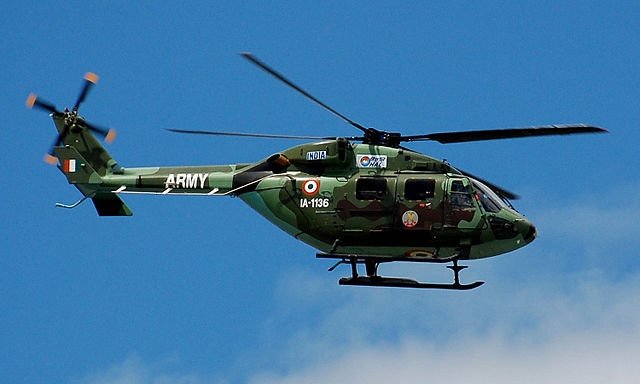
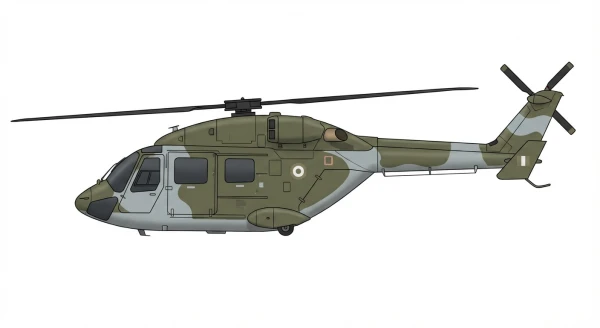
The HAL Dhruv is an Indian multi-role utility helicopter developed and manufactured by Hindustan Aeronautics Limited (HAL). Its development began in the 1980s, with the primary aim to replace the aging fleet of helicopters in the Indian military and provide a domestically-produced option. The first flight took place in 1992, and it was officially introduced into service in 2002. The helicopter was developed with technical assistance from Germany's Messerschmitt-Bölkow-Blohm (MBB), now part of Airbus Helicopters. The Dhruv has been deployed by various branches of the Indian military as well as civilian organizations and has been exported to several other countries.
The development of the HAL Dhruv was initiated to address the need for a modern, multi-role helicopter within the Indian armed forces and civilian sectors. Work began in the 1980s, with an ambitious goal to produce a helicopter that would be adaptable to diverse conditions, ranging from the high altitudes of the Himalayas to the hot deserts of Rajasthan.
Technical assistance was sought from Germany's Messerschmitt-Bölkow-Blohm (MBB) to navigate the complexities of advanced helicopter design. The collaboration helped in the creation of a design that included a hingeless main rotor and bearingless tail rotor, aimed at reducing maintenance and increasing reliability. The first prototype took to the skies in 1992, ten years after the project's initiation.
The Dhruv features a composite construction, making it lighter and more resilient. It was designed with a modular approach, enabling it to be easily configured for various roles including troop transport, search and rescue, and medical evacuation. The avionics package was made to be flexible, allowing for incremental upgrades over time. Initially, the helicopter was powered by the Turbomeca TM 333-2B2 turboshaft, but later versions have been fitted with the more powerful Shakti engine, co-developed by HAL and Turbomeca.
One design challenge faced during development was the need for high-altitude performance, given India's unique topography. Modifications were made to the airframe and engine to enable better performance in the high-altitude conditions common in regions like Ladakh and Siachen Glacier. After multiple rounds of testing and iterations, the Dhruv was officially introduced into service in 2002. Since then, the helicopter has been continually updated to meet the evolving needs of its operators.
Armament
The HAL Dhruv can be outfitted with a range of weapon systems, depending on its intended role. The armed variant of the Dhruv is commonly known as the "Rudra." The Rudra is equipped with an array of weaponry that can include anti-tank guided missiles, 70mm rocket pods, and a chin-mounted 20mm gun. Additionally, it can carry Mistral air-to-air missiles for self-defense against aerial threats. The weapons are controlled through an advanced fire control system that is integrated into the helicopter's avionics.
For reconnaissance and target acquisition, the Rudra features electro-optical and infrared sensors, along with a laser range-finder and designator. These systems enable the helicopter to accurately detect, identify, and engage ground and aerial targets even in adverse conditions. The Rudra is also equipped with electronic warfare systems for self-defense, which include radar warning receivers, laser warning receivers, and countermeasure dispensing systems.
Operational history
In the military domain, the Dhruv has been deployed in a variety of roles including troop transport, casualty evacuation, and logistics supply. It has seen action in counter-insurgency operations in regions such as Jammu and Kashmir. The armed variant, known as the Rudra, has been used in combat roles, augmenting the capabilities of ground forces with its array of weapons.
The Dhruv also gained recognition for its high-altitude capabilities, being used extensively in the Himalayas for both military and civilian roles. It has been a part of rescue and relief operations during natural disasters like floods and earthquakes. Notably, the Dhruv was actively deployed in rescue missions during the 2010 flash floods in Leh, and also in the aftermath of the 2013 Uttarakhand floods, where it was used for evacuating stranded people and delivering essential supplies.
In terms of international deployment, the Dhruv has been exported to several countries including Nepal, Mauritius, Maldives, and Ecuador. The Ecuadorian Air Force, however, faced reliability issues and subsequently grounded the fleet after a series of accidents. Despite these setbacks, the Dhruv has generally been well-received in export markets for its versatility and lower operating costs compared to other helicopters in its class.
Variants
The HAL Dhruv has several variants, especially:
- Dhruv Mk III: This is an advanced version featuring the more powerful Shakti engine and modern avionics, designed primarily for high-altitude warfare such as operations in the Himalayas.
- Rudra: Also known as the ALH-WSI (Advanced Light Helicopter-Weapon System Integrated), this is the armed version of the Dhruv. The Rudra is equipped with anti-tank missiles, rocket pods, and a chin-mounted 20mm gun, among other weapons. It also has advanced sensors and targeting systems for reconnaissance and fire-control.
- Dhruv-WSI: This is a specialized variant aimed at improving the helicopter's utility in warfare scenarios. It features better electronic warfare systems and can carry an increased payload of armaments compared to the standard Dhruv models.
- Naval Dhruv: This variant is adapted for maritime roles and is operated by the Indian Navy. It comes equipped with specialized avionics and systems for anti-submarine warfare, although it is primarily used for search and rescue, and surveillance.