Maldives Military Forces
The Maldives ranks #163 of 170 militaries worldwide in 2026. The Air Force flies 4 aircraft. The Maldives has no nuclear weapons.
Armed Forces in 2026
| Domain | Strength | Composition |
|---|---|---|
| Coast Guard Aviation Squadron | 4 aircraft | 2 helicopters |
ATLAS Index (Aggregate Total of Land, Air and Sea strength)
Full ranking →| Pillar | Weight | Score | Basis |
|---|---|---|---|
| Manpower | 10% | 0.0 | Active, reserve & paramilitary personnel |
| Ground forces | 20% | 0.0 | ARMS inventory power: armour & artillery by type and era, attack helicopters, armament |
| Naval power | 20% | 0.0 | SEAS inventory power: hulls by type, size and era, air wing, sustainment, armament |
| Air power | 25% | 11.8 | AIRS inventory power: aircraft by type and generation, enablers, armament |
| Nuclear deterrent | 10% | 0.0 | No declared nuclear capability |
| Defense budget | 15% | 0.0 | Data unavailable |
| Availability | modifier | ground ×1.00 · naval ×1.00 · air ×1.00 | Budget per point of each force, from the branch indexes |
Country File
| Population | 527K (2024) |
| GDP | $7.1 billion (2024) |
| GDP per capita | $13,379 |
| Inflation rate | 1.4% (2024) |
| Capital | Malé |
| Region | Asia |
| Land area | 298 km² |
| Coastline | 644 km |
| Currency | MVR |
Strategic Overview in 2026
Strategic Position
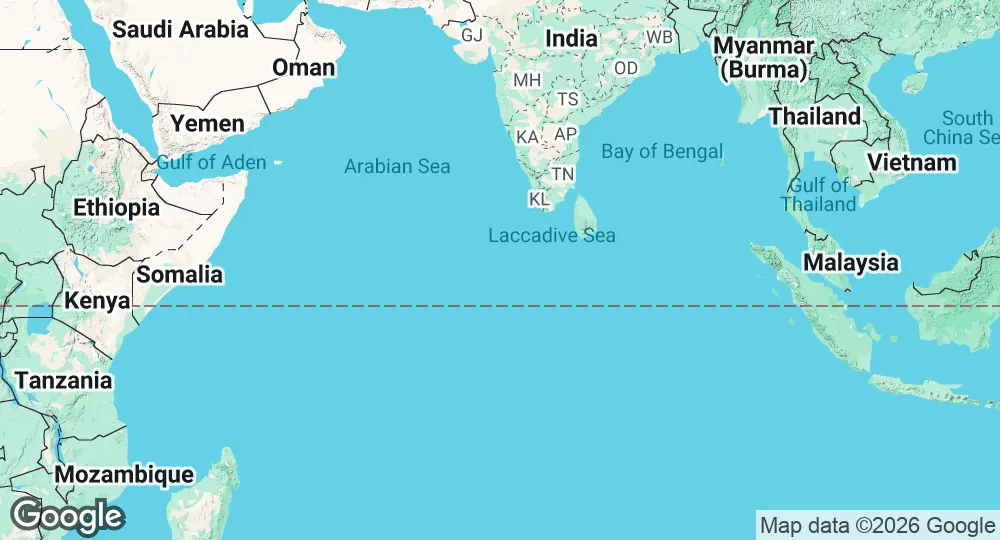
The Maldives occupies a central position in the Indian Ocean, spanning north-south across major international shipping lanes and the Eight Degree Channel. Its defense doctrine is centered on the protection of its Exclusive Economic Zone (EEZ), which encompasses approximately 900,000 square kilometers, and the maintenance of maritime sovereignty.
Historically reliant on a "India First" foreign policy, the Maldives shifted its strategic orientation following the 2023 presidential election. The current administration has prioritized "pro-Maldives" sovereignty, leading to the 2024 withdrawal of Indian military personnel who previously operated aviation assets in the country. These personnel were replaced by Indian civilian contractors to maintain technical operations.
To diversify its security partnerships, the Maldives signed a military assistance agreement with China in 2024 for the provision of non-lethal equipment and training. Simultaneously, the country strengthened ties with Turkey, which has emerged as a primary supplier of advanced hardware. Despite these shifts, the Maldives maintains its membership in the Colombo Security Conclave and continues its participation in the U.S. State Partnership Program through an arrangement with the New Jersey National Guard.
The primary security concerns for the Maldives include illegal, unreported, and unregulated (IUU) fishing, maritime terrorism, narcotics trafficking, and the impacts of climate change on low-lying island infrastructure.
Military Forces
The Maldives National Defence Force (MNDF) is a unified security organization under the authority of the Ministry of Defence. It lacks a traditional division into independent army, navy, and air force branches, instead utilizing a functional command structure. Personnel strength is approximately 4,000 to 5,000 active-duty members.
Coast Guard The Coast Guard is the most active branch, tasked with maritime law enforcement, search and rescue, and EEZ surveillance. Its fleet consists of patrol vessels provided by India, Sri Lanka, and Turkey. Inventory includes Trinkat-class patrol boats, a Saryu-class offshore patrol vessel, and various fast interceptor craft.
Air Force Established as a distinct service branch in 2024, the MNDF Air Force has expanded its capabilities from basic transport and medical evacuation to include combat and surveillance functions. The branch operates Bayraktar TB2 unmanned combat aerial vehicles (UCAVs) acquired from Turkey. It also maintains a fleet of Dhruv Advanced Light Helicopters and a Dornier 228 maritime surveillance aircraft, which were originally gifted by India.
Marine Corps and Special Forces The MNDF Marine Corps is responsible for land-based operations and the security of the archipelago’s dispersed islands. Specialized capabilities are concentrated in the Special Forces (SF), which focus on counter-terrorism and maritime boarding operations. The MNDF also includes the Fire and Rescue Service and a dedicated Presidential Guard.
Defense Industry
The Maldives possesses no domestic arms manufacturing sector. The MNDF is entirely dependent on foreign imports and bilateral aid for its hardware, ranging from small arms to maritime vessels and aerial platforms. Procurement is primarily managed through government-to-government agreements with Turkey, China, India, and the United States.
Strategic Trends
The primary trend in Maldivian defense is the rapid modernization of maritime domain awareness (MDA) capabilities. In 2024 and 2025, the MNDF transitioned from a reliance on foreign-piloted assets to an independent 24-hour surveillance model. The introduction of Turkish-made UCAVs represents a shift in doctrine toward autonomous patrolling of the northern and southern boundaries of the EEZ.
Defense spending has increased to accommodate the operational costs of new technology and the establishment of the MNDF Air Force. Budgetary priorities are focused on the acquisition of additional coastal radar systems and the expansion of the Coast Guard fleet to include larger, more endurance-capable vessels.
A significant constraint remains the geographic fragmentation of the country, which necessitates a decentralized force posture. To address this, the MNDF is improving inter-atoll communications and logistics to ensure rapid response to maritime incidents. The government has also emphasized "technical self-reliance," aiming to train Maldivian pilots and technicians to replace foreign contractors currently assisting with aircraft maintenance.
Military Expenditure: information from the Stockholm International Peace Research Institute (SIPRI) Military Expenditure Database. Last updated on 4 August 2026. Suggest a change
Frequently Asked Questions
How does Maldives rank militarily in the world?
Does Maldives have nuclear weapons?
How many aircraft does Maldives's air force have?
- AUG 42026 Updated Global Military Index updated in a site-wide editorial pass
- JUL 162026 Updated Global Military Index updated in a site-wide editorial pass
- JUN 162026 Updated Economic and demographic series refreshed (3 yearly records)
- JAN 132026 Updated Description added