Dornier Do 128
Summary
| Category | Military Transport Aircraft |
| Origin country | 🇩🇪 Germany |
| Manufacturer | Dornier |
| First flight | 4 March 1980 |
| Year introduced | 1994 |
| Number produced | 11 units |
| Average unit price | $1 million |
Technical specifications
| Version: Do 128-6 | |
|---|---|
| Operational range | 2,950 km (1,833 mi) |
| Maximum speed | 325 km/h (202 mph) |
| Wing area | 29 m² (312.2 sqft) |
| Wingspan | 15.6 m (51.0 ft) |
| Height | 3.9 m (12.8 ft) |
| Length | 11.4 m (37.4 ft) |
| Service ceiling | 9,936 m (32,598 ft) |
| Empty weight | 2,348 kg (5,176 lbs) |
| Max. takeoff weight | 3,842 kg (8,470 lbs) |
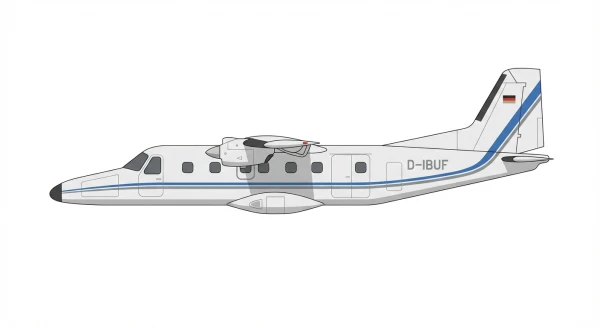
| Powerplant | 2 x turboprops Pratt & Whitney Canada PT6A-110 delivering 298 kW each |
Current operating countries
Description
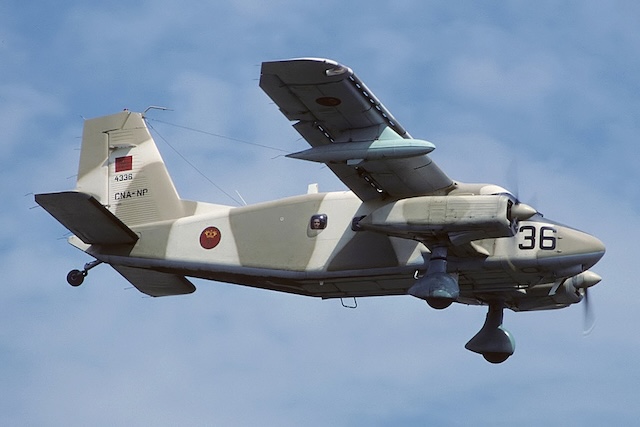
The Do 28 series encompasses two distinct twin-engine STOL utility aircraft lines from Dornier Flugzeugbau GmbH. The initial design, the Do 28 A/B, emerged in 1959 as a derivative of the single-engine Do 27, retaining its high-wing cantilever layout and lift augmentation devices, but distinguished by the incorporation of two Lycoming engines mounted on pylons along the forward fuselage. Later, with financial support from the German government, Dornier developed a larger STOL transport, the Do 28D Skyservant, designed to carry up to 13 passengers. The first flight of the Do 28D occurred on February 23, 1966, and it was subsequently displayed at the Paris Air Show in June 1967.
The Do 28 series showcases distinct design approaches in its two main variants. The Do 28 A/B, developed from the Do 27, retained the high-wing cantilever layout and lift augmentation devices, with the defining feature being the incorporation of two Lycoming engines and main landing gear shock struts attached to pylons on the forward fuselage. Later, the Do 28D Skyservant emerged as a complete redesign, sharing only the basic layout and wing construction with earlier versions, with a rectangular fuselage and engine nacelles intended for simplicity, ruggedness, and ease of maintenance for operation in demanding conditions. The Skyservant featured large double doors for cargo and a spacious unobstructed cabin when seats were removed.
The Dornier Do 28 series saw extensive use, notably with the German Air Force and Marineflieger, serving primarily as a transportation and communications aircraft. Twenty aircraft were allocated to the Marineflieger, with ten configured for maritime reconnaissance, enhanced by additional underwing fuel tanks for extended missions. During the Gulf War in 1991, two Do 28D-2/OU variants, equipped with radar and SLAR for oil pollution monitoring, were deployed to the Persian Gulf under United Nations control for several weeks, operated by MFG 5. The type operated in around 30 countries, with over 150 aircraft built. Turkey operated two specially equipped SIGINT versions, alongside the standard transport models. The aircraft served with the German forces until replaced by the Dornier 228 in 1994. While the type was generally considered a reliable workhorse, the high noise and vibration levels in the cabin eventually prompted its replacement with the quieter, turboprop-powered Do 228.
Main Variants:
-
Do 28A-1: The initial production version of the Do 28, featuring two 250 hp Lycoming O-540-A1A engines and an increased wingspan.
-
Do 28B-1: An improved variant of the Do 28A, distinguished by an enlarged nose, additional fuel tanks, increased tailplane area, and more powerful 290 hp Lycoming IO-540 fuel-injected engines.
-
Do 28D-2: A Skyservant variant featuring an increased maximum takeoff weight, a strengthened fuselage, and an enlarged cabin.
-
Do 28D-2/OU: A specialized modification of the Do 28D, equipped with radar and SLAR for monitoring oil pollution, operated by the German Marineflieger.
-
Dornier 128-2: An improved iteration of the Do 28D-2, which replaced the D-2 in 1980, incorporating various enhancements.