Nigeria Military Forces
Open-source order of battle for 2026: 143,000 active troops, 164 aircraft, 143 warships, 2,050 ground vehicles.
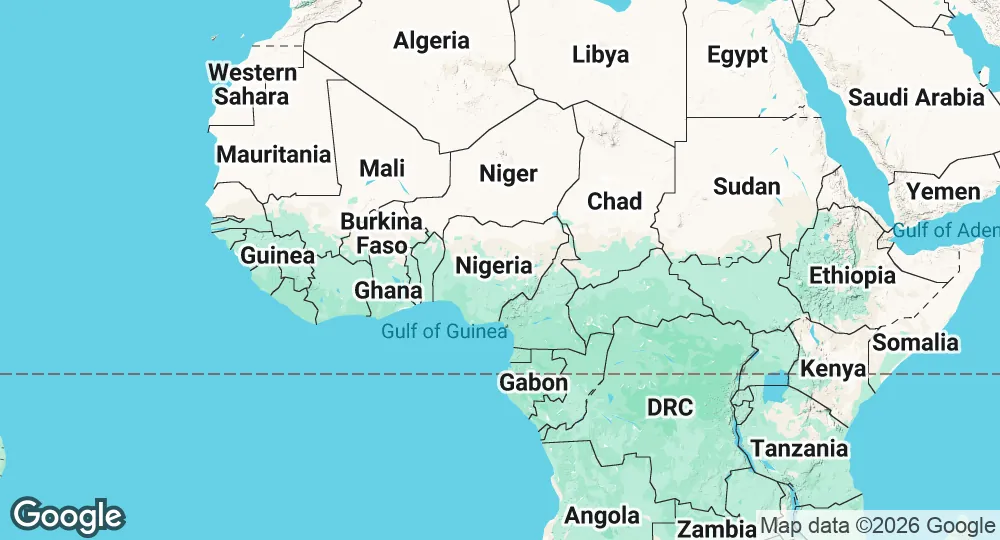

Armed Forces in 2026
| Domain | Strength | Composition |
|---|---|---|
| Air Force | 164 aircraft | 24 combat 73 helicopters +75 on order |
| Nigerian Navy | 143 warships | 1 major combatants |
| Ground Forces | 2,050 vehicles | 330 main battle tanks |
| Personnel | 143,000 active | 80,000 paramilitary |
Global Military Index
Full ranking →| Pillar | Weight | Score | Basis |
|---|---|---|---|
| Manpower | 15% | 70.7 | Active, reserve & paramilitary personnel |
| Ground forces | 20% | 55.0 | Tanks, armor & artillery weighted by type |
| Naval power | 20% | 37.4 | Weighted by hull type: carrier tiers, nuclear vs conventional submarines |
| Air power | 25% | 39.1 | Weighted by aircraft type and fleet age |
| Nuclear deterrent | 10% | 0.0 | No declared nuclear capability |
| Defense budget | 10% | 43.4 | Annual spending, purchasing-power adjusted |
| Readiness | modifier | ×0.91 | Budget per soldier: proxy for training, maintenance & technology |
Country File
| Population | 232.7M (2024) |
| GDP | $252.3 billion (2024) |
| GDP per capita | $1,084 |
| Military budget | $1.5 billion (2024) |
| Share of GDP | 0.6% (2024) |
| Military spending per capita | $7 (2024) |
| Inflation rate | 33.24% (2024) |
| Capital | Abuja |
| Region | Africa |
| Land area | 910,768 km² |
| Coastline | 853 km |
| Land borders | 4,047 km |
| Bordering countries | 4 |
| Currency | NGN |
Strategic Overview in 2026
Strategic Position
Nigeria occupies a central geopolitical role in West Africa, primarily focused on maintaining regional stability and combating asymmetric internal threats. The primary security concerns include the protracted insurgency of Boko Haram and Islamic State West Africa Province (ISWAP) in the northeast, banditry and mass abductions in the northwest, and communal violence in the Middle Belt. In 2025, the government updated its counterterrorism doctrine to classify all armed groups operating outside state authority as terrorists, facilitating broader military engagement against non-state actors.
Regional strategy is coordinated through the Economic Community of West African States (ECOWAS) and the Multinational Joint Task Force (MNJTF). Nigeria hosted the maiden African Chiefs of Defence Staff Summit in 2025 to promote a continental defense framework and shared intelligence. Beyond domestic operations, the military provides regional security support, evidenced by the 2025 deployment of fighter jets and ground troops to assist the Benin Republic during a period of instability. Bilateral defense cooperation remains active with the United Kingdom, United States, China, and Pakistan, focused on counterterrorism training and equipment procurement.
Military Forces
The Armed Forces of Nigeria (AFN) consist of the Nigerian Army, Nigerian Navy, and Nigerian Air Force, overseen by the Defence Headquarters under the Chief of Defence Staff. As of 2026, the total active personnel strength is approximately 215,000, supported by a reserve force of 80,000. Paramilitary support is provided by the Nigerian Security and Civil Defence Corps.
Nigerian Army The Army is the largest branch and manages several multi-service counter-insurgency operations, such as Operation HADIN KAI. The armored inventory includes T-72 and VT4 main battle tanks. Operational mobility is supported by over 1,200 armored fighting vehicles and mine-resistant ambush-protected (MRAP) platforms. Artillery units operate BM-21 Grad multiple rocket launchers and various self-propelled and towed systems.
Nigerian Air Force (NAF) The NAF is undergoing a scheduled fleet expansion targeting 49 new aircraft by the end of 2026. Current combat operations utilize JF-17 Thunder multirole fighters, A-29 Super Tucano light attack aircraft, and Alpha Jets. The helicopter fleet includes Mi-35 and T-129 ATAK attack helicopters, with AH-1Z Vipers and AW-109 Trekkers scheduled for delivery by 2026. The NAF also operates unmanned aerial vehicles (UAVs) for surveillance and strike missions, including the CH-4 and Bayraktar TB2. Strategic transport is provided by C-130 Hercules and CASA 295 aircraft.
Nigerian Navy The Navy is tasked with securing 850 kilometers of coastline and the Gulf of Guinea. Operations focus on protecting oil infrastructure and countering piracy. The fleet consists of general-purpose frigates, offshore patrol vessels, and fast attack craft.
Defense Industry
The Defence Industries Corporation of Nigeria (DICON) serves as the primary state-run manufacturer. Under the DICON Act 2023, the organization has expanded its mandate to regulate the domestic defense industrial sector and foster private partnerships. A 2026 strategic objective aims for the annual production of 30 million rounds of ammunition. Additionally, a 2025 memorandum of understanding with international partners targets domestic gunpowder production by August 2026 to reduce reliance on imports.
Domestic manufacturing includes the production of MRAPs and armored personnel carriers by indigenous firms such as Proforce, E-PILS, and Vanquish. DICON also maintains a partnership with G7G for the assembly of weapons from completely knocked-down parts. Recent collaborative agreements with the Ministry of Steel Development and Ajaokuta Steel Company aim to provide the industrial base necessary for local military hardware fabrication.
Strategic Trends
The 2026 defense budget allocates ₦5.41 trillion (approximately $3.9 billion) to national security, representing a continued prioritization of the sector within federal spending. A primary trend is the modernization of personnel welfare and salaries, introduced by the leadership of Chief of Defence Staff General Olufemi Oluyede in late 2025 to improve troop retention and morale.
A persistent challenge is the extensive deployment of the military for internal security duties across all 36 states. Analysts indicate this provides immediate stability but results in a cycle of dependency that strains defense resources and limits the capacity of the Nigeria Police Force. Procurement remains focused on high-technology platforms, particularly for the Air Force, and the refurbishment of existing armored assets through the Army Command Engineering Depot. Future force structure shifts emphasize intelligence-driven operations and the integration of cyber defense and artificial intelligence into the national security architecture.
Frequently Asked Questions
How large is Nigeria's military?
What is Nigeria's defense budget?
How does Nigeria rank militarily in the world?
Does Nigeria have nuclear weapons?
How many aircraft does Nigeria's air force have?
How large is Nigeria's navy?
How many tanks does Nigeria have?
What percentage of GDP does Nigeria spend on defense?
What is Nigeria's military personnel per capita?
Does Nigeria have paramilitary forces?
Military Expenditure: CIA World Factbook. Suggest a change