HF-24 Marut
Indian jet fighter-bomber, developed in the 1960s, primarily used in ground attack roles during the late 20th century. Key figures: top speed 1,112 km/h, range 396 km, max takeoff weight 10,908 kg, built 147.
| Crew | 1 |
| Length | 15.9 m (52.1 ft) |
| Wingspan | 9 m (29.5 ft) |
| Height | 3.6 m (11.8 ft) |
| Wing area | 28 m² (301.4 sqft) |
| Empty weight | 6,195 kg (13,658 lbs) |
| Max. takeoff weight | 10,908 kg (24,048 lbs) |
| Powerplant | 2 × Bristol Siddeley Orpheus Mk 703 22 kN each |
| Maximum speed | 1112 km/h (691 mph) |
| Operational range | 396 km (246 mi) |
| Climb rate | 22.5 m/s (73.8 ft/s) |
- Rocket Pod Retractable Matra pack of 50× 2.68 in (68 mm) rockets
- Unguided Bomb Up to 4,000 lb (1,800 kg) of bombs on four wing pylons
Description
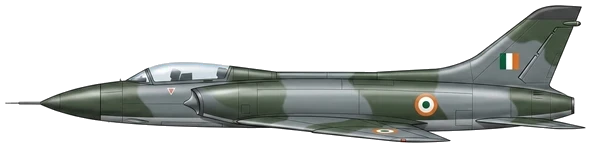
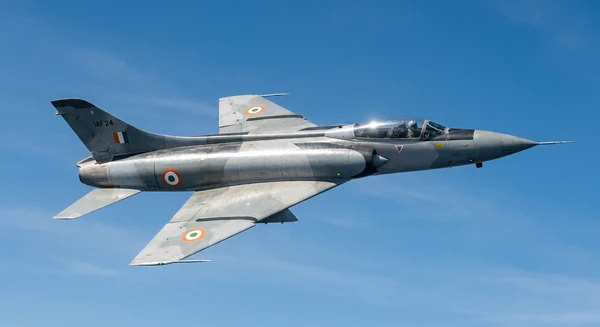
The HAL HF-24 Marut was an Indian twin-engine jet fighter developed and manufactured by Hindustan Aeronautics Limited (HAL) during the 1960s and early 1970s. Designed by German engineer Kurt Tank alongside Project Engineer George William Benjamin, the Marut was India's first indigenously developed jet fighter. Development commenced in 1956, utilizing a full-scale wooden glider demonstrator designated the HAL X-241, which first flew on 3 April 1959. The prototype Marut completed its first flight on 17 June 1961. Although designed to achieve Mach 2, the aircraft was limited to subsonic speed (Mach 0.93) because HAL could not secure more powerful powerplants, instead utilizing twin Bristol Siddeley Orpheus Mk 703 turbojets. The Indian Air Force (IAF) accepted its first production Marut on 1 April 1967. A total of 147 aircraft were manufactured, including 18 trainers, before production ceased.
Design
System features included automatic reversion to manual flight controls during hydraulic failures, and twin engines that aided combat survivability. The airframe produced high trail drag, and the aircraft suffered from a lack of maneuverability due to insufficient engine power. The Marut carried an internal armament of four 30 mm ADEN cannons with 120 rounds per gun and a retractable Matra pack containing 50 68 mm (2.68 in) rockets. For external stores, it possessed four wing pylons capable of carrying up to 4,000 lb (1,800 kg) of bombs.
Operational History
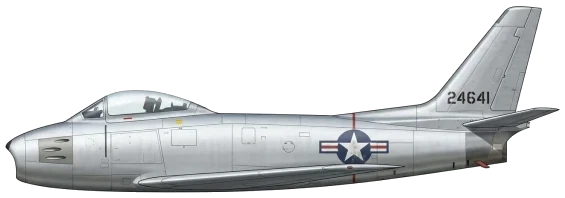
The IAF was the sole operator of the Marut, deploying the type with No. 10, No. 31, and No. 220 Squadrons. It was primarily utilized as a fighter-bomber in the ground-attack role. During the Indo-Pakistani War of 1971, Maruts flew over 300 combat sorties, providing close air support during the Battle of Longewala, where they destroyed Pakistani tanks. During the conflict, no Maruts were lost in air-to-air combat; three were lost to ground fire and one was destroyed on the ground. Multiple aircraft successfully returned to base on a single engine after sustaining combat damage. On 7 December 1971, a Marut pilot recorded the type's sole aerial victory by shooting down a Pakistani F-86 Sabre. In 1982, the IAF proposed phasing out the Marut fleet, and the type was gradually retired, with the last aircraft relinquished by No. 220 Squadron in mid-1990.
Variants
- HAL X-241: A full-scale research glider built with identical dimensions and control configurations to replicate the proposed production aircraft.
- Marut Mk.1: The standard single-seat ground-attack fighter variant.
- Marut Mk.1A: A pre-production variant fitted with an afterburning Bristol Siddeley Orpheus 703 engine.
- Marut Mk.1T: A two-seat training version of the aircraft.
- Marut Mk.1R: A test version consisting of two aircraft fitted with afterburning Bristol Siddeley Orpheus 703R engines.
Frequently Asked Questions
What type of aircraft is the HF-24 Marut?
What is the maximum speed of the HF-24 Marut?
What is the range of the HF-24 Marut?
When did the HF-24 Marut first fly?
How many HF-24 Marut have been built?
Which countries operate the HF-24 Marut?
- JUL 12026 Created Page created: HF-24 Marut