F-86 Sabre
American fighter jet, iconic of the Korean War period, widely operational across cold-war frontline, supersonic, and recognized for its dog-fighting capability. Key figures: top speed 1,127 km/h, range 2,454 km, service ceiling 15,850 m, max takeoff weight 9,621 kg, unit price $1.2M, built 9,860.
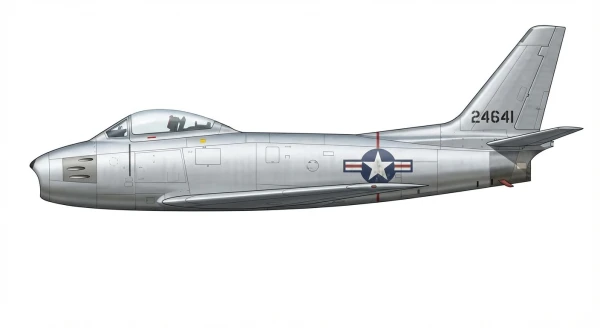
| Crew | 1 |
| Length | 11.4 m (37.5 ft) |
| Wingspan | 11.3 m (37.1 ft) |
| Height | 4.4 m (14.4 ft) |
| Wing area | 28.1 m² (302.5 sqft) |
| Empty weight | 5,443 kg (12,000 lbs) |
| Max. takeoff weight | 9,621 kg (21,211 lbs) |
| Powerplant | 1 × turbojet Rolls-Royce Avon 26 3,402 kgf each |
| Ejection seat | North American T-5 |
| Maximum speed | 1127 km/h (Mach 1.13) |
| Operational range | 2,454 km (1,525 mi) |
| Service ceiling | 15,850 m (52,001 ft) |
| Climb rate | 61.0 m/s (200.1 ft/s) |
Description
The North American F-86 Sabre is a transonic single-seat jet fighter built by North American Aviation in the United States, operated as a fighter-interceptor and fighter-bomber. It entered USAF service in 1949 with the 1st Fighter Wing's 94th Fighter Squadron and was the first American swept-wing fighter capable of engaging the MiG-15 over Korea. Total production of all variants, including licence-built aircraft in Canada, Australia, Japan and Italy, reached 9,860 units, making it the most-produced Western jet fighter.
Development
North American submitted four designs in early 1945 against a USAAF requirement for a medium-range, single-seat, high-altitude day escort fighter/fighter-bomber, and received a contract for three XP-86 prototypes. The initial straight-wing layout, derived from the FJ-1 Fury, fell short of the required 600 mph and offered no advantage over the XP-80 and XP-84. Captured German aerodynamic data on swept wings led to adoption of a 35° swept wing after wind tunnel testing. The prototype was rolled out on 8 August 1947 and first flew on 1 October 1947 with George Welch at the controls from Muroc Dry Lake. On 15 September 1948 Major Richard L. Johnson set a world speed record of 671 mph in an F-86A. US production ran from 1949 to 1956; Canadair built 1,815 aircraft, CAC 112, Fiat 221 and Mitsubishi 300.
Design
The wing used modified NACA four-digit airfoils with automatic leading-edge slats based on the Messerschmitt Me 262 and an electrically adjustable stabilizer. Many aircraft were retrofitted with the "6–3" wing, a fixed leading edge with extended chord, after Korean combat experience. The XP-86 used a General Electric J35-C-3 of 4,000 lbf; the F-86A-1 the J47-GE-7 of 5,200 lbf; and the F-86H the J73-GE-3 of 9,250 lbf. The F-86E introduced an all-flying tail. Early aircraft carried the Mark 18 manual-ranging gunsight; late F-86A-5s and F-86Es used the A-1CM gunsight with AN/APG-30 radar for automatic ranging. Other avionics included AN/APG-5 range-only radar, AN/APG-37 search radar and the AN/ARC-34 UHF radio.
Armament
Standard armament was six 0.50 in M3 Browning machine guns in the nose, firing at 1,200 rounds per minute and harmonized to converge at 1,000 ft, with AP and API ammunition. Project GunVal modified ten aircraft to carry four 20 mm T-160 cannons; later F-86H aircraft carried four 20 mm cannons. The F-86F-40 carried up to 5,300 lb of stores on four external hardpoints, typically two 1,000 lb bombs plus two 200 US gal drop tanks, along with napalm canisters, 5-inch rockets and provision for a tactical nuclear weapon. ROCAF and PAF Sabres were modified to carry AIM-9 Sidewinders.
Operational History
Three F-86 squadrons deployed to the Far East in December 1950 after the MiG-15 appeared. The 51st Fighter-Interceptor Wing converted from the F-80 in December 1951, and the 8th and 18th Fighter-Bomber Wings converted to the F-86F in spring 1953; No. 2 Squadron SAAF flew Sabres within the 18th FBW. USAF pilots were initially credited with 792 MiGs for 78 air-combat losses, later revised internally to roughly 200 kills; official figures record 224 F-86s lost in Korea. ROCAF F-86Fs used Sidewinders against PLAAF MiG-15s and MiG-17s during the 1958 Taiwan Strait crisis under Operation Black Magic. Pakistan received 102 F-86Fs from 1954 and 90 ex-Luftwaffe CL-13 Mk.6s in 1966, flying them in the 1965 and 1971 wars until withdrawal in 1980. Portugal deployed F-86Fs to Portuguese Guinea from 1961, flying 577 combat sorties before withdrawal in 1964.
Variants
- F-86A: First production model, 554 built with the J47 engine and six .50 in machine guns.
- F-86E: Improved flight control system with all-flying tail, 456 built, plus 60 by Canadair as the F-86E-6.
- F-86F: Uprated engine and "6–3" wing, 2,239 built, with the F-35 block cleared for tactical nuclear weapons.
- F-86D/L: All-weather radar-equipped interceptor with afterburning engine and Mk. 4 rockets in place of guns, 2,506 built.
- F-86H: Fighter-bomber with deeper fuselage, J73 engine and LABS, 473 built.
Frequently Asked Questions
What type of aircraft is the F-86 Sabre?
What is the maximum speed of the F-86 Sabre?
What is the range of the F-86 Sabre?
When did the F-86 Sabre first fly?
How many F-86 Sabre have been built?
How much does a F-86 Sabre cost?
What is the service ceiling of the F-86 Sabre?
- AUG 302026 Updated Description updated
- APR 72026 Updated Sources and cross-references refreshed
- APR 52026 Updated Ejection seat added
- JAN 122026 Updated Range updated in a site-wide editorial pass