IA-63 Pampa
Summary
| Category | Military Training Aircraft |
| Origin country | 🇦🇷 Argentina |
| Manufacturer | FMA |
| First flight | 6 October 1984 |
| Year introduced | 1988 |
| Number produced | 32 units |
Technical specifications
| Version: IA-63 | |
|---|---|
| Operational range | 1,500 km (932 mi) |
| Maximum speed | 815 km/h (506 mph) |
| Wing area | 15.6 m² (168.2 sqft) |
| Wingspan | 9.7 m (31.8 ft) |
| Height | 4.3 m (14.1 ft) |
| Length | 10.9 m (35.8 ft) |
| Service ceiling | 12,900 m (42,323 ft) |
| Empty weight | 2,820 kg (6,217 lbs) |
| Max. takeoff weight | 5,000 kg (11,023 lbs) |
| Climb rate | 26.0 m/s (85.3 ft/s) |
| Takeoff distance | 430 m (1,411 ft) |
| Powerplant | 1 x turbojet Honeywell TFE731-2 delivering 1588 kgf each |
| Ejection seat | UPC Stencel S-III-S3IA63 |
Current operating countries
| Country | Units | ||
|---|---|---|---|

|
Argentina | 27 (+4) | |
All operators
Armament
Bombs payload:
- Low-Drag Mk 81
- Low-Drag Mk 82
Description
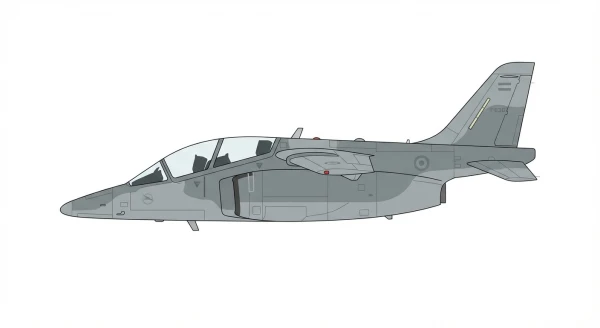
Preliminary design studies for a replacement for the Morane-Saulnier MS-760 of the Argentine Air Force started at the Fábrica Militar de Aviones (FMA) in 1978. These studies resulted in the selection of a proposal powered by a single Garrett TFE731 turbofan with high, unswept wings. At the same time, FMA signed a partnership agreement with Dornier to develop the new aircraft. The Pampa prototype first flew on 6 October 1984. Production of the initial series was delayed and hampered by the Argentinian economy, and as a result, 18 production aircraft were built in the first batch (1988–90) and six in the second batch (2006–07) for the Argentine Air Force. First deliveries occurred in April 1988.
The IA-63 Pampa's design incorporates high, unswept wings and a single Garrett TFE731 turbofan engine. It is a single-engine aircraft distinguished by its straight supercritical wings. The Pampa's construction primarily utilizes aluminum alloy, with carbon fiber components in areas like the air intakes. It accommodates a crew of two in tandem configuration, situated beneath a single-piece clamshell canopy. The avionics systems are simpler, reflecting its primary role as a trainer, though it has some combat capability.
The IA-63 Pampa is equipped with five hardpoints for armament: one on the fuselage centerline, two inboard underwing pylons capable of carrying up to 400 kg (880 lb) each, and two outer wing pylons rated for 250 kg (550 lb) each. It can be fitted with a 30 mm Defa-Giat 554 cannon with 145 rounds of ammunition, or with four 7.62 mm Colibri Pods. The aircraft can also carry LAU-32/51 rocket pods, LAU-10 rocket pods, and ARM-657 Mamboretá pods for missiles, as well as Mk81/ Mk82 bombs and CBLS 200 practice bombs.
The IA-63 Pampa has primarily served within the Argentine Air Force, where the initial 18 production aircraft were delivered between 1988 and 1990, followed by a second batch of six aircraft in 2006-2007. These aircraft, all modernized, are assigned to the IV Brigada Aérea at Mendoza, undertaking advanced pilot training.
Main Variants:
-
IA-63: The initial production version of the Pampa, designed for advanced training of Argentine Air Force pilots.
-
Vought Pampa 2000: A proposed variant of the IA-63 for the Joint Primary Aircraft Training System competition, featuring enhancements for the U.S. Air Force.
-
AT-63 Pampa "Phase 2": An upgraded Pampa variant with a new engine and advanced avionics, marketed by Lockheed Martin as an attack trainer.
-
IA-63 Pampa GT "Phase 3": A redesigned version with further improvements, including updated systems and capabilities.
-
LMAASA IA 63 Pampa NG: Lockheed Martin collaboration to produce updated Pampas.