Argentina Military Forces
Open-source order of battle for 2026: 72,100 active troops, 241 aircraft, 43 warships, 1,447 ground vehicles.
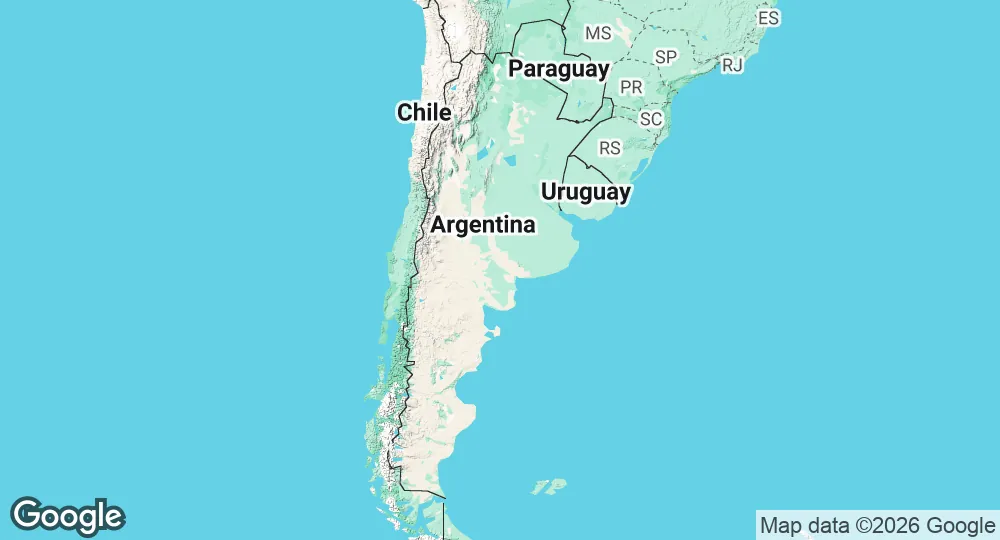

Armed Forces in 2026
| Domain | Strength | Composition |
|---|---|---|
| Air Force | 241 aircraft | 26 combat 101 helicopters 16 air bases +57 on order |
| Argentine Navy | 43 warships | 3 major combatants 3 naval bases |
| Ground Forces | 1,447 vehicles | 231 main battle tanks |
| Personnel | 72,100 active | 31,250 paramilitary |
ARMS Index (Aggregate Rating of Military Strength)
Full ranking →| Pillar | Weight | Score | Basis |
|---|---|---|---|
| Manpower | 15% | 64.0 | Active, reserve & paramilitary personnel |
| Ground forces | 20% | 52.6 | Tanks, armor & artillery weighted by type |
| Naval power | 20% | 35.4 | Weighted by hull type: carrier tiers, nuclear vs conventional submarines |
| Air power | 25% | 37.7 | Weighted by aircraft type and fleet age |
| Nuclear deterrent | 10% | 0.0 | No declared nuclear capability |
| Defense budget | 10% | 44.3 | Annual spending, purchasing-power adjusted |
| Readiness | modifier | ×1.02 | Budget per soldier: proxy for training, maintenance & technology |
Country File
| Population | 45.7M (2024) |
| GDP | $638.4 billion (2024) |
| GDP per capita | $13,970 |
| Military budget | $3.8B (2024) |
| Share of GDP | 0.6% (2024) |
| Military spending per capita | $84 (2024) |
| Inflation rate | 219.88% (2024) |
| Capital | Buenos Aires |
| Region | America |
| Land area | 2,736,690 km² |
| Coastline | 4,989 km |
| Land borders | 9,665 km |
| Bordering countries | 5 |
| Currency | ARS |
Strategic Overview in 2026
Strategic Position
Argentina occupies a central position in the Southern Cone, with strategic interests concentrated on the South Atlantic, the Magellanic passages, and claims over the Argentine Antarctic Territory. Primary security concerns involve the protection of maritime resources within the Exclusive Economic Zone (EEZ)—specifically targeting illegal, unreported, and unregulated (IUU) fishing—and the maintenance of territorial claims in the South Atlantic, including the Falkland Islands (Malvinas).
Under the administration of President Javier Milei, Argentine defense policy has shifted toward a definitive alignment with Western powers, specifically the United States and Israel. In April 2024, Argentina formally requested to become a "global partner" of NATO, seeking to enhance interoperability and access to advanced training and technology. The country retains its status as a Major Non-NATO Ally (MNNA) of the United States, a designation held since 1998. Regional relationships with Brazil and Chile remain cooperative, characterized by joint exercises and confidence-building measures, though Argentina’s recent pivot toward Western security frameworks marks a departure from previous regional multi-alignment strategies.
Military Forces
The Armed Forces of the Argentine Republic are organized into three primary branches under the Ministry of Defense, supported by two major paramilitary organizations under the Ministry of Security. Total active military personnel number approximately 100,000, supported by approximately 30,000 reserves.
Argentine Army (Ejército Argentino): The army maintains approximately 10 brigades, including armored, mechanized, mountain, and paratrooper units. The armored core consists of the Tanque Argentino Mediano (TAM), which is currently undergoing modernization to the 2CA2 standard with Israeli technology. The first batch of these modernized units entered service in late 2024. The army is also transitioning its mechanized infantry toward wheeled platforms, having reached agreements for the acquisition of Stryker 8x8 armored vehicles to enhance rapid deployment capabilities.
Argentine Air Force (Fuerza Aérea Argentina): The air force is in a transition phase following the 2024 purchase of 24 F-16AM/BM Fighting Falcons from Denmark. The first operational units arrived in late 2025, with full integration and operational status at the VI Air Brigade in Tandil expected during 2026. This acquisition restores supersonic intercept capabilities lost in 2015. The force also operates the A-4AR Fightinghawk and the domestically produced IA-63 Pampa III for training and light attack. Transport capacity is being reinforced with C-130 Hercules and Embraer ERJ-140 aircraft.
Argentine Navy (Armada de la República Argentina): The navy focuses on maritime surveillance and Antarctic logistics. Its surface fleet is centered on German-designed MEKO 360 destroyers and MEKO 140 corvettes, most of which require extensive maintenance or mid-life upgrades. The most modern assets are four French-built Gowind-class Offshore Patrol Vessels (OPVs). In 2025, the navy began incorporating P-3 Orion maritime patrol aircraft from Norway. Argentina currently lacks an operational submarine capability, though a letter of intent for Scorpene-class submarines was signed with France in late 2024.
Paramilitary Forces: The National Gendarmerie (Gendarmería Nacional) consists of approximately 40,000 personnel tasked with border security and internal stability. The Naval Prefecture (Prefectura Naval) maintains approximately 35,000 personnel and acts as the national coast guard, operating a fleet of patrol vessels and aircraft for fisheries protection.
Defense Industry
The domestic defense sector is led by FAdeA (Fábrica Argentina de Aviones) in Córdoba. Current projects include the serial production of the IA-63 Pampa III Block 2 and the development of the IA-100B "Malvina" primary trainer. FAdeA also serves as a regional supplier for Embraer, producing components for the C-390 Millennium transport aircraft. In the maritime sector, the Tandanor and Río Santiago shipyards focus on the repair and modernization of the existing fleet. Argentina also maintains advanced nuclear engineering capabilities through INVAP, which is developing the CAREM-25 small modular reactor (SMR) and participating in joint ventures for radar and satellite technology.
Strategic Trends
The primary trend in Argentine defense is the systemic shift toward NATO-standard equipment and Western logistics. Modernization priorities for 2026 include the infrastructure preparation for the F-16 fleet and the procurement of 8x8 armored vehicles. While defense spending has historically hovered between 0.6% and 0.8% of GDP, the 2026 budget project aims to increase the combined allocation for defense and internal security toward 2% of GDP, though persistent economic volatility remains a constraint on procurement timelines. A major doctrinal priority is the "Defense of the South," emphasizing a reinforced military presence in Patagonia and the South Atlantic to deter incursions into national waters and support Antarctic logistics.
Military Expenditure: CIA World Factbook. Last updated on 4 August 2026. Suggest a change
Argentine Defense Manufacturing
Designed in ArgentinaFrequently Asked Questions
How large is Argentina's military?
What is Argentina's defense budget?
How does Argentina rank militarily in the world?
Does Argentina have nuclear weapons?
How many aircraft does Argentina's air force have?
How large is Argentina's navy?
How many tanks does Argentina have?
What percentage of GDP does Argentina spend on defense?
What is Argentina's military personnel per capita?
Does Argentina have paramilitary forces?
- AUG 42026 Updated Global Military Index updated in a site-wide editorial pass
- JUL 162026 Updated Global Military Index updated in a site-wide editorial pass
- JUL 22026 Updated Rank insignia and ranks overview added
- JUN 162026 Updated Yearly statistics, military spending and 2 more fields updated
- JAN 172026 Updated Main battle tank count and Global Military Index updated
- JAN 132026 Updated Description updated