IA-63 Pampa
Argentinian advanced trainer jet, designed in the '80s, predominantly used for instruction and aerobatic displays. Key figures: top speed 815 km/h, range 1,500 km, service ceiling 12,900 m, max takeoff weight 5,000 kg, built 32. In service with 1 air force as of 2026 — Argentina (27).
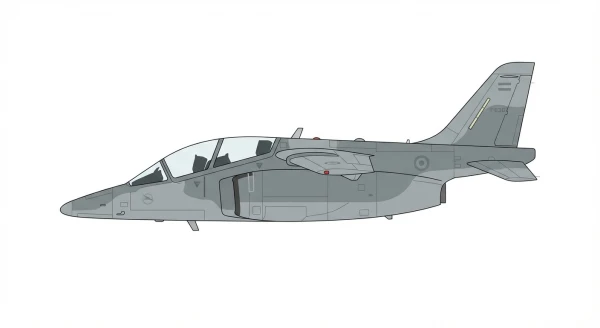
| Length | 10.9 m (35.8 ft) |
| Wingspan | 9.7 m (31.8 ft) |
| Height | 4.3 m (14.1 ft) |
| Wing area | 15.6 m² (168.2 sqft) |
| Empty weight | 2,820 kg (6,217 lbs) |
| Max. takeoff weight | 5,000 kg (11,023 lbs) |
| Powerplant | 1 × turbofan Honeywell TFE731-2 1,588 kgf each |
| Ejection seat | UPC Stencel S-III-S3IA63 |
| Maximum speed | 815 km/h (506 mph) |
| Operational range | 1,500 km (932 mi) |
| Service ceiling | 12,900 m (42,323 ft) |
| Climb rate | 26.0 m/s (85.3 ft/s) |
| Takeoff distance | 430 m (1,411 ft) |

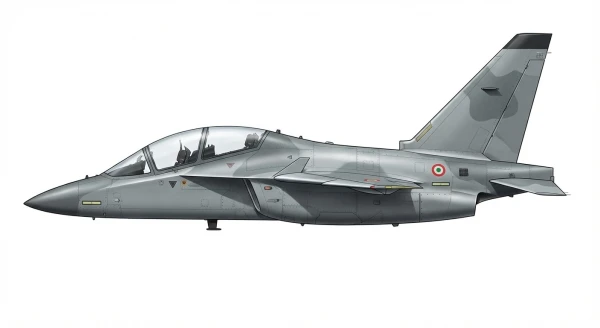

Description
The IA-63 Pampa is a single-engine advanced jet trainer with light attack capability, built in Argentina by the Fábrica Militar de Aviones (later FAdeA) with design assistance from Dornier of West Germany. Developed to replace the Argentine Air Force's Morane-Saulnier MS-760, it first flew in 1984 and entered service in April 1988. It is the principal advanced training aircraft of the Argentine Air Force and the country's only jet aircraft in series production.
Development
Design studies began at FMA in 1978, leading to a configuration with a single Garrett TFE731 turbofan and high, unswept wings. FMA signed a partnership agreement with Dornier, whose Alpha Jet influenced the layout. The prototype flew on 6 October 1984 and first deliveries followed in April 1988. Production has been constrained by the Argentine economy: 18 aircraft were built in a first batch between 1988 and 1990, six more in 2006–07, and a third batch of 40 announced by FAdeA on 10 October 2013 was never funded at that scale. The Pampa III prototype flew in 2016; a February 2018 contract worth $30.3 million covered three additional aircraft, with the first, serial E-824, flying on 21 September 2018. Six Pampa III were delivered between February 2019 and 27 March 2020.
Design
The Pampa is smaller than the Alpha Jet, single-engined, and uses straight supercritical wings with the Dornier DoA-7 airfoil rather than swept surfaces. The airframe is mainly aluminium alloy, with carbon fibre used for components such as the air intakes. The two crew sit in tandem under a single-piece clamshell canopy. Avionics are simpler than those of the Alpha Jet. Power comes from one Honeywell TFE731-2-2N turbofan rated at 15.57 kN, giving 819 km/h at 7,000 m, a 12,900 m ceiling, and 1,500 km range at a maximum take-off weight of 5,000 kg. The Phase 2 upgrade introduced a new engine and an avionics package compatible with the A-4AR and its weapons system.
Armament
A single 30 mm DEFA-GIAT 554 cannon with 145 rounds can be carried, along with four 7.62 mm Colibrí gun pods. Five hardpoints are fitted, rated at 400 kg on the inboard underwing pylons and 250 kg on the fuselage centreline and outer wing pylons. Stores include LAU-32/51 and LAU-10 rocket pods, ARM-657 Mamboretá pods, Mk 81 and Mk 82 bombs, and CBLS 200 practice bomb carriers.
Operational History
All 18 first-batch aircraft, since modernised, serve with the IV Brigada Aérea at Mendoza in the advanced training role. In the 1990s LTV/Vought entered a derivative in the USAF Joint Primary Aircraft Training System competition, which was won by the Beechcraft T-6 Texan II. Guatemala signed a $28 million contract for two Pampa III on 3 July 2019, but the purchase was cancelled by the Guatemalan auditor general after Transparency International alleged procurement law violations.
Variants
- IA-63: Initial production trainer for the Argentine Air Force, 24 built in two batches.
- Vought Pampa 2000: LTV/Vought-modified version offered for the USAF JPATS competition.
- AT-63 Pampa "Phase 2": Attack-trainer upgrade with new engine and A-4AR-compatible avionics, marketed by Lockheed Martin after its 1995 acquisition of FMA.
- IA-63 Pampa III "Phase 3": Redesigned version first flown in 2016, six delivered to Argentina by March 2020.
- LMAASA IA 63 Pampa NG: Lockheed Martin collaboration for updated production aircraft.
Frequently Asked Questions
What type of aircraft is the IA-63 Pampa?
What is the maximum speed of the IA-63 Pampa?
What is the range of the IA-63 Pampa?
When did the IA-63 Pampa first fly?
How many IA-63 Pampa have been built?
Which countries operate the IA-63 Pampa?
What is the service ceiling of the IA-63 Pampa?
- AUG 302026 Updated Description updated
- AUG 52026 Updated Powerplant updated in a site-wide editorial pass
- APR 72026 Updated Sources and cross-references refreshed
- JAN 122026 Updated Range updated in a site-wide editorial pass