H120 / EC120 Colibri
French light utility helicopter, notable for widespread civil use and law enforcement operations since the late 20th century. Key figures: top speed 278 km/h, range 727 km, service ceiling 17,600 m, max takeoff weight 1,700 kg, built 700. In service with 7 air forces as of 2026 — China (93), Spain (15), Indonesia (12) and 4 others.
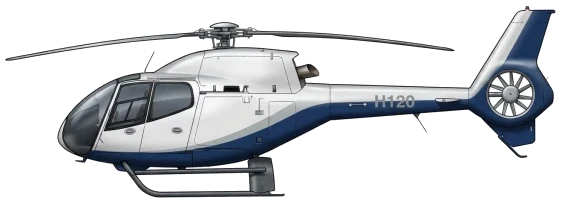
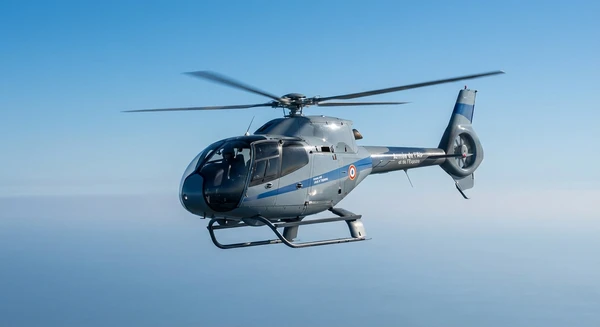
| Length | 11.5 m (37.8 ft) |
| Wingspan | 10 m (32.8 ft) |
| Height | 3.4 m (11.2 ft) |
| Empty weight | 950 kg (2,094 lbs) |
| Max. takeoff weight | 1,700 kg (3,748 lbs) |
| Powerplant | 1 × turboshaft Turbomeca Arrius 2F 376 kW each |
| Maximum speed | 278 km/h (173 mph) |
| Operational range | 727 km (452 mi) |
| Service ceiling | 17,600 m (57,743 ft) |
| Climb rate | 6.7 m/s (22.0 ft/s) |


Description
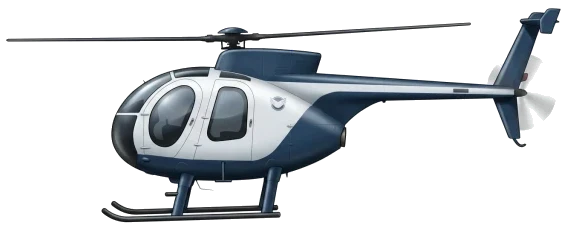
The Airbus Helicopters H120 Colibri (originally the Eurocopter EC120) is a five-seat, single-turbine light helicopter, developed in France for utility, transport and training missions. The first production example was delivered in 1998. It is known for its eight-blade Fenestron shrouded tail rotor and for a noise signature 6.7 decibels below ICAO limits.
Development
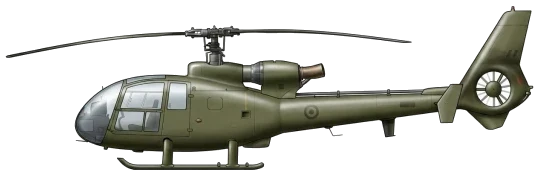
The programme originated in the P120, an Aérospatiale project to replace the Gazelle and the SA 315B Lama. During the 1980s, Aérospatiale sought partners in China, Singapore and Australia. The joint development contract was signed on 20 October 1992 between Eurocopter (61%, technical leadership and final assembly), CATIC (24%, cabin structure and fuel system) and Singapore Aerospace (15%, tail boom, doors and composite materials). The first prototype flew on 9 June 1995 and had logged 60 flight hours by February 1996, with a second prototype joining the test programme the same year. The commercial launch took place in February 1997 at the HAI show in Anaheim; more than 50 orders had been recorded by June 1997 and more than 100 by October 1998, raising the production rate from four to six aircraft per month. A second assembly line was established at Australian Aerospace in Brisbane in 2002. A production agreement signed on 11 June 2004 gave HAIG manufacture of the HC120 at Harbin with exclusivity over the Chinese market. Airbus Helicopters announced the end of the programme on 30 November 2017, only five H120s having been delivered in 2016. A demonstrator fitted with a 330 kW HIPE AE440 V8 diesel engine running on kerosene flew on 6 November 2015 under the Clean Sky programme, achieving a 42% reduction in fuel consumption.
Design
The EC120 B uses a three-blade Spheriflex main rotor head and an eight-blade Fenestron. It is powered by a Turbomeca Arrius 2F rated at 376 kW for take-off, for a maximum weight of 1,715 kg with internal load and 1,800 kg with external load. Maximum cruise speed is 226 km/h and endurance 4 h 32 min. The aircraft is certified to JAR/FAR 27 with an energy-absorbing structure, crashworthy seats and a crash-resistant fuel tank. The cabin accommodates a pilot and four passengers, or one stretcher and one or two medical attendants; the 0.8 m³ baggage hold brings the total usable volume to 2.94 m³, and a sling allows 700 kg to be carried. Instrumentation is based on the dual-screen VEMD with First Limit Indicator. Optional equipment includes wire-strike protection, a sand filter, skis, emergency floats, FLIR cameras and external searchlights.
Operational History
More than 550 examples had been delivered by 2008. US Customs and Border Protection selected the EC120B in 2004 for its Light Sign Cutter requirement, ordering 15 aircraft in 2006 and a further five later. The Spanish Air Force operates it at Armilla air base and in 2003 formed the five-aircraft Patrulla ASPA aerobatic team. In January 2008, France selected 36 EC120 Bs fitted with Sagem avionics, operated by Hélidax under a 22-year public-private partnership, with the last delivery on 12 October 2010. The traffic police of Iraqi Kurdistan has operated the type since 2011. The Chinese PLA became the launch customer for the HC120 in June 2014 with eight aircraft ordered and fifty on option. Other military operators: Indonesia, Malaysia, Myanmar and Singapore.
Variants
- P120L: Initial prototype before the type was redesignated EC120 Colibri.
- EC120B Colibri: Standard production version, built in France and Australia.
- HC120: Variant assembled in China by Harbin Aircraft Manufacturing Corporation since 2004.
Frequently Asked Questions
What type of aircraft is the H120 / EC120 Colibri?
What is the maximum speed of the H120 / EC120 Colibri?
What is the range of the H120 / EC120 Colibri?
When did the H120 / EC120 Colibri first fly?
How many H120 / EC120 Colibri have been built?
Which countries operate the H120 / EC120 Colibri?
What is the service ceiling of the H120 / EC120 Colibri?
- AUG 302026 Updated Description updated
- AUG 52026 Updated Powerplant updated in a site-wide editorial pass
- JUL 232026 Updated Sources and cross-references refreshed
- APR 72026 Updated Sources and cross-references refreshed
- FEB 72026 Updated H120 / EC120 Colibri: top speed added; H120 / EC120 Colibri: range added; H120 / EC120 Colibri: wingspan added