Nesher
Israeli multirole fighter, developed in the late 1960s as a derivative of the Mirage 5, and extensively used in Middle Eastern and South Atlantic conflicts. Key figures: top speed 2,573 km/h, range 1,300 km, service ceiling 17,680 m, max takeoff weight 13,500 kg, built 61.
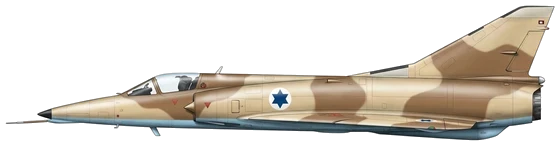
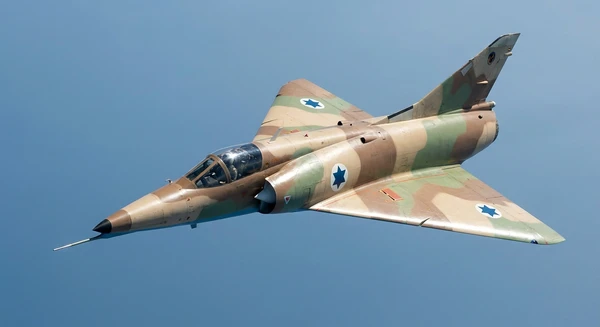
| Crew | 1 |
| Length | 15.7 m (51.3 ft) |
| Wingspan | 8.2 m (27.0 ft) |
| Height | 4.3 m (13.9 ft) |
| Wing area | 34.8 m² (374.6 sqft) |
| Empty weight | 6,600 kg (14,550 lbs) |
| Max. takeoff weight | 13,500 kg (29,762 lbs) |
| Powerplant | 1 × SNECMA Atar 9C |
| Maximum speed | 2573 km/h (Mach 2.4) |
| Operational range | 1,300 km (808 mi) |
| Service ceiling | 17,680 m (58,005 ft) |
| Climb rate | 83.0 m/s (272.3 ft/s) |
- Unguided Bomb 12,730lb of ordnance
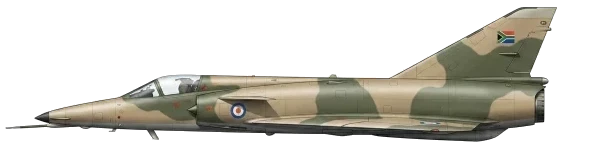
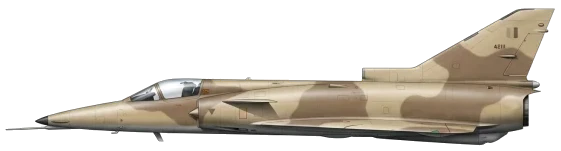
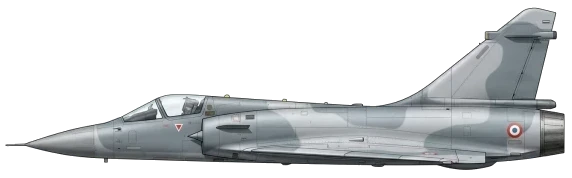
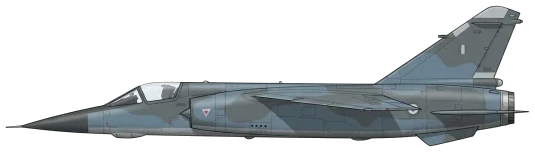
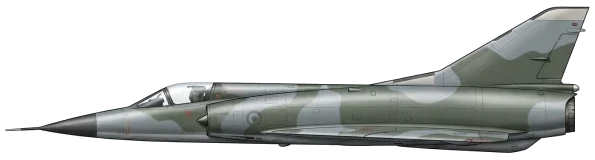
Description
The Israel Aircraft Industries (IAI) Nesher is a multirole fighter based on the French Dassault Mirage 5. Development originated from an Israeli requirement to replace aircraft lost during the Six-Day War and the War of Attrition. While Israel initially partnered with Dassault to develop the Mirage 5, a 1969 French arms embargo prevented the delivery of 50 aircraft already ordered and paid for by Israel. In response, Israel commenced domestic production of the airframe using obtained technical drawings and manufacturing jigs.
Development
The first Nesher prototype conducted its maiden flight in September 1969. Deliveries to the Israeli Air Force (IAF) began in May 1971 under the initial designation Raam A. Production continued until 1974, totaling 51 single-seat fighters and 10 two-seat trainers.
Design
The Nesher airframe is identical to the Mirage 5 but incorporates Israeli-built avionics and Martin-Baker zero-zero ejection seats. To increase fuel capacity and ordnance load, the design de-emphasized all-weather capability by removing the main radar system. The aircraft is powered by a SNECMA Atar 9C afterburning turbojet. Israel manufactured these engines domestically after obtaining blueprints from the Swiss company Sulzer and reverse-engineering existing Atar units.
Armament
Internal armament consists of two 30mm IAI/DEFA 552 cannons with 140 rounds per gun. The aircraft features seven hardpoints—six under the wings and one under the fuselage—with a total payload capacity of 4,200 kg (9,259 lb). Air-to-air armament includes the AIM-9D and the Israeli-made Shafrir heat-seeking missile.
Operational History
During the 1973 Yom Kippur War, IAF Neshers were credited with over 100 aerial kills. Israel began phasing out the type in the mid-1970s as the IAI Kfir entered service. The retired airframes were refurbished and sold to the Argentine Air Force, where they were designated as the Dagger.
Argentina deployed Daggers during the 1978 Beagle conflict and the 1982 Falklands War. During the 45-day Falklands conflict, Daggers flew 153 sorties against ground and naval targets. Their anti-ship attacks resulted in damage to several vessels, including HMS Antrim, Brilliant, Broadsword, Ardent, Arrow, and Plymouth. Argentina lost 11 Daggers in combat, including nine shot down by Royal Navy Sea Harriers. Surviving Argentine aircraft were later upgraded to the Finger standard, which replaced British-made electronic components with French-sourced systems from Thomson-CSF.
Variants
- Nesher S: Single-seat ground-attack fighter version produced for the Israeli Air Force.
- Nesher T: Two-seat tandem-architecture training version for the Israeli Air Force.
- Dagger A: Refurbished single-seat Nesher S fighters exported to the Argentine Air Force.
- Dagger B: Refurbished two-seat Nesher T trainers exported to the Argentine Air Force.
- Finger: Argentine upgrade featuring new avionics and HUD systems to approximate Kfir C.2 standards.
Frequently Asked Questions
What type of aircraft is the Nesher?
What is the maximum speed of the Nesher?
What is the range of the Nesher?
When did the Nesher first fly?
How many Nesher have been built?
Which countries operate the Nesher?
What is the service ceiling of the Nesher?
- MAY 102026 Created Page created: Nesher