Nishant
Indian unmanned aerial vehicle developed in the late 20th century, primarily used for battlefield surveillance, reconnaissance, and target designation by the Indian Army. Key figures: top speed 216 km/h, range 100 km, service ceiling 3,962 m, max takeoff weight 380 kg, unit price $3.1M, built 4. In service with 1 air force as of 2026 — India (13).
| Length | 4.6 m (15.1 ft) |
| Wingspan | 6.5 m (21.3 ft) |
| Max. takeoff weight | 380 kg (838 lbs) |
| Powerplant | 1 × ALVIS AR-801 41 kW each |
| Maximum speed | 216 km/h (134 mph) |
| Operational range | 100 km (62 mi) |
| Endurance | 4 hours |
| Service ceiling | 3,962 m (12,999 ft) |
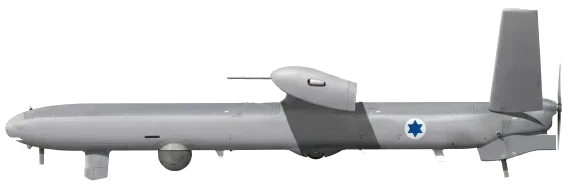
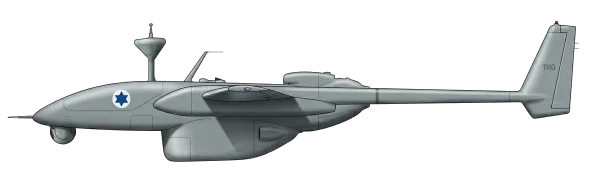
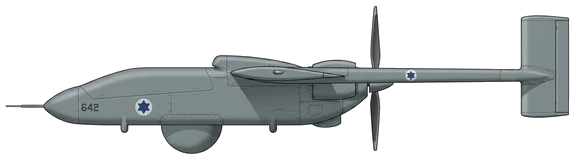
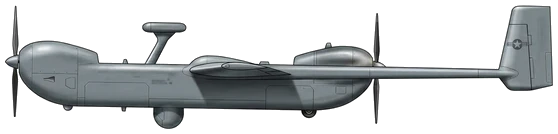
Description
The DRDO Nishant is an unmanned aerial vehicle developed by the Aeronautical Development Establishment (ADE), a laboratory of India's Defence Research and Development Organisation, for the Indian Armed Forces. Designed for battlefield reconnaissance, surveillance, target designation, artillery fire correction, damage assessment, ELINT and SIGINT, it was one of the few UAVs in its weight class launched from a hydro-pneumatic catapult and recovered by parachute, removing any runway requirement. Four aircraft were delivered to the Indian Army, all of which were lost in crashes, leading to closure of the programme in 2015.
Development
Indigenous development of a remotely piloted vehicle for the Army was assigned to DRDO in September 1988, with the General Staff Qualitative Requirement finalised by the Army in May 1990. The first test flight took place in 1995, and the 100th flight was completed by 15 June 2002. The Indian Army ordered 12 Nishant UAVs with ground support systems by 2007, and a further flight test was conducted near Kolar on 20 June 2008. On 5 April 2009 an indigenous 55 hp Wankel rotary engine, weighing about 25 kg and developed jointly by the National Aerospace Laboratories, the Vehicle Research and Development Establishment and ADE, was flown for the first time from a disused Second World War runway near Kolar, reaching 1.8 km altitude during a 40-minute sortie. The engine was intended to replace the imported powerplant. Confirmatory user trials were held at Pokhran in April 2010 and completed on 3 February 2011. Four aircraft were delivered by 2011 at a cost of ₹800 million, the unit cost being ₹22 crore. The programme total was ₹90 crore.
Design
The Nishant has a length of 4.6 m, a wingspan of 6.5 m and a gross weight of 350–380 kg. Power comes from a single ALVIS AR-801 rotary engine of 41 kW (55 hp) driving a two-bladed fixed-pitch pusher propeller, giving a maximum speed of 216 km/h, a range of 100 km, an endurance of 4.5 hours and a service ceiling of 3,962 m. The payload consists of 45 kg of electro-optical, infrared or laser sensors, including an integral laser target designator, with day and night capability. Launch is by a Mobile Hydro-Pneumatic Launcher mounted on a Tatra truck, weighing 14,000 kg and rated for 1,000 launches before overhaul; release occurs at 45 m/s in 0.6 second using 100 kW, with subsequent launches at 20-minute intervals. Recovery uses a parachute and landing bags. Ground equipment comprises a ground control station, antenna vehicle/ground data terminal, avionics preparation vehicle, mechanical maintenance vehicle, UAV transportation vehicle and power supply vehicle. Three MHPL systems were built by R&DE(E).
Operational History
The Indian Army first deployed the Nishant system in July 1999 against Pakistan-backed guerrilla forces in the Kashmir Valley. Two aircraft crash-landed in Jaisalmer district near the India–Pakistan border on 28 and 30 April 2010 during user trials, and villagers damaged the airframes before recovery teams arrived. Two more were lost near Jaisalmer in April 2015 and the last two crashed at Pokhran on 4 and 19 November 2015, the losses attributed to problems in the recovery phase. The second phase, covering eight further UAVs and two ground systems, was cancelled and the programme closed. India was the sole operator.
Variants
- Nishant: Baseline catapult-launched, parachute-recovered reconnaissance UAV, four of which were delivered to the Indian Army.
- Panchi: Wheeled derivative capable of conventional take-off and landing from semi-prepared runways, which began taxi trials in September 2014 and completed five flights.
Frequently Asked Questions
What type of aircraft is the Nishant?
What is the maximum speed of the Nishant?
What is the range of the Nishant?
When did the Nishant first fly?
How many Nishant have been built?
Which countries operate the Nishant?
How much does a Nishant cost?
What is the service ceiling of the Nishant?
- AUG 302026 Updated Description updated
- JUL 62026 Created Page created: Nishant