T-23 Uirapuru
Brazilian military trainer aircraft, developed in the mid-1960s, used for primary flight training by South American air forces. Key figures: top speed 225 km/h, range 800 km, service ceiling 4,500 m, max takeoff weight 840 kg, built 155.
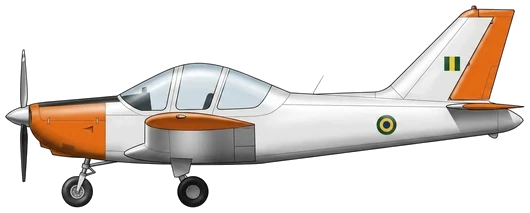
| Crew | 2 (student, instructor) |
| Length | 6.6 m (21.7 ft) |
| Wingspan | 8.5 m (27.9 ft) |
| Height | 2.7 m (8.9 ft) |
| Wing area | 13.5 m² (145.3 sqft) |
| Empty weight | 540 kg (1,190 lbs) |
| Max. takeoff weight | 840 kg (1,852 lbs) |
| Powerplant | 1 × Lycoming O-320-B2B 120 kW each |
| Maximum speed | 225 km/h (140 mph) |
| Operational range | 800 km (497 mi) |
| Endurance | 4 hours |
| Service ceiling | 4,500 m (14,764 ft) |
| Climb rate | 4.0 m/s (13.1 ft/s) |
Description
The Aerotec A-122 Uirapuru was a Brazilian military trainer aircraft. Developed as a low-wing monoplane, it completed its first flight on 2 June 1965. In October 1967, the Brazilian Air Force ordered 30 aircraft to replace its obsolete Fokker S.11 and S.12 (T-21 and T-22) trainers at the Air Force Academy. The Brazilian Air Force subsequently ordered an additional 40 units, followed by a final order of 30, with these military examples designated T-23. By the time production ended in 1977, a total of 155 aircraft had been built, including prototypes. This total included 30 aircraft sold to the civilian market.
Design
The T-23 featured a tricycle undercarriage and side-by-side seating for the pilot and instructor. The aircraft was powered by a single 120 kW (160 hp) Lycoming O-320-B2B four-cylinder horizontally-opposed air-cooled engine, driving a two-bladed Sensenich M-76-DM-60 fixed-pitch metal propeller. Physical dimensions included a wingspan of 8.50 meters, a length of 6.60 meters, and an empty weight of 540 kg. During operational service, the T-23 suffered fatal accidents during spin training. To resolve this aerodynamic issue, a ventral fin was installed under the rear fuselage.
Operational History
In addition to Brazilian service, the aircraft was exported to other South American militaries. The Bolivian Air Force ordered 36 examples in 1974, operating the type until 1997. The Paraguayan Air Force purchased eight aircraft in 1975 to replace its Fokker T-21s, and received six additional units donated by the Brazilian Air Force in 1986. The Escuela Nacional de Aeronáutica Civil in Paraguay also operated a single aircraft in the early 1970s. Most Paraguayan aircraft were retired from service in 1992 and replaced by the Enaer T-35 Pillán. By 2009, only one T-23 remained in flying condition.
Variants
- A-122A Uirapuru: The primary military trainer version, designated T-23 by the Brazilian Air Force.
- A-122B Uirapuru: The civilian production version of the aircraft.
- A-122C Uirapuru: A military trainer variant designated T-23C.
- A-132 Uirapuru II: An enlarged version with an improved canopy and larger vertical tail surfaces, later designated as the A-132 Tangará.
Frequently Asked Questions
What type of aircraft is the T-23 Uirapuru?
What is the maximum speed of the T-23 Uirapuru?
What is the range of the T-23 Uirapuru?
When did the T-23 Uirapuru first fly?
How many T-23 Uirapuru have been built?
Which countries operate the T-23 Uirapuru?
What is the service ceiling of the T-23 Uirapuru?
- JUL 12026 Created Page created: T-23 Uirapuru