Tu-126 Moss
Soviet airborne early warning and control aircraft, developed in the late 1950s and early 1960s, operated during the Cold War from 1965 to 1984. Key figures: top speed 790 km/h, range 7,000 km, service ceiling 10,700 m, max takeoff weight 171,000 kg, built 9.
| Crew | 12 |
| Length | 56.5 m (185.4 ft) |
| Wingspan | 51.4 m (168.6 ft) |
| Height | 16.1 m (52.7 ft) |
| Wing area | 311.1 m² (3348.6 sqft) |
| Empty weight | 103,000 kg (227,076 lbs) |
| Max. takeoff weight | 171,000 kg (376,990 lbs) |
| Powerplant | 4 × Kuznetsov NK-12MV 11,033 kW each |
| Maximum speed | 790 km/h (491 mph) |
| Operational range | 7,000 km (4,350 mi) |
| Endurance | 10 hours |
| Service ceiling | 10,700 m (35,105 ft) |
Description
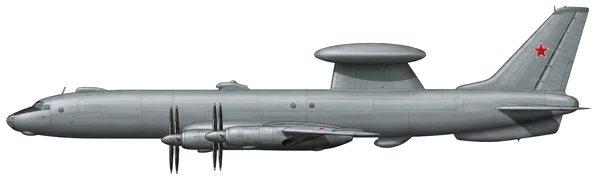
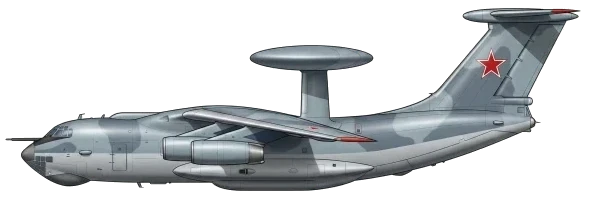
The Tupolev Tu-126 (NATO reporting name: Moss) was a Soviet airborne early warning and control aircraft derived from the Tu-114 airliner by the Tupolev design bureau. It entered service in 1965 and remained operational until 1984, serving as the Soviet Union's first purpose-built AEW&C platform and the predecessor to the Beriev A-50.
Development
The requirement originated in 1958, when concern over an American nuclear strike approaching the USSR from the north created a need for airborne radar coverage in place of a land-based chain along the Soviet northern coast, which would have been prohibitively expensive. The Tupolev Design Bureau was tasked with the design and initially examined installations in the Tu-95 and Tu-116, but both airframes proved too narrow to accommodate operator stations and equipment cooling. The wider fuselage of the Tu-114 was selected instead. The first prototype flew on 23 January 1962. Testing ran through the autumn of 1964 and showed the radar performed adequately over water but poorly over land; the contra-rotating propellers of the four engines also degraded radar performance, a problem only partly addressed by fitting a new radar designated Shmel. Eight production aircraft were built between 1965 and 1968 in addition to the prototype.
Design
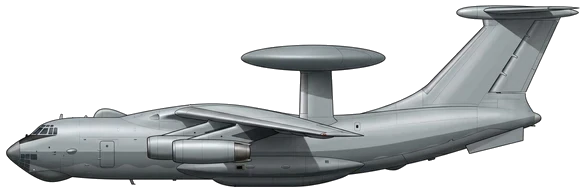
The Tu-126 retained the swept-wing, four-engine turboprop layout of the Tu-114, with a length of 56.5 m including the refuelling probe, a wingspan of 51.4 m and a wing area of 311.1 m². Power came from four Kuznetsov NK-12MV axial-flow turboprops of 11,033 kW each, driving eight-bladed contra-rotating propellers. Gross weight was 171,000 kg with 60,800 kg of fuel, giving a range of 7,000 km on internal fuel, an endurance of 10 hours unrefuelled and 20 hours with one in-flight refuelling. Maximum speed was 790 km/h, cruise speed 520 km/h at 9,000 m, and service ceiling 10,700 m. An air-to-air refuelling probe was fitted to meet the range requirement. The primary sensor was the Liana radar (NATO reporting name Flap Jack), housed in a rotodome mounted above the rear fuselage. The radar had no look-down capability. The crew numbered 12, with provision for a full relief crew.
Operational History
The Tu-126 entered service in 1965 but was not identified by Western intelligence until 1968, when it appeared in a Soviet documentary film. All aircraft were nominally based at Šiauliai Air Base. Western assessments rated the radar inferior to Western equivalents, judging it unable to detect cruise missiles or small aircraft at low altitude; the same assessments credited the type with powerful jamming equipment. The NATO shift to low-level penetration tactics reduced the aircraft's utility, as the Liana lacked look-down capability. Operators were the Soviet Air Forces, the Soviet Air Defence Forces and the Egyptian Air Force. The type was replaced by the Beriev A-50, and the last Tu-126 was retired in 1984.
Frequently Asked Questions
What type of aircraft is the Tu-126 Moss?
What is the maximum speed of the Tu-126 Moss?
What is the range of the Tu-126 Moss?
When did the Tu-126 Moss first fly?
How many Tu-126 Moss have been built?
Which countries operate the Tu-126 Moss?
What is the service ceiling of the Tu-126 Moss?
- AUG 302026 Updated Description updated
- JUL 232026 Updated Sources and cross-references refreshed
- JUN 302026 Created Page created: Tu-126 Moss