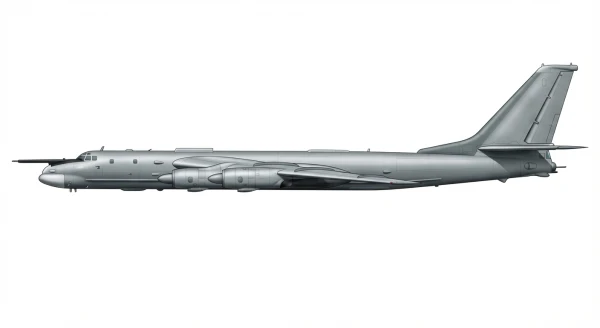
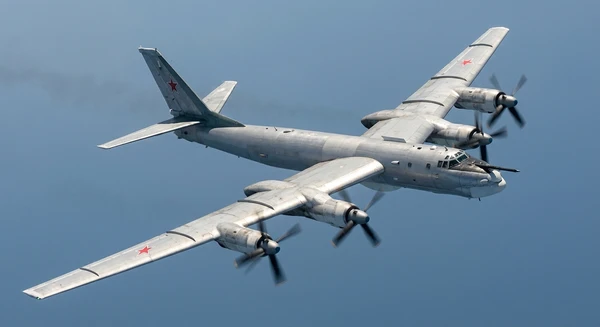
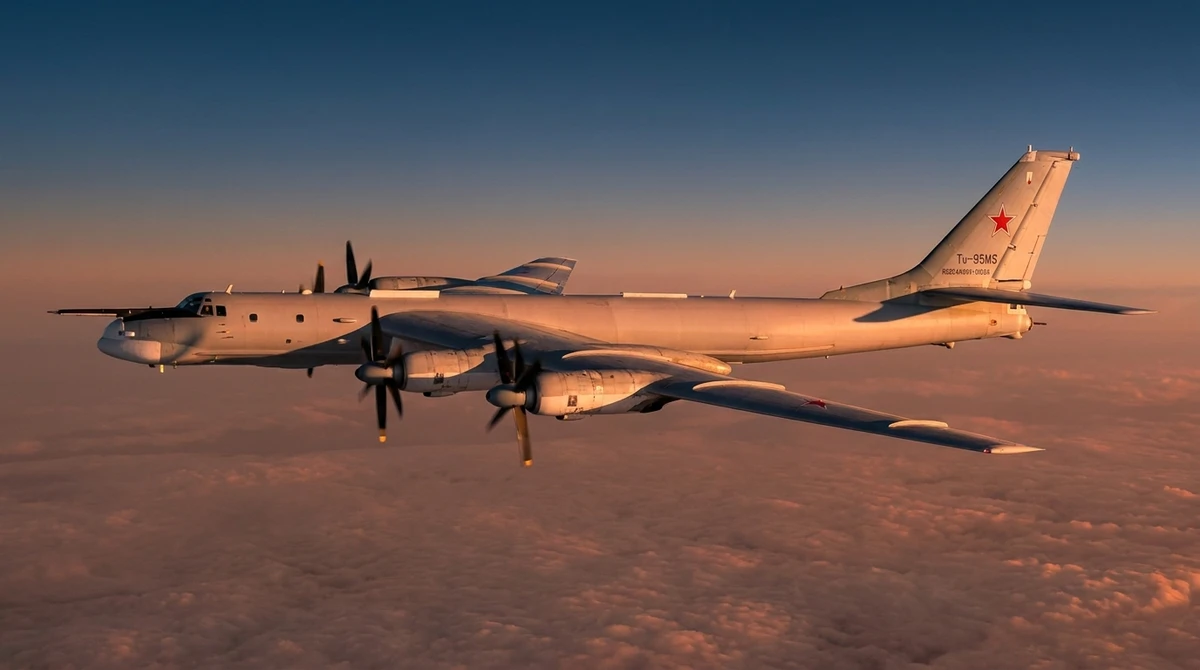
The Tupolev Tu-95 (NATO reporting name "Bear") is a Soviet four-engine turboprop strategic bomber and missile launch platform designed by the Tupolev design bureau. First flown in 1952, the aircraft entered service with the Long-Range Aviation of the Soviet Air Forces in 1956. It is the only turboprop-powered strategic bomber remaining in operational service and is known for its high noise levels caused by supersonic propeller blade tips.
Development
Development began in response to a 1950 requirement for a strategic bomber with an un-refueled range of 8,000 km and an 11,000 kg payload capacity. Andrei Tupolev selected turboprop engines to balance speed and fuel consumption requirements. Government approval for the design was granted on 11 July 1951. The prototype Tu-95/I first flew in November 1952 but crashed six months later following a propeller gearbox failure. The second prototype, Tu-95/II, incorporated NK-12 turboprops, leading to series production in January 1956. The modernized Tu-95MS variant entered production in 1981.
Design
The aircraft features a mid-mounted wing with 35 degrees of sweep, positioning the main wing spar forward of the bomb bay. It is powered by four Kuznetsov NK-12 turboprop engines, each driving a set of eight-bladed contra-rotating propellers. The airframe utilizes a retractable tricycle landing gear system where all units retract rearward, with the main gear housing inside the inner engine nacelle extensions. Modernized Tu-95MSM variants incorporate Novella NV1.021 passive electronically scanned array radar, upgraded NK-12MPM engines, and new AV-60T propellers to reduce airframe vibration.
Armament
The Tu-95 carries an internal and external weapon payload of up to 15,000 kg. Defensive armament consists of two 23 mm GSh-23 autocannons mounted in a tail turret. Modernized variants utilize an internal rotary launcher carrying six Kh-55-series cruise missiles, supplemented on upgraded models by four underwing pylons capable of carrying eight external Kh-101 or Kh-102 cruise missiles.
Operational History
During the Cold War, Soviet Tu-95s conducted long-range maritime reconnaissance and Arctic strike training, and a modified airframe dropped the Tsar Bomba thermonuclear device on 30 October 1961. Strategic patrol flights were suspended in 1991 but were resumed by Russia in 2007. The bomber made its combat debut in November 2015, launching cruise missiles during the Russian intervention in Syria. Russian Aerospace Forces have since deployed Tu-95MS aircraft to launch Kh-101 missiles during the invasion of Ukraine. Ukrainian drone strikes in 2022, 2025 and 2026 damaged or destroyed several airframes at Engels-2, Belaya, and Olenya airbases; on 28 August 2026 a Tu-95MS at Engels-2 lost a third of its right wing to a long-range drone and was assessed as beyond repair.
Variants
- Tu-95: Basic initial production variant of the strategic bomber built without a nose refueling probe.
- Tu-95RTs: Maritime reconnaissance and targeting variant fitted with a ventral search radar radome for naval targeting.
- Tu-95MS: Cruise missile platform based on the Tu-142 airframe, equipped with an internal rotary launcher for Kh-55 missiles.
- Tu-95MSM: Modernized variant featuring Novella NV1.021 radar, upgraded NK-12MPM engines, and external hardpoints for Kh-101 missiles.
- Tu-114: Commercial passenger airliner derivative developed directly from the Tu-95 design.