T-3 vs KT-100
| Japanese training aircraft, operational during the late 20th-century, widely adopted for flight instruction in Japan's Self-Defense Forces. | |
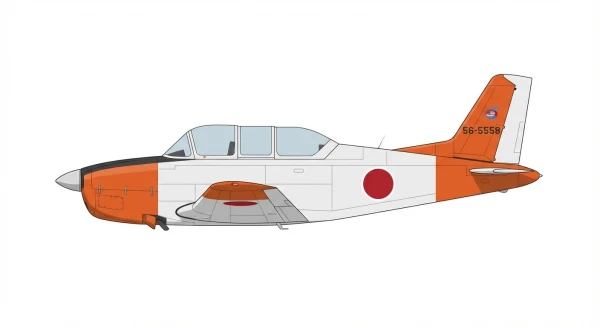
|
|
| Origin country | 🇯🇵 Japan |
| Category | Military Training Aircraft |
| Manufacturer | Fuji |
| First flight | 26 September 1974 |
| Year introduced | 1978 |
| Number produced | 50 units |
| Average unit price | $-- million |
| Korean trainer aircraft, operational since the 2000s, predominantly deployed for basic flight training within the Republic of Korea Air Force. | |
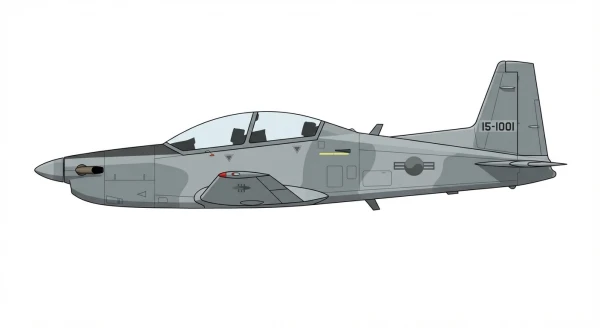
|
|
| Origin country | 🇰🇷 South Korea |
| Category | Military Training Aircraft |
| Manufacturer | KAI |
| First flight | 20 July 2011 |
| Year introduced | 2015 |
| Number produced | 23 units |
| Average unit price | $0.6 million |
| Wing area | 16.5 m² |
| Wingspan | 10.0 m ◉ |
| Height | 3.0 m ◉ |
| Length | 8.0 m ◉ |
| Maximum speed | 377 km/h ◉ |
| Operational range | 1,038 km ◉ |
| Service ceiling | 8,169 m ◉ |
| Max. takeoff weight | 1,510 kg ◉ |
| Empty weight | 1,120 kg ◉ |
| Total thrust | 1 x 254 kW ◉ |
| Wing area | -- m² |
| Wingspan | 11.3 m ◉ |
| Height | 2.7 m ◉ |
| Length | 8.0 m ◉ |
| Maximum speed | 389 km/h ◉ |
| Operational range | 1,900 km ◉ |
| Service ceiling | 5,304 m ◉ |
| Max. takeoff weight | 1,633 kg ◉ |
| Empty weight | 1,089 kg ◉ |
| Total thrust | 1 x 235 kW ◉ |
Performance Radar Chart
Frequently Asked Questions
Which is faster, the T-3 or KT-100?
The KT-100 is faster with a maximum speed of 389 km/h compared to the T-3's 377 km/h, a difference of 12 km/h.
Which has longer range, the T-3 or KT-100?
The KT-100 has a longer range at 1,900 km compared to the T-3's 1,038 km.
Which can fly higher, the T-3 or KT-100?
The T-3 has a higher service ceiling at 8,169 meters (26,801 ft) compared to the KT-100's 5,304 meters (17,401 ft).
Which is heavier, the T-3 or KT-100?
The KT-100 has a higher maximum takeoff weight at 1,633 kg compared to the T-3's 1,510 kg.
Which is larger, the T-3 or KT-100?
The T-3 is longer at 8.0 meters compared to the KT-100's 8.0 meters.
Which entered service first, the T-3 or KT-100?
The T-3 entered service first in 1978, 37 years before the KT-100 which entered service in 2015.
Which has been built in greater numbers, the T-3 or KT-100?
The T-3 has been produced in greater numbers with 50 units compared to 23 units of the KT-100.