KT-100
Korean trainer aircraft, operational since the 2000s, predominantly deployed for basic flight training within the Republic of Korea Air Force. Key figures: top speed 389 km/h, range 1,900 km, service ceiling 5,304 m, max takeoff weight 1,633 kg, unit price $0.57M, built 23. In service with 1 air force as of 2026 — South Korea (23).
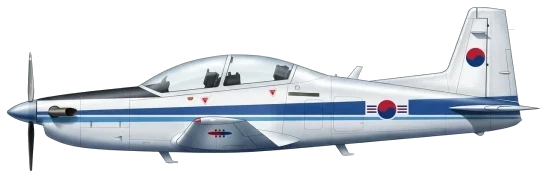
| Length | 8.0 m (26.3 ft) |
| Wingspan | 11.3 m (37.0 ft) |
| Height | 2.7 m (8.9 ft) |
| Empty weight | 1,089 kg (2,401 lbs) |
| Max. takeoff weight | 1,633 kg (3,600 lbs) |
| Powerplant | 1 × pistons engine Continental TSIOF-550-K 235 kW each |
| Maximum speed | 389 km/h (242 mph) |
| Operational range | 1,900 km (1,181 mi) |
| Service ceiling | 5,304 m (17,402 ft) |

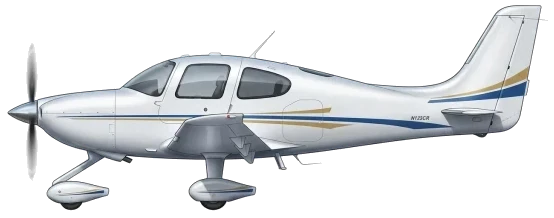
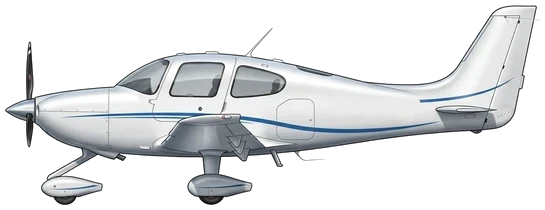
Description
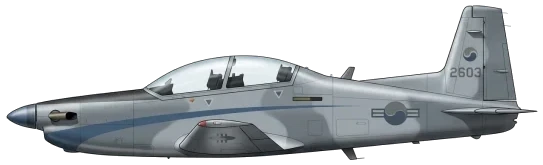
The KAI KT-100 is the military trainer variant of the KC-100 Naraon, a four-seat, low-wing, single-engine light aircraft developed and manufactured by Korea Aerospace Industries (KAI) of South Korea. The KT-100 first flew on 5 October 2015 and was ordered by the Republic of Korea Air Force academy for ab initio flight familiarisation. The baseline KC-100 was the first civil-oriented aircraft developed in South Korea.
Development
KAI had previously worked almost exclusively on government and military programmes, including the KUH-1 Surion, T-50 Golden Eagle and KT-1 Woongbi, and sought entry into the civil market. South Korea had imported all non-military aircraft for decades, and KAI worked with the Korea Office of Civil Aviation (KOCA) to define an aircraft certifiable under Korea Airworthiness Standard Part 23. Design targets included 10% lower fuel consumption than contemporaries in the class, a cabin 3 to 5 cm wider than the Cirrus SR-22 or Cessna 400, and up to 90% domestically sourced technology. Development began in June 2008 on a five-year timeframe; the preliminary design phase was completed by May 2010, and the first prototype flew on 15 June 2011. The flight test programme, conducted jointly with KOCA, involved 559 sorties by two prototypes and ended on 22 March 2013, with type certification granted a week later. Roughly half of the sorties addressed aerodynamics, 17% avionics, 10% the engine and 7% structures. Unit price was forecast at US$575,000 in 2011. Development of the KT-100 trainer variant followed during the 2010s.
Design
The airframe is all-composite, built primarily from carbon fibre, with cabin access via gull-wing doors on both sides of the fuselage. The wing uses a laminar-flow airfoil and winglets, and the flight controls include an aileron-rudder interconnection system added following flight test feedback. Avionics comprise the Avidyne Entegra II glass cockpit with dual integrated flight displays, MLB700/MLX770 data link, FMS900w flight management system, digital VHF radio, DFC100 autopilot and an airborne collision avoidance system. Power comes from a single Continental TSIOF-550-K turbocharged piston engine of 315 hp (235 kW) with FADEC, driving a Hartzell three-blade ASC-II composite propeller at a nominal 2,500 rpm; the diesel-fuelled Austro AE300 was considered in 2010 as better suited to the trainer market. Standard equipment includes a TKS anti-icing system, air conditioning and supplemental oxygen, with a Spin Recovery Parachute System offered as an option that deploys automatically when sensors detect excessive spin. Length is 8 m, wingspan 11.29 m, height 2.71 m and maximum take-off weight 1,633 kg, with a maximum speed of 370 km/h and a range of 1,900 km.
Operational History
In May 2014 the South Korean Air Force academy signed a memorandum of understanding for the KT-100, the first series production contract for the type. The fleet replaces the academy's 20 Ilyushin Il-103 aircraft used for initial flight familiarisation, with deliveries expected to be complete by the end of 2016.
Variants
- KC-100 Naraon: Four-seat civil light aircraft certified in March 2013.
- KT-100: Military trainer variant for the South Korean Air Force academy, first flown 5 October 2015.
Frequently Asked Questions
What type of aircraft is the KT-100?
What is the maximum speed of the KT-100?
What is the range of the KT-100?
When did the KT-100 first fly?
How many KT-100 have been built?
Which countries operate the KT-100?
How much does a KT-100 cost?
What is the service ceiling of the KT-100?
- AUG 302026 Updated Description updated
- APR 72026 Updated Sources and cross-references refreshed
- FEB 72026 Updated Ceiling added
- JAN 122026 Updated Range added; price added