AMX-10 RC vs EBRC Jaguar
AMX-10 RC vs EBRC Jaguar at a glance — weight 17,200 vs 25,000 kg, top speed 85 vs 90 km/h, range 800 vs 800 km, crew 4 vs —.
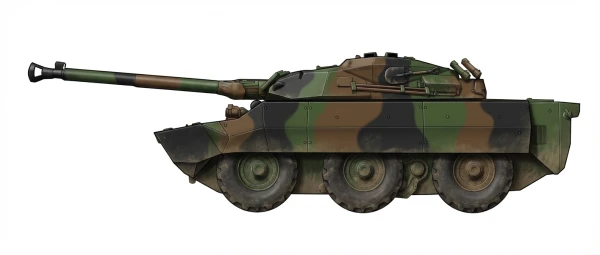
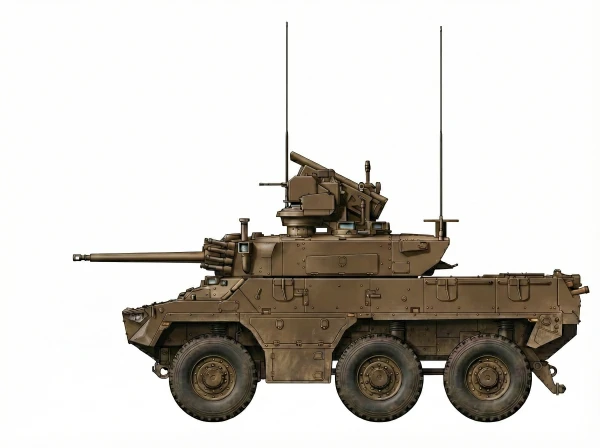
| AMX-10 RC | EBRC Jaguar | |
|---|---|---|
| Origin country | 🇫🇷 France | 🇫🇷 France |
| Category | Light Armoured Vehicle | Light Armoured Vehicle |
| Type | Reconnaissance Armored Vehicle | Armoured fighting and reconnaissance vehicle |
| Manufacturer | GIAT Industries | KNDS France / Arquus / Thales |
| Number produced | 464 units | 60 units |
| Estimated unit price | $-- million | $6.3 million |
| Combat weight | 17.2 tons | 25.0 tons |
| Maximum speed | 85 km/h | 90 km/h |
| Operational range | 800 km | 800 km |
| Length | 9.15 m | 7.80 m |
| Width | 2.78 m | 2.99 m |
| Height | 2.56 m | 2.80 m |
| Crew | 4 | 3 (driver + gunner + commander) |
| AMX-10 RC | EBRC Jaguar | |
|---|---|---|
| Main armament | 105 mm F2 BK MECA L/47 medium-pressure gun | 40 mm Cased Telescoped Armament System |
| Secondary weapon | 1 × 7.62 mm NF1 coaxial machine gun | 4 Akeron MP missiles |
| Engine | Baudouin Diesel Model 6F11 SRX (current) | Militarized Volvo D11 6-cylinder in-line turbodiesel engine, 500 hp (370 kW) |
Detailed Comparison
The AMX-10 RC and its successor, the EBRC Jaguar, mark a generational shift in French armored reconnaissance doctrine, transitioning from heavy direct fire support to collaborative, network-centric combat. While the AMX-10 RC emphasizes high-mobility firepower with a 105 mm gun, the Jaguar prioritizes survivability, sensor integration, and versatile engagement options via the SCORPION program to operate in complex modern environments.
Development and Design
Designed in the 1970s, the AMX-10 RC utilizes a specialized 6x6 skid-steering chassis and variable hydropneumatic suspension, optimizing it for strategic mobility and, originally, amphibious operations. Its welded aluminum hull prioritized weight reduction for rapid deployment. In contrast, the EBRC Jaguar was developed by a KNDS-Arquus-Thales consortium to function as a digital node within the "SCORPION bubble." Entering service in 2022, the Jaguar eschews skid steering for a conventional drivetrain and rear-wheel steering. It introduces blast-deflecting architecture and predictive maintenance sensors, reflecting a shift toward high-intensity protection and sustainment over pure mechanical agility.
Protection and Firepower
The AMX-10 RC mounts a 105 mm F2 medium-pressure gun, offering substantial high-explosive and anti-tank capability. However, its unstabilized nature necessitates a halt to fire accurately, a significant tactical limitation. The Jaguar adopts a versatile 40 mm Cased Telescoped Armament System, capable of high-elevation engagement against infantry and UAVs, supplemented by Akeron MP missiles for beyond-line-of-sight anti-tank lethality.
Defensively, the Jaguar is superior. While the AMX-10 RC relies on speed and light aluminum armor (upgraded with add-on plates in the RCR variant), the 25-ton Jaguar integrates modular armor, acoustic gunfire localization, and laser warning receivers. This significantly enhances survivability against modern threats compared to the older vehicle's vulnerability to artillery and autocannons.
Mobility and Logistics
Despite being heavier (25 tons vs 17.2 tons), the Jaguar achieves a higher top speed of 90 km/h utilizing a 500 hp militarized Volvo engine, compared to the AMX-10 RC's 85 km/h. The Jaguar’s logistical footprint is optimized through shared components with other SCORPION vehicles and embedded health monitoring systems. Conversely, the AMX-10 RC requires careful maintenance of its complex hydropneumatic suspension and gearboxes, which historically suffered issues during prolonged road movements. The AMX-10 RC offers a range of 800 km, matched by the Jaguar, ensuring both maintain deep operational reach.
Deployment and Combat Record
The AMX-10 RC possesses a deep combat history, from the Gulf War to counter-insurgency in Mali. Its 2023 deployment in Ukraine highlighted its utility in fire support but exposed severe vulnerabilities when used for frontal assaults against high-intensity artillery. The Jaguar entered service in 2022 and has not yet seen major combat. It is currently integrating into French light cavalry regiments and Belgian forces, focusing on intelligence gathering and collaborative target designation via the SICS combat system.
Conclusion
The AMX-10 RC remains a potent asset for rapid flanking and hit-and-run raids where its heavy caliber can be leveraged against hardened targets. However, the EBRC Jaguar represents a necessary evolution, trading the raw caliber of a tank destroyer for the adaptability of missiles and autocannons. The Jaguar excels in the multidimensional battlespace, where survivability against drones and network connectivity are as critical as firepower.