M-46 Field Gun vs M101 Howitzer
M-46 Field Gun vs M101 Howitzer at a glance — weight 8,400 vs 2,030 kg, range 27 vs 18 km, crew 8 vs 8.
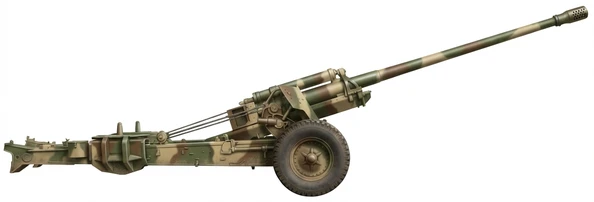
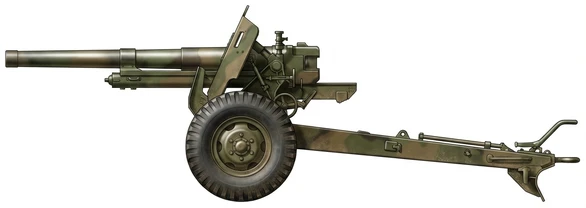
| M-46 Field Gun | M101 Howitzer | |
|---|---|---|
| Origin country | 🇷🇺 Russia | 🇺🇸 United States |
| Category | Towed Artillery | Towed Artillery |
| Type | Towed Field Gun | Artillery piece |
| Manufacturer | Perm Machine-Building Plant | Rock Island Arsenal |
| Number produced | 6,500 units | 10,202 units |
| Estimated unit price | $-- million | $0.0 million |
| Combat weight | 8.4 tons | 2.0 tons |
| Operational range | 27 km | 18 km |
| Length | 11.84 m | 5.94 m |
| Width | 2.45 m | 2.21 m |
| Height | -- m | 1.73 m |
| Crew | 8 | 8 |
| M-46 Field Gun | M101 Howitzer | |
|---|---|---|
| Main armament | 130 mm M-46 gun | 105 mm high explosive (HE) semi-fixed ammunition |
| Secondary weapon | -- | HEAT M67 Shell |
Detailed Comparison
Weighing 8.4 tons and firing a 130mm naval-derived projectile out to 27 km, the Soviet M-46 operates as a corps-level counter-battery asset, whereas the 2.03-ton US M101 functions as a highly mobile, short-range 105mm infantry support weapon. Built decades apart, their physical weights and calibers dictate their tactical employment, logistical footprints, and survivability in modern conflicts.
Development and Design
The M101 evolved from post-WWI studies of German artillery, standardized for U.S. production in 1941 to prioritize mass manufacturing and vehicle towing. Its split-trail carriage and pneumatic tires facilitated rapid repositioning for infantry battalions in the mid-20th century. The M-46, entering production in 1951, derived its 55-caliber barrel from the M-36 naval gun. Soviet designers prioritized kinetic energy and range over mobility, incorporating a hydro-pneumatic recoil buffer and a tied-jaw horizontal sliding-block breech to handle high-pressure 130mm propellant charges.
Protection and Firepower
As towed systems, neither platform offers crew protection beyond rudimentary gun shields against small arms and shrapnel; survivability relies entirely on range and displacement speed. The M-46 dominates in sheer firepower. Firing an HE fragmentation projectile out to 27 km (extended further with modern base-bleed rounds), it routinely outranged NATO 155mm systems until the 1980s. Its flat trajectory allows direct-fire anti-tank use, facilitated by the APN-3 night sight. The M101’s 105mm semi-fixed ammunition reaches a maximum of 18 km with rocket-assisted projectiles, but standard HE ranges are much shorter. It relies on a higher rate of fire and high-angle plunging trajectories to suppress infantry, lacking the explosive yield for hardened bunkers or counter-battery duels against heavier Soviet-bloc guns.
Mobility and Logistics
The M101 possesses a strict logistical advantage due to its small footprint.
These weight disparities translate directly to tactical mobility:
- M101 (2.03 tons): Sling-loadable by medium helicopters and towable by light utility vehicles, facilitating rapid deployment in rugged terrain.
- M-46 (8.4 tons): Requires dedicated heavy trucks or tracked prime movers and a two-wheeled limber, degrading cross-country mobility and increasing emplacement time.
This emplacement delay makes the M-46 highly vulnerable to modern counter-battery radars and loitering munitions.
Deployment and Combat Record
The M101 saturated the frontlines of WWII, Korea, and Vietnam, where its air-mobility allowed U.S. forces to establish firebases in triple-canopy jungle. Today, it serves primarily in low-intensity operations, such as by the Armed Forces of the Philippines in urban combat in Marawi. The M-46 has a heavily documented counter-battery record. In the Angolan Civil War, FAPLA used it to stall South African armored columns at Cuito Cuanavale. In the ongoing Russian invasion of Ukraine, both sides have reactivated M-46s from storage to bridge gaps in 152mm and 155mm ammunition supplies, exploiting its 27 km range to strike behind the line of contact.
Conclusion
The M-46 is objectively the superior weapon for conventional, mechanized artillery warfare. Its 27 km range and heavier payload allow it to execute counter-battery missions and strike operational depth targets that the M101 cannot reach. In a modern conflict like Ukraine, the M101's short range makes it unsurvivable near the forward line of own troops (FLOT) due to drone surveillance. However, in expeditionary operations, mountain warfare, or air-assault missions where heavy lift is unavailable, the 2.03-ton M101 remains the only viable choice between the two platforms.