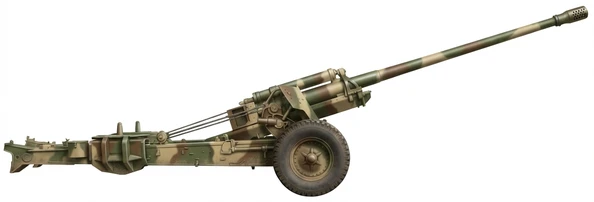
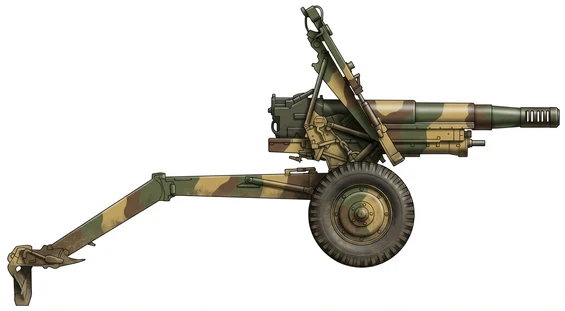
The Soviet 130 mm M-46 and the Italian 105 mm OTO Melara Mod 56 occupy opposite ends of the towed artillery spectrum during the Cold War. The 8.4-ton M-46 is a heavy, corps-level asset designed for deep counter-battery fire, while the 1.29-ton Mod 56 is a specialized pack howitzer built for extreme portability in mountainous terrain.
Development and Design
Factory No 172 developed the M-46 starting in 1946 to replace World War II-era 122 mm and 152 mm systems. Adapting the ballistics of the M-36 naval gun, Soviet engineers mounted a 55-caliber barrel on a split-trail carriage with a hydro-pneumatic recoil mechanism. OTO Melara designed the Mod 56 in the 1950s specifically for Italian Alpini brigades. The design prioritizes modularity; the weapon breaks down into 12 components for mule transport. This severe weight reduction compromises the structural longevity of the carriage, a trade-off accepted to achieve man-portability.
Protection and Firepower
The M-46 achieves a maximum range of 27 km using standard high-explosive fragmentation rounds, outranging most Western contemporary equivalents until the mass deployment of 155 mm 39-caliber systems. It fires separate-loading ammunition, requiring an eight-man crew to sustain fire. The Mod 56 utilizes standard NATO 105 mm fixed ammunition (US M1 type) but is constrained by a short barrel, limiting its range to 11 km. Both guns mount basic shields to protect against shrapnel. Mod 56 crews face higher vulnerability to counter-battery fire due to their shorter standoff distance and the inability of the lightweight carriage to sustain high-volume defensive fire.
Mobility and Logistics
Mobility dictates the tactical employment of both systems:
The 1.29-ton Mod 56 is slung beneath utility helicopters, transportable by pack animals, or towed by light 4x4s.
The 8.4-ton M-46 relies on heavy tracked or wheeled prime movers, traveling with its 11.84-meter barrel retracted onto a two-wheeled limber.
While the Mod 56 allows for rapid airmobile deployment, combat data from Australian and New Zealand units in Vietnam proved the carriage degrades rapidly under sustained fire missions, demanding intensive maintenance.
Deployment and Combat Record
The M-46 served as a primary counter-battery tool in Angola, where FAPLA used it against South African mechanized forces at Cuito Cuanavale. In the Russo-Ukrainian War, both Russia and Ukraine have reactivated M-46s from storage to supplement 152 mm and 155 mm losses, relying on its 27 km range for standoff strikes. The Mod 56 saw use in the Aden Emergency, Borneo, and Vietnam. During the 1982 Falklands War, Argentine forces deployed the Mod 56 against British troops. The British had previously replaced their Mod 56s (L5s) with the L118 Light Gun because the Mod 56 lacked the range required in conventional infantry engagements.
Conclusion
The M-46 holds a definitive edge in conventional, high-intensity warfare. Its 27 km range and heavy payload remain relevant in attritional artillery duels, driving its reactivation in Ukraine. The OTO Melara Mod 56 is only viable in niche mountain or airborne operations where lift capacity dictates weapon selection. In theaters where heavier lift is available or counter-battery threats exist, the Mod 56's 11 km range and fragile carriage make it a liability compared to modern light guns, whereas the M-46 maintains raw kinetic utility.