M10 Wolverine vs M18 Hellcat
M10 Wolverine vs M18 Hellcat at a glance — weight 29,028 vs 18,142 kg, top speed 48 vs 80 km/h, range 322 vs 240 km, crew 5 vs 5.
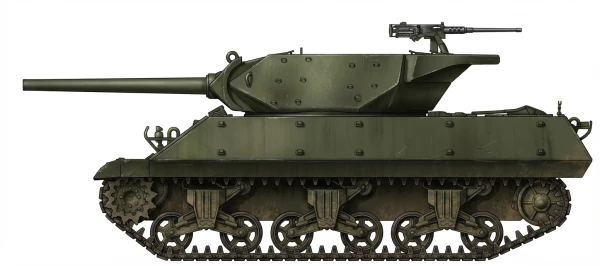
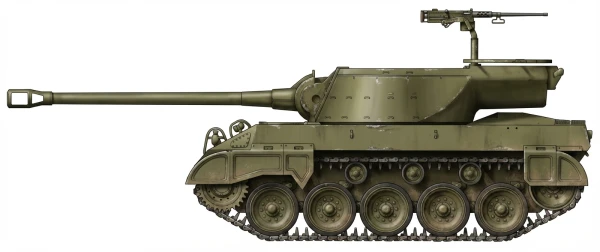
| M10 Wolverine | M18 Hellcat | |
|---|---|---|
| Origin country | 🇺🇸 United States | 🇺🇸 United States |
| Category | Tank Destroyer | Tank Destroyer |
| Type | Tank Destroyer | Tank Destroyer |
| Manufacturer | U.S Army Ordnance | U.S Army Ordnance |
| Number produced | 5,000 units | 2,500 units |
| Estimated unit price | $0.0 million | $0.1 million |
| Combat weight | 29.0 tons | 18.1 tons |
| Maximum speed | 48 km/h | 80 km/h |
| Operational range | 322 km | 240 km |
| Length | 6.00 m | 6.70 m |
| Width | 3.05 m | 3.00 m |
| Height | 2.50 m | 2.60 m |
| Crew | 5 | 5 |
| M10 Wolverine | M18 Hellcat | |
|---|---|---|
| Main armament | 1 M7 76.2mm gun | 1 M7 76.2mm gun |
| Secondary weapon | 1 M2 12.7mm machine gun | 1 M2 12.7mm machine gun |
| Engine | General Motors S6-71 Diesel Engines (x2) with 375 hp each | Continental R-975 Diesel Engine with 400 hp |
Detailed Comparison
The U.S. Army Ordnance Department fielded the M10 and M18 during World War II under the Tank Destroyer doctrine, which required fast, heavily armed vehicles to intercept enemy armor breakthroughs. The M10, built on a modified M4 Sherman chassis, prioritized production speed and mechanical commonality. The M18 was a clean-sheet design engineered specifically for the tank destroyer role, trading armor and range for maximum speed.
Development and Design
The M10 entered service in 1942 as an interim solution. By utilizing the existing M4 medium tank hull and vertical volute spring suspension, manufacturers produced 5,000 units rapidly. The resulting 29-ton vehicle retained the high profile of a standard medium tank. Conversely, Buick’s 1944 M18 was purpose-built. At 18.1 tons, it incorporated a torsion bar suspension and a novel rail system allowing its 400-hp Continental radial engine to slide out for rapid field maintenance. Both vehicles utilized open-topped turrets to maximize situational awareness, leaving crews exposed to airburst artillery and infantry.
Protection and Firepower
Both platforms prioritized firepower over armor. The M10 mounted the 3-inch gun M7, while the M18 utilized the ballistically similar 76 mm M1 series. Both struggled against the frontal glacis of German Panthers until the late-1944 introduction of High Velocity Armor Piercing (HVAP) ammunition. The M18 held a strict advantage in fire control:
- The M18 utilized an electro-hydraulic traverse, allowing it to track moving targets rapidly.
- The M10 relied on a slow, manually cranked turret, restricting response times in close engagements.
Armor on both was negligible against direct anti-tank fire. The M10 used sloped plates up to 57mm thick, while the M18’s armor peaked at 25mm, rendering it proof only against small arms and shrapnel.
Mobility and Logistics
With a power-to-weight ratio of 22 hp/ton and a top speed of 80 km/h, the M18 dictated the tactical pace. This speed enabled the shoot-and-scoot tactics required to flank heavy armor. The M10, capped at 48 km/h, operated at standard medium tank speeds. However, the M10 held a logistical advantage in operational range (322 km versus the M18’s 240 km) and shared a deep parts supply chain with the ubiquitous Sherman.
Deployment and Combat Record
The M10 saw early action in North Africa, validating the tank destroyer concept at El Guettar. However, its sluggish turret restricted its lethality in Normandy. The M18 proved the doctrine’s viability at the 1944 Battle of Arracourt, where the 704th Tank Destroyer Battalion utilized its 80 km/h speed to flank and destroy heavier Panzer formations. Post-WWII, the heavier M10 chassis absorbed larger up-gunning programs, including Israeli retrofits with French 75mm guns and British 17-pounder Achilles conversions. The M18 found longevity in the Yugoslav Wars as mobile fire support and in Taiwan.
Conclusion
The M18 has the absolute edge in anti-armor combat. Its torsion bar suspension, electro-hydraulic traverse, and 80 km/h speed align precisely with the shoot-and-scoot requirements of a lightly armored tank destroyer. The M10 was an expedient stopgap; its manual turret and medium tank mass prevented it from executing the high-speed flanking maneuvers required to survive engagements with heavier enemy armor.