Bhutan Military Forces
Bhutan ranks #169 of 170 militaries worldwide in 2026. The Air Force flies 2 aircraft. Landlocked, Bhutan has no navy and no nuclear weapons.
Armed Forces in 2026
| Domain | Strength | Composition |
|---|---|---|
| Air Force | 2 aircraft | 2 helicopters |
ATLAS Index (Aggregate Total of Land, Air and Sea strength)
Full ranking →| Pillar | Weight | Score | Basis |
|---|---|---|---|
| Manpower | 10% | 0.0 | Active, reserve & paramilitary personnel |
| Ground forces | 20% | 0.0 | ARMS inventory power: armour & artillery by type and era, attack helicopters, armament |
| Naval power | 20% | 0.0 | SEAS inventory power: hulls by type, size and era, air wing, sustainment, armament |
| Air power | 25% | 5.6 | AIRS inventory power: aircraft by type and generation, enablers, armament |
| Nuclear deterrent | 10% | 0.0 | No declared nuclear capability |
| Defense budget | 15% | 0.0 | Data unavailable |
| Availability | modifier | ground ×1.00 · naval ×1.00 · air ×1.00 | Budget per point of each force, from the branch indexes |
Country File
| Population | 791K (2024) |
| GDP | $3.0 billion (2023) |
| GDP per capita | $3,806 |
| Inflation rate | 2.76% (2024) |
| Capital | Thimphu |
| Region | Asia |
| Land area | 38,394 km² |
| Land borders | 1,075 km |
| Bordering countries | 2 |
| Currency | BTN |
Strategic Overview in 2026
Strategic Position
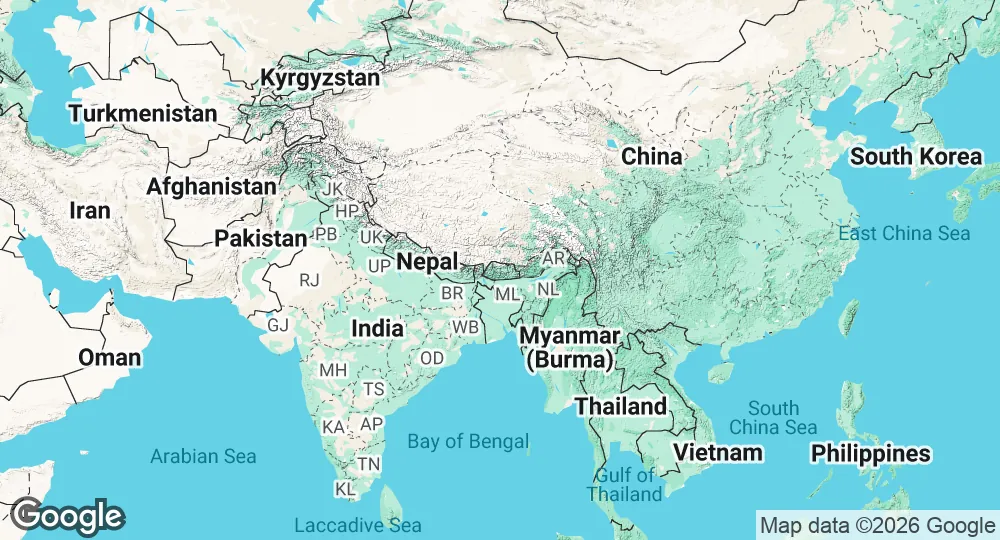
Bhutan occupies a landlocked position in the Eastern Himalayas, situated between the People’s Republic of China to the north and the Republic of India to the south, east, and west. This location places the state at the center of the territorial competition between these two regional powers. A primary security concern is the demarcation of the northern border with China, specifically regarding disputed sectors such as the Doklam plateau, Pasamlung, and Jakarlung valleys. These areas are adjacent to the Siliguri Corridor, a narrow strip of Indian territory connecting mainland India to its northeastern states, which informs the strategic alignment between Thimphu and New Delhi.
Bhutan maintains a unique bilateral security relationship with India, formalized under the 2007 Treaty of Friendship. While the revised treaty removed the requirement for Bhutan to be "guided" by India in its foreign policy, it stipulates that neither country shall allow the use of its territory for activities harmful to the national security and interests of the other. In practice, India provides for Bhutan's external defense. The Indian Military Training Team (IMTRAT) maintains a permanent presence in Bhutan, tasked with the training and professional development of Bhutanese personnel.
Defense doctrine centers on sovereignty protection and internal security. The military is configured to manage border incursions and maintain internal stability rather than engage in large-scale conventional warfare. Strategic priorities involve balancing relations with China—marked by ongoing boundary negotiations—while maintaining the security partnership with India.
Military Forces
The armed forces of Bhutan consist of the Royal Bhutan Army (RBA), the Royal Bodyguard (RBG), and the Royal Bhutan Police (RBP). Total active personnel across these organizations is approximately 8,000. There is no independent air force or navy; the Indian Air Force provides air support and transport capabilities under bilateral arrangements.
The Royal Bhutan Army is a light infantry force organized into several wings and specialized detachments. Its primary role is border security and the protection of territorial integrity. The Royal Bodyguard is an elite unit dedicated to the protection of the Druk Gyalpo (King) and the royal family. While the Royal Bhutan Police functions as a law enforcement agency under the Ministry of Home and Cultural Affairs, it serves as a paramilitary reserve force and undergoes basic military training.
The military inventory is composed primarily of light infantry weapons and equipment suited for mountainous terrain. The RBA operates armored personnel carriers, including the BTR-60 and BTR-80 variants. Logistics and transport are supported by a small fleet of utility helicopters, including the Mil Mi-8 and Mi-17, often operated or maintained in coordination with Indian assistance. Communication systems and light artillery pieces are also integrated into infantry formations.
Specialized capabilities are limited, though the RBA maintains mountain warfare proficiency due to the country's geography. There is no domestic cyber command or nuclear capability. Personnel participate in United Nations peacekeeping operations, which provides exposure to international operational standards.
Strategic Trends
The primary strategic trend in 2025 and 2026 is the acceleration of border infrastructure development. Bhutan has increased the density of border outposts along its northern and western frontiers in response to Chinese infrastructure expansion in disputed territories. This includes the construction of roads and permanent structures to facilitate faster troop movements and monitoring.
Boundary negotiations with China represent a central diplomatic and strategic effort. In 2025, technical-level talks continued regarding a "three-step roadmap" aimed at resolving the border dispute. Bhutanese officials seek a settlement that preserves territorial integrity while avoiding entanglement in broader Sino-Indian tensions.
Modernization efforts are modest and focus on communications, surveillance, and personal equipment for infantry units. Procurement is heavily subsidized by or sourced from India. The defense budget remains consistent as a percentage of GDP, reflecting a priority on social development while maintaining a baseline deterrent and internal security capability.
A recent shift in defense posture involves the Gyalpozhing project and related national service initiatives designed to train youth in various skills, including basic security and disaster response. This reflects an effort to broaden the base of citizens capable of supporting national defense and civil protection during emergencies without significantly expanding the standing professional military. Personnel constraints remain a challenge, as the small population limits the scale of the volunteer force. Bhutan remains reliant on India for advanced surveillance, air defense, and electronic warfare capabilities.
Military Expenditure: information from the Stockholm International Peace Research Institute (SIPRI) Military Expenditure Database. Last updated on 16 July 2026. Suggest a change
Frequently Asked Questions
How does Bhutan rank militarily in the world?
Does Bhutan have nuclear weapons?
How many aircraft does Bhutan's air force have?
- JUL 162026 Updated Global Military Index updated in a site-wide editorial pass
- JUN 162026 Updated Economic and demographic series refreshed (3 yearly records)
- JAN 132026 Updated Description added
- JUN 132025 Updated Country data reviewed and updated