F27 Friendship
Dutch passenger aircraft, utilized globally throughout the mid-to-late 20th century, notable for military and commercial operations. Key figures: top speed 509 km/h, range 2,600 km, service ceiling 8,992 m, max takeoff weight 20,410 kg, unit price $3.5M, built 586. In service with 4 air forces as of 2026 — Iran (12), Bolivia (2), Thailand (2) and 1 other.
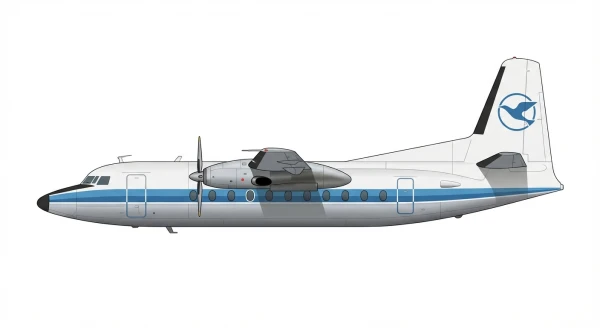
| Length | 23.6 m (77.3 ft) |
| Wingspan | 29 m (95.1 ft) |
| Height | 8.5 m (27.9 ft) |
| Wing area | 70 m² (753.5 sqft) |
| Empty weight | 12,148 kg (26,782 lbs) |
| Max. takeoff weight | 20,410 kg (44,996 lbs) |
| Powerplant | 2 × turboprops Rolls-Royce Dart Mk 536-7R 1,529 kW each |
| Maximum speed | 509 km/h (316 mph) |
| Operational range | 2,600 km (1,616 mi) |
| Service ceiling | 8,992 m (29,501 ft) |
| Climb rate | 7.4 m/s (24.3 ft/s) |



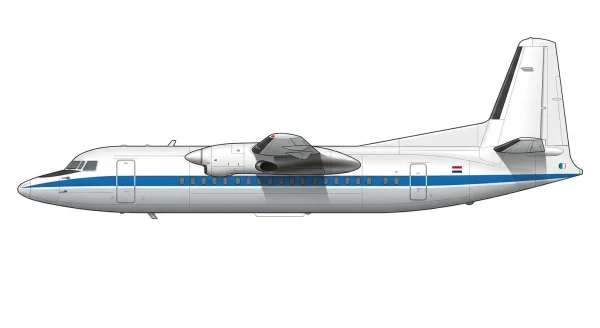
Description
The Fokker F27 Friendship is a twin-engine turboprop airliner developed and manufactured by Fokker in the Netherlands. Designed as a replacement for piston-engine types such as the Douglas DC-3, it first flew on 24 November 1955 and entered revenue service on 19 November 1958 with Aer Lingus. It is the most numerous post-war aircraft built in the Netherlands and the best-selling European turboprop airliner, and was also produced under licence in the United States by Fairchild.
Development
By 1951 Fokker was studying a 32-seat DC-3 replacement, consulting existing DC-3 operators on the performance and refinements they expected. Several configurations were evaluated, including Wright Cyclone radials, before Fokker settled on a high-wing layout with two Rolls-Royce Dart turboprops and a pressurised 28-seat cabin. The name Friendship was adopted in 1953. Four prototypes were built, two flyable aircraft funded by the Netherlands Institute of Aircraft Development and two for static and fatigue testing; the first, PH-NIV, flew on 24 November 1955. The second prototype and production aircraft were 0.9 m longer to correct tail-heavy handling and seat four more passengers, and used the Dart Mk 528. Fokker signed a licence agreement with Fairchild in 1956; the first American-built aircraft flew on 12 April 1958 and Fairchild production continued until July 1973. Fokker production ended in 1987 after 592 aircraft, with a further 207 F-27s and FH-227s built by Fairchild. In the early 1980s Fokker developed the F27 Mark 050, marketed as the Fokker 50, which replaced the F27 in production.
Design
The high-mounted wing gave a higher lift coefficient than a low wing, allowed a lower floor level for ground loading, and provided unobstructed passenger views without weight penalty. Fokker used the Redux metal-to-metal bonding process, becoming the second manufacturer after de Havilland to do so, giving longer fatigue life, a lighter structure and smoother aerodynamic surfaces. The cabin was pressurised and the Dart turboprops produced less vibration and noise than piston engines. The F.27 is 25.06 m long with a 29 m span, has a maximum take-off weight of 19,773 kg, and is powered by two Rolls-Royce Dart Mk.532-7 engines of 1,678 kW each, giving a 460 km/h cruise and 2,600 km range with 44–52 passengers and two or three crew.
Operational History
Early customers included Braathens SAFE, Luxair, New Zealand National Airways Corporation, Trans Australia Airlines, Ansett, East-West Airlines and Turkish Airlines. Sales were initially slow, requiring bank and Dutch government support, but demand rose sharply in 1960; the base price of an RDa.6-powered aircraft that year was £239,000. Many airframes were later converted to cargo work; FedEx Express was the last large US freight operator, retiring its fleet by the end of 2009. The United States Army Parachute Team operated a single C-31A from 1985 until September 2019. In service totals fell from 65 aircraft with 30 airlines in July 2010 to 10 aircraft with 7 operators in July 2018.
Variants
- F27-100: First production model, seating 44 passengers.
- F27-200: Powered by the more powerful Dart Mk 532 engine.
- F27-400: Combi passenger/cargo aircraft with Dart 7 engines and a large cargo door; the F27-400M served the US Army as the C-31A Troopship.
- F27-500: Fuselage stretched by 1.5 m, Dart Mk 528 engines and up to 52 passengers, first flown in November 1967.
- FH-227: Stretched version developed and built independently by Fairchild Hiller.
Frequently Asked Questions
What type of aircraft is the F27 Friendship?
What is the maximum speed of the F27 Friendship?
What is the range of the F27 Friendship?
When did the F27 Friendship first fly?
How many F27 Friendship have been built?
Which countries operate the F27 Friendship?
How much does a F27 Friendship cost?
What is the service ceiling of the F27 Friendship?
- AUG 302026 Updated Description updated
- AUG 52026 Updated Climb rate added
- JUL 232026 Updated Sources and cross-references refreshed
- APR 72026 Updated Sources and cross-references refreshed
- JAN 122026 Updated Range updated in a site-wide editorial pass