Djibouti Military Forces
Djibouti ranks #118 of 170 militaries worldwide in 2026, with 10,450 active troops. The Air Force flies 17 aircraft; the Navy operates 24 warships. Djibouti has no nuclear weapons.
Armed Forces in 2026
| Domain | Strength | Composition |
|---|---|---|
| Air Force | 17 aircraft | 10 helicopters |
| Djiboutian Navy | 24 warships | |
| Personnel | 10,450 active | 2,000 paramilitary |
ATLAS Index (Aggregate Total of Land, Air and Sea strength)
Full ranking →| Pillar | Weight | Score | Basis |
|---|---|---|---|
| Manpower | 10% | 23.0 | Active, reserve & paramilitary personnel |
| Ground forces | 20% | 0.0 | ARMS inventory power: armour & artillery by type and era, attack helicopters, armament |
| Naval power | 20% | 22.1 | SEAS inventory power: hulls by type, size and era, air wing, sustainment, armament |
| Air power | 25% | 14.3 | AIRS inventory power: aircraft by type and generation, enablers, armament |
| Nuclear deterrent | 10% | 0.0 | No declared nuclear capability |
| Defense budget | 15% | 7.9 | Annual spending, purchasing-power adjusted |
| Availability | modifier | ground ×0.80 · naval ×0.80 · air ×0.80 | Budget per point of each force, from the branch indexes |
Country File
| Population | 1.2M (2025) |
| GDP | $4.6 billion (2025) |
| GDP per capita | $3,906 |
| Military budget | $36M (2008) |
| Share of GDP | 2.6% (2008) |
| Share of govt spending | 9.1% (2008) |
| Military spending per capita | $41 (2008) |
| Inflation rate | -0.31% (2025) |
| Capital | Djibouti |
| Region | Africa |
| Land area | 23,180 km² |
| Coastline | 314 km |
| Land borders | 528 km |
| Bordering countries | 3 |
| Currency | DJF |
Strategic Overview in 2026
Strategic Position
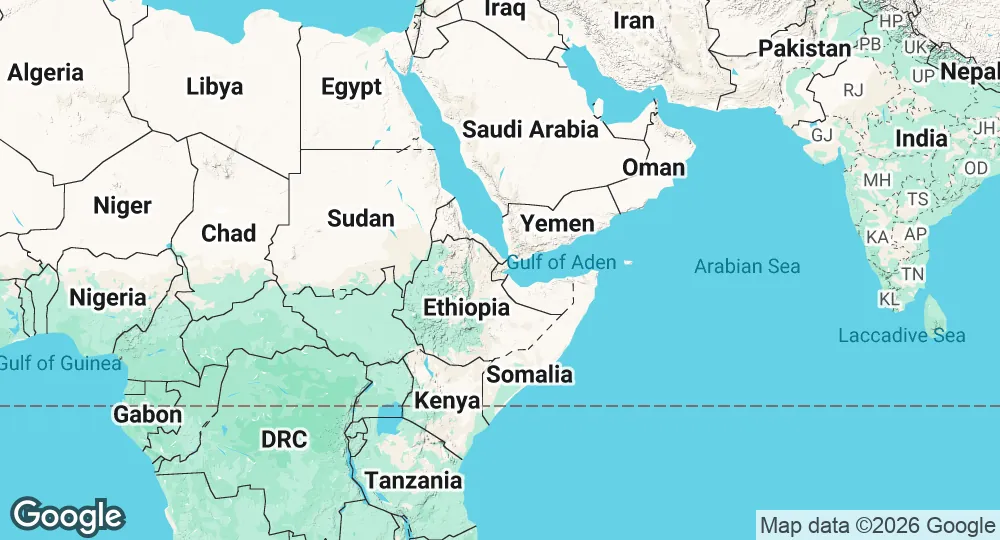
Djibouti's defense posture is defined by its location on the Bab el-Mandeb strait, a maritime chokepoint connecting the Red Sea and the Gulf of Aden. This position facilitates the hosting of multiple foreign military installations, which is the primary driver of the state's security and economic policy. As of 2026, Djibouti continues to host military bases for the United States (Camp Lemonnier), China (People's Liberation Army Support Base), France (Base Aérienne 188), Japan, and Italy.
In 2025, Djibouti expanded its bilateral security network by signing a military cooperation protocol with Turkey and a security pact with Egypt. These agreements reflect a policy of diversifying international partnerships to balance the influence of resident global powers. The state maintains active membership in the African Union (AU), the Arab League, and the Intergovernmental Authority on Development (IGAD).
Primary security concerns include regional instability originating from Yemen and Somalia, and a protracted border dispute with Eritrea involving the Ras Doumeira territory. Djibouti maintains a policy of neutrality regarding state-level conflicts in the Red Sea while allowing resident foreign forces to conduct counter-terrorism and anti-piracy operations against non-state actors.
Military Forces
The Djibouti Armed Forces (Forces Armées Djiboutiennes, or FAD) are organized into the National Army, the Djiboutian Air Force, and the Djiboutian Navy. Paramilitary components include the National Gendarmerie, the Republican Guard, and the Djiboutian Coast Guard. Total active personnel are approximately 15,000.
The Army is the primary branch and consists of several infantry regiments, a rapid action regiment, and specialized paratrooper battalions. Current inventory includes:
- Armored Vehicles: Operates T-72 main battle tanks and Norinco WMA301 tank destroyers.
- Armored Personnel Carriers/MRAPs: Fields BTR-80, AML-90 reconnaissance vehicles, and Casspir mine-protected vehicles.
- Artillery: Utilizes M-109L self-propelled howitzers and various towed systems.
The Air Force focuses on transport, surveillance, and light attack capabilities. It operates out of Djibouti–Ambouli International Airport. Inventory includes:
- Rotary Wing: Operates Mi-24/35 attack helicopters and Mi-8/17 transport helicopters.
- Fixed Wing: Maintains a fleet of Harbin Y-12, Cessna 208, and MA60 transport aircraft.
- Unmanned Aerial Vehicles (UAVs): Operates Bayraktar TB2 drones for reconnaissance and strike missions.
The Navy and Coast Guard are responsible for territorial water security and anti-smuggling operations. The fleet consists of patrol boats, including Swari-class and Metal Shark vessels, as well as limited landing craft capabilities. In 2025, the Coast Guard conducted the "Bull Shark" multinational exercise to improve maritime interoperability with US AFRICOM and EU naval forces.
Strategic Trends
Djibouti's military modernization is characterized by the procurement of hardware from Turkey and China, specifically focusing on unmanned systems and mobile armored platforms. The acquisition of Turkish Bayraktar TB2 drones represents a shift toward enhanced border surveillance and precision-strike capabilities.
Defense spending is estimated at approximately 3.5% of GDP. A significant portion of this expenditure is subsidized by lease payments from foreign nations, which provide a stable revenue stream for the military budget.
Future force development is constrained by the "geopolitical congestion" of hosting rival foreign militaries in close proximity. This environment requires the FAD to maintain a high degree of coordination with international commands. In 2025 and 2026, the FAD increased its participation in regional exercises such as "Justified Accord" to address asymmetric threats, including piracy and regional militant incursions. Border security remains a priority, with reported increases in surveillance activity along the northern frontier in response to regional shifts in the Horn of Africa.
Military Expenditure: information from the Stockholm International Peace Research Institute (SIPRI) Military Expenditure Database. Last updated on 25 September 2026. Suggest a change
Frequently Asked Questions
How large is Djibouti's military?
What is Djibouti's defense budget?
How does Djibouti rank militarily in the world?
Does Djibouti have nuclear weapons?
How many aircraft does Djibouti's air force have?
How large is Djibouti's navy?
What percentage of GDP does Djibouti spend on defense?
What is Djibouti's military personnel per capita?
Does Djibouti have paramilitary forces?
- SEP 252026 Updated Population, GDP and inflation added for 2025; GDP and inflation series revised
- AUG 42026 Updated Global Military Index updated in a site-wide editorial pass
- AUG 32026 Updated Global Military Index updated
- JUL 242026 Updated Global Military Index updated
- JUL 162026 Updated Global Military Index updated in a site-wide editorial pass
- JUN 162026 Updated Yearly statistics and Global Military Index updated
- APR 82026 Updated Paramilitary personnel updated