Cambodia Military Forces
Cambodia ranks #72 of 170 militaries worldwide in 2026, with 124,300 active troops. The Cambodian Army fields 2,163 ground vehicles, including 644 main battle tanks; the Air Force flies 25 aircraft; the Navy operates 21 warships. Cambodia has no nuclear weapons.
Armed Forces in 2026
| Domain | Strength | Composition |
|---|---|---|
| Royal Cambodian Air Force | 25 aircraft | 21 helicopters |
| Royal Cambodian Navy | 21 warships | 1 naval bases |
| Ground Forces | 2,163 vehicles | 644 main battle tanks |
| Personnel | 124,300 active | 67,000 paramilitary |
ATLAS Index (Aggregate Total of Land, Air and Sea strength)
Full ranking →| Pillar | Weight | Score | Basis |
|---|---|---|---|
| Manpower | 10% | 43.8 | Active, reserve & paramilitary personnel |
| Ground forces | 20% | 34.9 | ARMS inventory power: armour & artillery by type and era, attack helicopters, armament |
| Naval power | 20% | 18.9 | SEAS inventory power: hulls by type, size and era, air wing, sustainment, armament |
| Air power | 25% | 16.0 | AIRS inventory power: aircraft by type and generation, enablers, armament |
| Nuclear deterrent | 10% | 0.0 | No declared nuclear capability |
| Defense budget | 15% | 16.6 | Annual spending, purchasing-power adjusted |
| Availability | modifier | ground ×0.80 · naval ×0.97 · air ×1.03 | Budget per point of each force, from the branch indexes |
Country File
| Population | 17.6M (2024) |
| GDP | $46.4 billion (2024) |
| GDP per capita | $2,628 |
| Military budget | $695M (2024) |
| Share of GDP | 1.5% (2024) |
| Military spending per capita | $39 (2024) |
| Inflation rate | 0.81% (2024) |
| Capital | Phnom Penh |
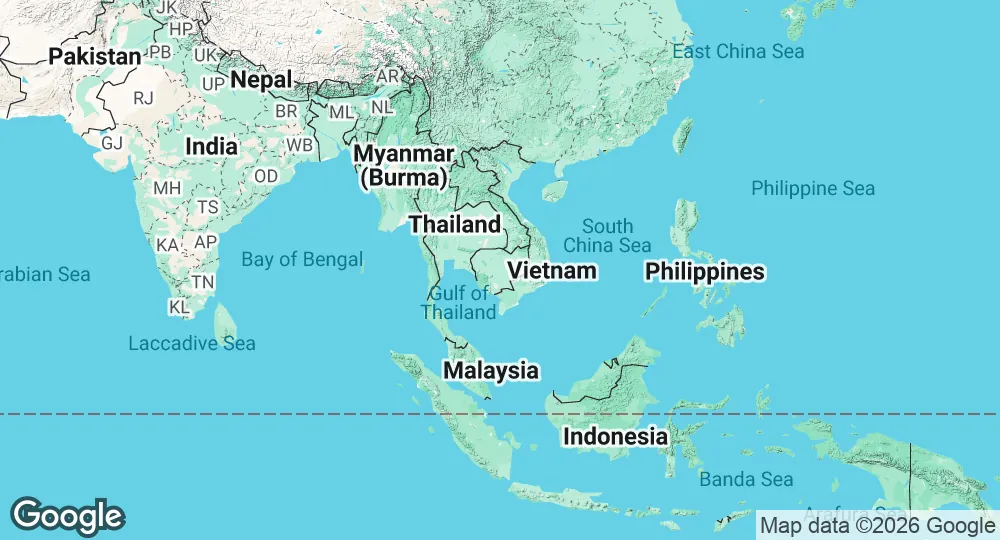
| Region | Asia |
| Land area | 176,515 km² |
| Coastline | 443 km |
| Land borders | 2,572 km |
| Bordering countries | 3 |
| Currency | KHR |
Strategic Overview in 2026
Strategic Position
Cambodia maintains a defense posture defined by a constitutional commitment to neutrality and non-alignment. The country’s primary security concerns involve border integrity, internal stability, and the management of overlapping maritime claims in the Gulf of Thailand. Cambodia is a member of the Association of Southeast Asian Nations (ASEAN) and participates in the ASEAN Defense Ministers' Meeting (ADMM) framework.
The bilateral relationship with China is the central pillar of Cambodian defense policy. This partnership includes the Provision of Military Assistance (PMA), infrastructure development, and regular combined exercises such as the Golden Dragon series. Relations with neighboring Thailand and Vietnam are managed through border commissions, though historical disputes over demarcation—specifically the area surrounding the Preah Vihear Temple—periodically influence troop deployments.
The Royal Cambodian Armed Forces (RCAF) prioritize the protection of the monarchy and the sovereignty of the state. Military doctrine emphasizes territorial defense through a mix of conventional force structures and internal security functions. Cambodia also contributes personnel to United Nations Peacekeeping Operations (UNPKO), primarily in engineering, demining, and medical roles in Africa and the Middle East.
Military Forces
The Royal Cambodian Armed Forces (RCAF) are under the command of the Ministry of National Defense, with the King as the Supreme Commander and the Prime Minister exercising executive control. The RCAF is divided into the Royal Cambodian Army, Royal Cambodian Navy, Royal Cambodian Air Force, and the Royal Gendarmerie. Total active personnel are estimated at 125,000, supported by a paramilitary force of approximately 70,000.
Royal Cambodian Army The Army is the largest branch and is organized into six military regions. It operates a fleet of main battle tanks including T-55 and Type 59 variants. Armored capability is supplemented by BTR-60 and Type 63 armored personnel carriers. Artillery assets include BM-21 Grad and Type 81 multiple rocket launchers, alongside various Soviet-era towed howitzers.
Royal Cambodian Navy The Navy focuses on coastal defense and the protection of fisheries. Its fleet consists primarily of patrol craft, including Stenka-class and Shershen-class vessels. The Ream Naval Base has undergone expansion to accommodate larger ships and modernized maintenance facilities.
Royal Cambodian Air Force The Air Force lacks fixed-wing combat aircraft. Its inventory is composed of transport and utility helicopters, including Mil Mi-17 and Harbin Z-9 platforms. It maintains a limited number of transport aircraft such as the Xian MA60.
Royal Gendarmerie The Royal Gendarmerie is a paramilitary branch responsible for internal security, counter-terrorism, and assistance to civil authorities. It maintains units in every province and operates under the jurisdiction of the RCAF High Command.
Strategic Trends
Military modernization is characterized by a transition from Soviet-era equipment to Chinese-manufactured systems. Procurement priorities focus on enhancing air defense, artillery range, and maritime surveillance. In 2025 and 2026, the RCAF integrated new batches of tactical vehicles and unmanned aerial vehicles (UAVs) for border monitoring.
The expansion of the Ream Naval Base is a primary infrastructure trend. The addition of a new pier and dry dock facilities allows for the docking of larger warships, potentially including those from the People's Liberation Army Navy (PLAN), although Cambodian officials maintain the site is for national use only.
Defense spending is estimated at approximately 2.3% of GDP. Constraints facing the military include a fragmented logistics system and a reliance on external aid for high-tech procurement. The leadership transition to a new generation of commanders, many of whom received Western or regional military education, is expected to influence future training standards and operational planning. Forces continue to prioritize demining operations, as Cambodia remains one of the most landmine-affected countries globally.
Military Expenditure: CIA World Factbook. Last updated on 4 August 2026. Suggest a change
Frequently Asked Questions
How large is Cambodia's military?
What is Cambodia's defense budget?
How does Cambodia rank militarily in the world?
Does Cambodia have nuclear weapons?
How many aircraft does Cambodia's air force have?
How large is Cambodia's navy?
How many tanks does Cambodia have?
What percentage of GDP does Cambodia spend on defense?
What is Cambodia's military personnel per capita?
Does Cambodia have paramilitary forces?
- AUG 42026 Updated Global Military Index updated in a site-wide editorial pass
- JUL 242026 Updated Global Military Index updated
- JUL 162026 Updated Global Military Index updated in a site-wide editorial pass
- JUN 162026 Updated Yearly statistics, military spending and 2 more fields updated
- JAN 232026 Updated Rank insignia updated (4 entries)
- JAN 212026 Updated Rank insignia updated (77 entries)
- JAN 172026 Updated Main battle tank count and Global Military Index updated