Nepal Military Forces
Nepal ranks #127 of 170 militaries worldwide in 2026, with 96,600 active troops. The Air Force flies 22 aircraft. Landlocked, Nepal has no navy and no nuclear weapons.
Armed Forces in 2026
| Domain | Strength | Composition |
|---|---|---|
| Nepalese Army Air Service | 22 aircraft | 15 helicopters |
| Personnel | 96,600 active | 15,000 paramilitary |
ATLAS Index (Aggregate Total of Land, Air and Sea strength)
Full ranking →| Pillar | Weight | Score | Basis |
|---|---|---|---|
| Manpower | 10% | 40.1 | Active, reserve & paramilitary personnel |
| Ground forces | 20% | 0.0 | ARMS inventory power: armour & artillery by type and era, attack helicopters, armament |
| Naval power | 20% | 0.0 | SEAS inventory power: hulls by type, size and era, air wing, sustainment, armament |
| Air power | 25% | 15.7 | AIRS inventory power: aircraft by type and generation, enablers, armament |
| Nuclear deterrent | 10% | 0.0 | No declared nuclear capability |
| Defense budget | 15% | 14.7 | Annual spending, purchasing-power adjusted |
| Availability | modifier | ground ×0.80 · naval ×1.00 · air ×0.96 | Budget per point of each force, from the branch indexes |
Country File
| Population | 29.7M (2024) |
| GDP | $42.9 billion (2024) |
| GDP per capita | $1,447 |
| Military budget | $429M (2024) |
| Share of GDP | 1.0% (2024) |
| Military spending per capita | $14 (2024) |
| Inflation rate | 4.69% (2024) |
| Capital | Kathmandu |
| Region | Asia |
| Land area | 143,686 km² |
| Land borders | 2,926 km |
| Bordering countries | 2 |
| Currency | NPR |
Strategic Overview in 2026
Strategic Position
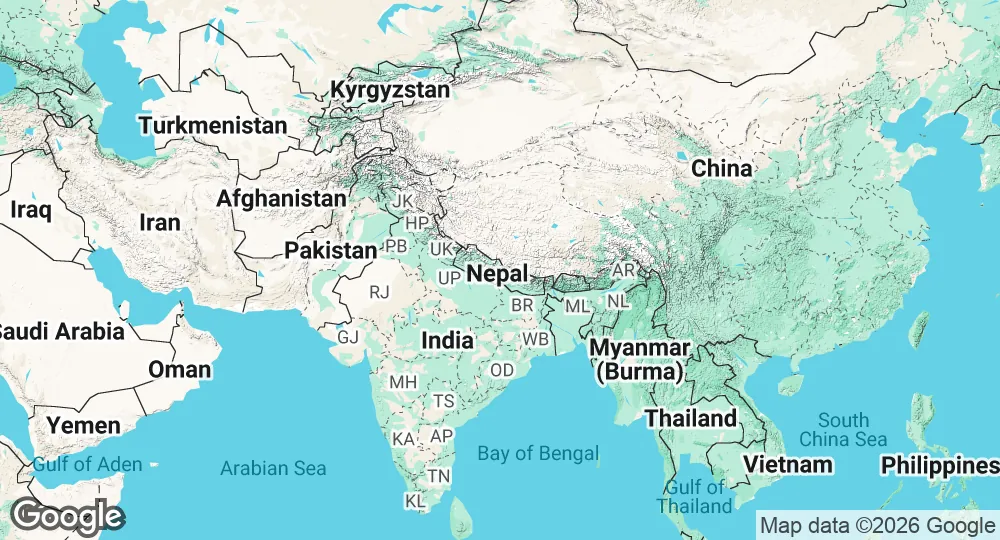
Nepal occupies a landlocked position in the Himalayas, situated between India and China. National defense doctrine is governed by the "Yam between two boulders" principle, a neutralist policy designed to maintain balanced relations with both neighboring powers while preserving territorial integrity. This posture is formalized through the 1950 Treaty of Peace and Friendship with India, which includes provisions for bilateral security cooperation and allows for the recruitment of Nepali citizens into the Indian Army’s Gorkha regiments.
Geopolitical priorities focus on non-alignment and the prevention of the country becoming a theater for regional rivalry. Nepal is not a member of any formal military alliances or regional defense pacts. A primary pillar of its strategic doctrine is its contribution to international security through United Nations (UN) peacekeeping operations. As of 2025, Nepal is the largest troop-contributing country to UN missions, utilizing these deployments to enhance its diplomatic influence and provide operational experience to its forces.
Internal security concerns center on disaster management, the protection of critical infrastructure, and maintaining stability during political transitions. The military is constitutionally mandated to support the government in national development projects and humanitarian assistance and disaster relief (HADR) operations, particularly in response to seismic and climate-related events.
Military Forces
The Nepali Armed Forces are a unified command structure primarily consisting of the Nepali Army (NA). As a landlocked nation, Nepal maintains no navy. The military is a volunteer force with approximately 95,000 active-duty personnel. The Armed Police Force (APF) serves as a paramilitary organization with roughly 40,000 personnel, primarily tasked with border security, counter-insurgency, and internal order.
The Nepali Army is organized into six combat divisions, which are geographically distributed across the country. Specialized units include the Ranger Battalion, which receives training modeled on international special forces standards, and a dedicated Disaster Management Directorate. The army also manages the Nepalese Army Air Service, which functions as an aviation wing rather than an independent air force. This wing operates a fleet comprised of Mi-17 transport helicopters, light utility helicopters, and short takeoff and landing (STOL) fixed-wing aircraft used for logistics, medical evacuation, and search and rescue.
Ground force equipment consists mainly of light infantry weaponry and armored personnel carriers (APCs). The army operates wheeled APCs and various light armored vehicles sourced from India, China, and the United States. Modernization efforts have shifted the standard infantry rifle from the INSAS toward the M16 series and the K2C1. The force lacks main battle tanks or dedicated fixed-wing combat aircraft, reflecting a doctrine focused on high-altitude infantry operations and domestic stability. For the upcoming House of Representatives elections in March 2026, the military has planned the mobilization of 80,000 personnel to provide security for polling and infrastructure.
Defense Industry
Nepal possesses a limited domestic defense industry and relies heavily on foreign imports for advanced military hardware. The state-operated Nepal Ordnance Factories, notably the facility at Sundarijal, produce small arms ammunition, explosives, and basic infantry gear. Local production is concentrated on ensuring a steady supply of consumables for internal security and peacekeeping needs rather than the manufacturing of complex weapon systems.
Imports are primarily facilitated through bilateral agreements with India and China. India remains the largest supplier of military vehicles, logistics equipment, and ordnance. The United States and South Korea provide specialized equipment, including communications technology and modern assault rifles.
Strategic Trends
Defense spending for the 2025/26 fiscal year is approximately NPR 62 billion, representing roughly 1.1% of GDP. Budgetary priorities emphasize infrastructure development, such as the "Bunker to Barracks" program, which aims to modernize living conditions and logistical facilities for service members.
Current modernization focuses on improving HADR capabilities and enhancing the technology suite for UN deployments. This includes the procurement of additional transport helicopters and drones for surveillance in rugged terrain. Despite a scheduled 25% reduction in global UN peacekeeping quotas in 2025 due to international budget constraints, the Nepali Army maintains its commitment to provide up to 10,000 troops if requested, seeking to maintain its status as a leading contributor.
Challenges facing the military include the logistical difficulties of operating in varied topographical extremes and the requirement to balance security partnerships with India and China. The military is also increasingly involved in large-scale national infrastructure projects, such as the construction of the Kathmandu-Terai Fast Track, which represents a shift toward a "development-security" nexus in national doctrine.
Military Expenditure: CIA World Factbook. Last updated on 4 August 2026. Suggest a change
Frequently Asked Questions
How large is Nepal's military?
What is Nepal's defense budget?
How does Nepal rank militarily in the world?
Does Nepal have nuclear weapons?
How many aircraft does Nepal's air force have?
What percentage of GDP does Nepal spend on defense?
What is Nepal's military personnel per capita?
Does Nepal have paramilitary forces?
- AUG 42026 Updated Global Military Index updated in a site-wide editorial pass
- JUL 162026 Updated Global Military Index updated in a site-wide editorial pass
- JUN 162026 Updated Yearly statistics, military spending and 2 more fields updated
- JAN 132026 Updated Description added