Suriname Military Forces
Suriname ranks #162 of 170 militaries worldwide in 2026, with 1,840 active troops. The Air Force flies 3 aircraft. Suriname has no nuclear weapons.
Armed Forces in 2026
| Domain | Strength | Composition |
|---|---|---|
| Air Force | 3 aircraft | 3 helicopters |
| Personnel | 1,840 active |
ATLAS Index (Aggregate Total of Land, Air and Sea strength)
Full ranking →| Pillar | Weight | Score | Basis |
|---|---|---|---|
| Manpower | 10% | 15.6 | Active, reserve & paramilitary personnel |
| Ground forces | 20% | 0.0 | ARMS inventory power: armour & artillery by type and era, attack helicopters, armament |
| Naval power | 20% | 0.0 | SEAS inventory power: hulls by type, size and era, air wing, sustainment, armament |
| Air power | 25% | 6.2 | AIRS inventory power: aircraft by type and generation, enablers, armament |
| Nuclear deterrent | 10% | 0.0 | No declared nuclear capability |
| Defense budget | 15% | 0.0 | Data unavailable |
| Availability | modifier | ground ×1.00 · naval ×1.00 · air ×1.00 | Budget per point of each force, from the branch indexes |
Country File
| Population | 634K (2024) |
| GDP | $4.4 billion (2024) |
| GDP per capita | $6,962 |
| Inflation rate | 16.23% (2024) |
| Capital | Paramaribo |
| Region | America |
| Land area | 156,000 km² |
| Coastline | 386 km |
| Land borders | 1,707 km |
| Bordering countries | 3 |
| Currency | SRD |
Strategic Overview in 2026
Strategic Position
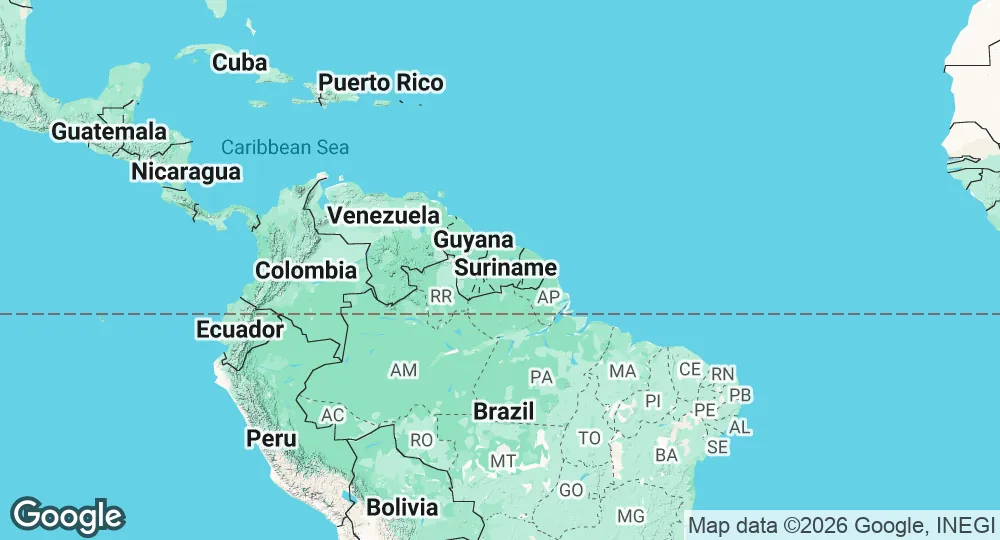
Suriname occupies a distinct geopolitical position on the northeastern coast of South America, characterized by a complex security environment defined by vast, difficult-to-monitor rainforest interiors and significant offshore maritime interests. Primary security concerns center on territorial integrity, specifically regarding long-standing border disputes with Guyana over the Tigri Area (New River Triangle) and maritime boundary definitions relevant to expanding offshore energy sectors.
The country maintains a policy of regional integration and multilateralism. Suriname is a member of the Caribbean Community (CARICOM) and formally joined the Regional Security System (RSS) in 2022 to enhance collective security and disaster response capabilities. Defense doctrine emphasizes sovereignty and territorial surveillance, with a particular focus on countering transnational organized crime, including narcotics trafficking and illegal gold mining.
Bilateral relationships are central to the national defense posture. Since 2025, the administration under President Jennifer Geerlings-Simons has prioritized deepening military-to-military cooperation with the Netherlands and France. Cooperation with France is particularly active along the Maroni River border with French Guiana, involving joint patrols and training. In 2024, Suriname signed a five-year framework agreement with the United States Southern Command to enhance institutional development and military mobility. Relations with Brazil remain foundational, historical procurement of armored vehicles and ongoing intelligence sharing.
Military Forces
The National Army (Nationaal Leger) is the unified defense force of Suriname, overseen by the Ministry of Defense. It is structured into four primary branches: the Land Forces (Landmacht), the Air Force (Luchtmacht), the Navy (Marine), and the Military Police (Militaire Politie). Total active personnel are approximately 2,500, with a reserve component of roughly 500.
The Land Forces constitute the largest branch and are optimized for light infantry and jungle warfare operations. Mechanized capabilities are provided by Brazilian-manufactured EE-9 Cascavel armored reconnaissance vehicles and EE-11 Urutu armored personnel carriers. The infantry is primarily equipped with FN FAL and AKM rifles, supplemented by FAMAS assault rifles donated by France in late 2023. Specialized capabilities include the Jungle Research and Action Commandos (CRAJ), a specialized unit trained by French forces for operations in the country’s dense interior.
The Navy and the Coast Guard operate in close coordination to secure the Exclusive Economic Zone (EEZ). The fleet is composed primarily of patrol craft, including Ocea FPB 72 and FPB 98 vessels. These assets are tasked with fishery protection, anti-smuggling operations, and increasingly, the protection of offshore oil and gas infrastructure.
The Air Force is primarily a transport and surveillance arm. It operates a small inventory of fixed-wing aircraft, including the Britten-Norman Islander and Cessna utility aircraft. Rotary-wing capabilities are provided by HAL Chetak helicopters acquired from India. There are no dedicated combat aircraft or advanced air defense systems in the current inventory.
The Military Police serves as a gendarmerie-style force, responsible for both military discipline and supporting civil authorities in border control and domestic security tasks.
Strategic Trends
The primary driver of Suriname’s current defense modernization is the expansion of the offshore energy sector in the Guyana-Suriname Basin. With large-scale oil production projected to begin in 2028, procurement priorities have shifted toward maritime domain awareness and the acquisition of more capable coastal and offshore patrol vessels.
Defense spending has historically remained below 1% of GDP, though recent years have seen increased allocations for personnel training and equipment maintenance. A renewed National Security Strategy, developed in consultation with CARICOM in late 2025, emphasizes the integration of digital security and cyber resilience into the defense framework, reflecting the rising threat of digital infrastructure interference as the country attracts more foreign direct investment.
Operational trends show an intensification of "Guiana Shield" cooperation, where Suriname, France, and Guyana coordinate on environmental security and the suppression of illegal mining operations. Constraints on the military include aging equipment fleets and limited technical maintenance capacity, though these are being addressed through expanded training exchanges and maintenance agreements with European and regional partners. Future force structure shifts are expected to emphasize modular units capable of rapid deployment to remote border regions.
Military Expenditure: information from the Stockholm International Peace Research Institute (SIPRI) Military Expenditure Database. Last updated on 4 August 2026. Suggest a change
Frequently Asked Questions
How large is Suriname's military?
How does Suriname rank militarily in the world?
Does Suriname have nuclear weapons?
How many aircraft does Suriname's air force have?
What is Suriname's military personnel per capita?
- AUG 42026 Updated Global Military Index updated in a site-wide editorial pass
- JUL 162026 Updated Global Military Index updated in a site-wide editorial pass
- JUN 162026 Updated Economic and demographic series refreshed (2 yearly records)
- JAN 132026 Updated Description added