Slovakia Military Forces
Slovakia ranks #85 of 170 militaries worldwide in 2026, with 15,850 active troops. The Slovak Army fields 487 ground vehicles, including 45 main battle tanks; the Air Force flies 51 aircraft, including 14 combat aircraft. Landlocked, Slovakia has no navy and no nuclear weapons.
Armed Forces in 2026
| Domain | Strength | Composition |
|---|---|---|
| Air Force | 51 aircraft | 14 combat 19 helicopters 5 air bases +19 on order |
| Ground Forces | 487 vehicles | 45 main battle tanks |
| Personnel | 15,850 active |
ATLAS Index (Aggregate Total of Land, Air and Sea strength)
Full ranking →| Pillar | Weight | Score | Basis |
|---|---|---|---|
| Manpower | 10% | 27.1 | Active, reserve & paramilitary personnel |
| Ground forces | 20% | 27.1 | ARMS inventory power: armour & artillery by type and era, attack helicopters, armament |
| Naval power | 20% | 0.0 | SEAS inventory power: hulls by type, size and era, air wing, sustainment, armament |
| Air power | 25% | 24.1 | AIRS inventory power: aircraft by type and generation, enablers, armament |
| Nuclear deterrent | 10% | 0.0 | No declared nuclear capability |
| Defense budget | 15% | 26.3 | Annual spending, purchasing-power adjusted |
| Availability | modifier | ground ×1.08 · naval ×1.00 · air ×1.06 | Budget per point of each force, from the branch indexes |
Country File
| Population | 5.4M (2024) |
| GDP | $140.9 billion (2024) |
| GDP per capita | $25,993 |
| Military budget | $2.8B (2025) |
| Share of GDP | 2.0% (2025) |
| Military spending per capita | $520 (2025) |
| Inflation rate | 2.76% (2024) |
| Capital | Bratislava |
| Region | Europe |
| Land area | 48,105 km² |
| Land borders | 1,524 km |
| Bordering countries | 5 |
| Currency | EUR |
Strategic Overview in 2026
Strategic Position
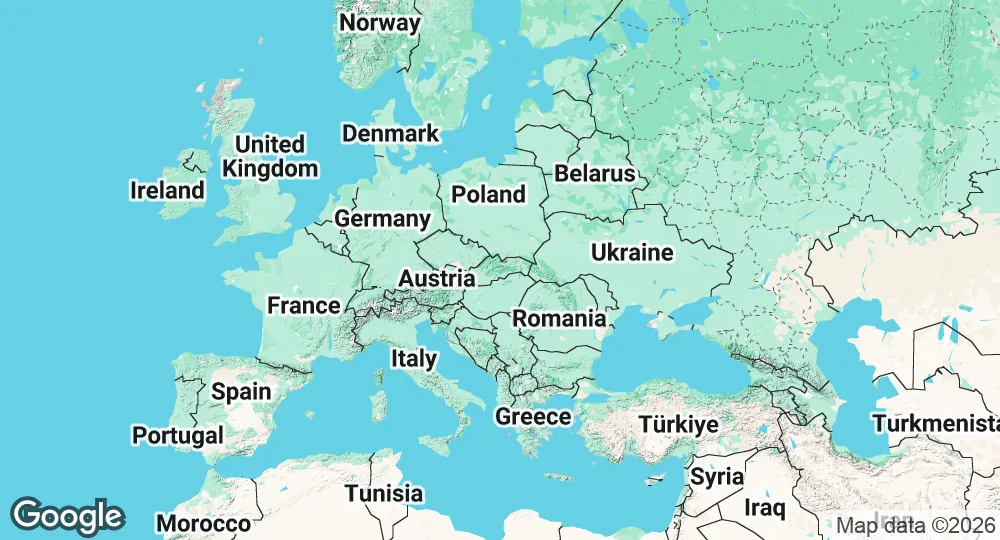
Slovakia occupies a landlocked position in Central Europe, bordering Austria, Czechia, Hungary, Poland, and Ukraine. Its defense posture is defined by its role as a frontline state on the eastern flank of the North Atlantic Treaty Organization (NATO), which it joined in 2004. Since the onset of the conflict in Ukraine, the 97-kilometer eastern border has become the primary focus of national security and surveillance operations.
The current defense doctrine is centered on collective defense under Article 5 of the North Atlantic Treaty. While Slovakia historically maintained close economic and energy ties with Russia, the strategic environment has prompted a shift toward Western military integration. Under the government formed in late 2023, Slovakia has limited state military aid to Ukraine to non-lethal and humanitarian support, such as demining equipment, while continuing to facilitate commercial arms exports and NATO transit through its territory. Regional cooperation is facilitated through the Visegrád Group (V4), though policy divergences regarding Ukraine have occasionally strained these relationships.
Military Forces
The Armed Forces of the Slovak Republic are organized into a professional unified structure under the General Staff, headquartered in Bratislava. The force consists of three primary branches: the Ground Forces, the Air Force, and the Special Operations Forces. As of 2025, active personnel numbers are approximately 21,000, supported by a growing active reserve and paramilitary elements within the National Defense Force.
The Ground Forces are organized around two mechanized brigades and are transitioning from Soviet-era platforms to Western equipment. The armor component operates Leopard 2A4 main battle tanks, received through a German exchange program, alongside older T-72M1 tanks slated for eventual retirement. For infantry transport and fire support, the army utilizes BVP-1 and BVP-2 tracked vehicles, which are currently being supplemented and replaced by CV90 Mk IV infantry fighting vehicles. The wheeled component includes Patria AMV 8x8 armored modular vehicles.
The Air Force has undergone a total platform transition following the donation of its MiG-29 fleet to Ukraine. Air defense and sovereignty missions are transitioning to F-16 Block 70 multirole fighters, with deliveries scheduled for completion by the end of 2025. The transport and rotary wings operate C-27J Spartan aircraft and UH-60M Black Hawk helicopters. For air defense, Slovakia is procuring the Barak-MX medium-range system to replace capabilities lost after the transfer of its S-300 system to Ukraine.
Special Operations Forces maintain specialized units for unconventional warfare, reconnaissance, and counter-terrorism, frequently deploying with NATO multinational battlegroups.
Defense Industry
Slovakia maintains a domestic defense manufacturing sector focused on artillery, ammunition, and armored vehicle components. The state-owned Konštrukta-Defence is the primary developer of the Zuzana 2 155mm self-propelled howitzer. Production of this system has been a focal point of both national procurement and export, particularly to Ukraine through allied-funded contracts. Based on combat feedback from high-intensity warfare, the industry is shifting focus toward the Eva M2 howitzer, a lighter and more mobile 6x6 system.
The country is a regional producer of large-caliber ammunition, with ZVS Holding significantly increasing production capacity for 155mm shells to meet European demand. Other domestic firms include ZTS - Špeciál, which produces barrels and weapon systems, and Grand Power, which manufactures small arms. While Slovakia relies on imports for advanced platforms like fighter jets and radar, it emphasizes domestic industrial participation in procurement contracts, such as the local assembly of CV90 and Patria vehicles.
Strategic Trends
Defense spending is approximately 2% of GDP in the 2025 and 2026 budgets, meeting the NATO minimum target. While NATO leadership has called for higher benchmarks, the Slovak government has indicated that it will not exceed 2% in the 2026 fiscal cycle, prioritizing the consolidation of public finances and dual-use infrastructure such as military-capable hospitals and roads.
Modernization is the dominant trend, with the "Long-Term Development Plan for the Ministry of Defense" focusing on heavy mechanized capabilities. Key procurement priorities through 2026 include the arrival of the CV90 fleet, the integration of F-16 fighters, and the establishment of a multi-layered integrated air and missile defense system. Slovakia is also evaluating candidates for a new main battle tank fleet to replace the T-72, with the Leopard 2A8, M1A2 Abrams, and K2 Black Panther identified as potential options. Constraints facing the military include a relatively small personnel pool and the challenge of maintaining operational readiness while simultaneously replacing the majority of its legacy heavy equipment.
Military Expenditure: CIA World Factbook. Last updated on 4 August 2026. Suggest a change
Frequently Asked Questions
How large is Slovakia's military?
What is Slovakia's defense budget?
How does Slovakia rank militarily in the world?
Does Slovakia have nuclear weapons?
How many aircraft does Slovakia's air force have?
How many tanks does Slovakia have?
What percentage of GDP does Slovakia spend on defense?
What is Slovakia's military personnel per capita?
- AUG 42026 Updated Global Military Index updated in a site-wide editorial pass
- AUG 32026 Updated Global Military Index updated
- JUL 162026 Updated Global Military Index updated in a site-wide editorial pass
- JUN 162026 Updated Yearly statistics, military spending and 2 more fields updated
- JAN 212026 Updated Rank insignia updated (38 entries)
- JAN 172026 Updated Main battle tank count and Global Military Index updated
- JAN 132026 Updated Description updated