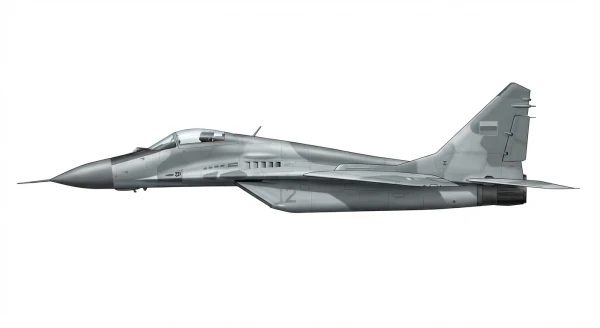
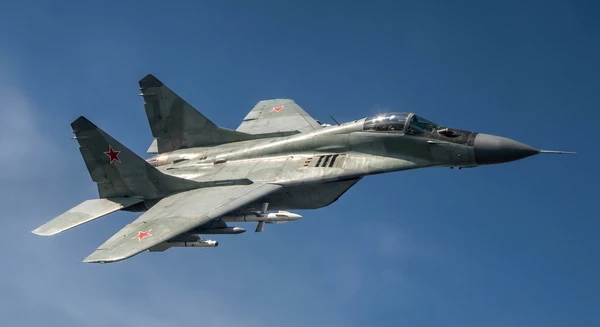
MiG-29 Fulcrum
Soviet twin-engine fighter jet, notable in late Cold War clashes, widely exported and integral to various aerial engagements globally. Key figures: top speed 2,450 km/h, range 2,100 km, service ceiling 18,000 m, max takeoff weight 18,000 kg, unit price $25M, built 1,600. In service with 22 air forces as of 2026 — India (59), Algeria (46), Ukraine (45) and 19 others.
| Crew | 1 |
| Length | 17.3 m (56.8 ft) |
| Wingspan | 11.4 m (37.3 ft) |
| Height | 4.7 m (15.5 ft) |
| Wing area | 38 m² (409.0 sqft) |
| Empty weight | 11,000 kg (24,251 lbs) |
| Max. takeoff weight | 18,000 kg (39,683 lbs) |
| Powerplant | 2 × turbofans Klimov RD-33 8,319 kgf each |
| Ejection seat | Zvezda K-36DM |
| Maximum speed | 2450 km/h (Mach 2.45) |
| Operational range | 2,100 km (1,305 mi) |
| Service ceiling | 18,000 m (59,055 ft) |
| Climb rate | 330.0 m/s (1082.7 ft/s) |
-
 India
59
India
59
-
 Algeria
46 +3
Algeria
46 +3
-
 Ukraine
45
Ukraine
45
-
 Egypt
43
Egypt
43
-
 Uzbekistan
38
Uzbekistan
38
-
 Myanmar
37
Myanmar
37
-
 North Korea
35
North Korea
35
-
 Belarus
32
Belarus
32
-
 Iran
30
Iran
30
-
 Syria
29
Syria
29
-
 Turkmenistan
24
Turkmenistan
24
-
 Yemen
23
Yemen
23
-
 Russia
22
Russia
22
-
 Serbia
15
Serbia
15
-
 Azerbaijan
14
Azerbaijan
14
-
 Poland
14
Poland
14
-
 Kazakhstan
13
Kazakhstan
13
-
 Bulgaria
12
Bulgaria
12
-
 Sudan
11
Sudan
11
-
 Bangladesh
8
Bangladesh
8
-
 Mongolia
6
Mongolia
6
-
 Peru
6
Peru
6
-
 Cuba
0
Cuba
0
- Air-to-Surface Vympel Kh-25 (AS-10 Karen)
- Air-to-Surface Vympel Kh-29 (AS-14 Kedge)
- Anti-Radiation Vympel Kh-31 Taifun (AS-17 Krypton)
- Air-to-Air Long-Range Vympel R-27 / K-27 (AA-10 Alamo)
- Air-to-Air Short-Range Vympel R-73 (AA-11 Archer)
- Air-to-Air Medium-Range Vympel R-77 RVV-AE (AA-12 Adder)
- Air-to-Surface Zvezda Kh-35 Uran (AS-20 Kayak)
Recent Events — MiG-29 Fulcrum
54 events →-
AUG 242026
 Russia
Struck by Ukrainian long-range drones at Millerovo Air Base near Dolotinka, Rostov Oblast; third Russian fighter reached in two days.
Damaged
Russia
Struck by Ukrainian long-range drones at Millerovo Air Base near Dolotinka, Rostov Oblast; third Russian fighter reached in two days.
Damaged
-
AUG 232026
Russia
Damaged in the same Ukrainian drone raid on Vityazevo airfield near Anapa, alongside a Flanker and a Kronshtadt Orion.
Damaged
-
AUG 102026
 Ukraine
Lost over Odesa Oblast during a combat mission against aerial targets; an anomaly during a missile launch set the aircraft alight, pilot ejected.
Crash
Ukraine
Lost over Odesa Oblast during a combat mission against aerial targets; an anomaly during a missile launch set the aircraft alight, pilot ejected.
Crash
-
JUL 212026
Russia
MiG-29 destroyed by a Ukrainian strike drone at Khalino airfield near Kursk; a covering Pantsir-S1 was hit in the same raid.
Destroyed
-
JUN 272026
Ukraine
MiG-29 destroyed on the ground by a Russian Geran-4 drone strike at Voznesensk Air Base, Mykolaiv Oblast, while preparing for takeoff.
Destroyed

Description
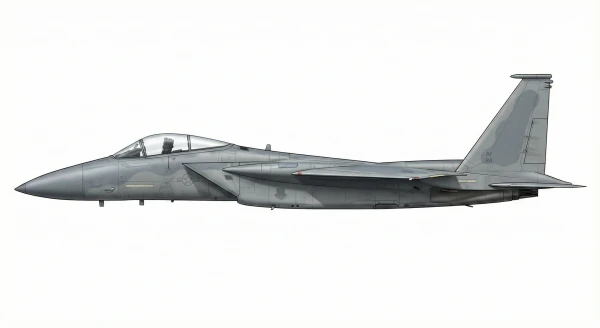
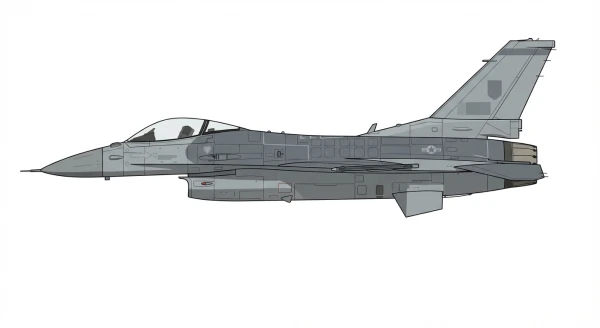
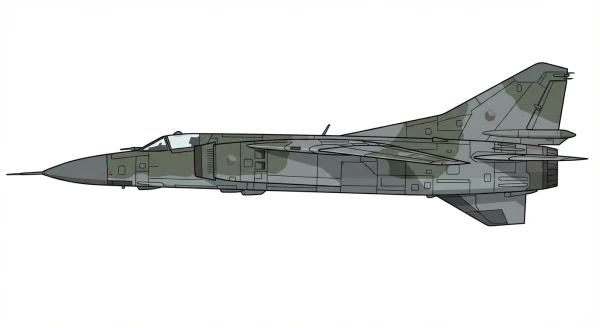
The Mikoyan MiG-29 is a twin-engine fighter aircraft designed by the Mikoyan design bureau in the Soviet Union. Developed as an air superiority fighter, the aircraft entered service with the Soviet Air Forces in 1983 to counter American fighters such as the F-15 Eagle and F-16 Fighting Falcon. It is known for its close-in combat agility and widespread foreign service, with more than 30 nations operating the type.
Development
In 1969, the Soviet General Staff initiated the Perspektivnyy Frontovoy Istrebitel requirement to counter new U.S. air superiority fighters. By 1971, the program was divided into heavy and lightweight categories, with Mikoyan assigned the Perspektivnyy Lyogkiy Frontovoy Istrebitel requirement for a lightweight tactical fighter. Detailed design work on the MiG-29A began in 1974, and the prototype made its first flight on 6 October 1977. Pre-production aircraft were first observed by Western intelligence in November 1977.
Design
The MiG-29 features an aluminum and composite airframe with mid-mounted swept wings, blended leading-edge root extensions, swept tailplanes, and twin vertical fins outboard of the engines. Power is provided by two Klimov RD-33 turbofans generating 50 kN of dry thrust and 81.3 kN in afterburner, with main intakes utilizing variable ramps and auxiliary upper-fuselage louvers for austere field operations. Sensor systems on baseline aircraft include the Phazotron N019 pulse-Doppler radar, an optical-electronic sighting system, and a helmet-mounted sight, while flight controls rely on mechanical-hydraulic actuation with a three-axis autopilot.
Armament
Internal armament consists of a single 30 mm GSh-30-1 autocannon located in the port wing root, fitted with 100 to 150 rounds. The aircraft features up to eight external hardpoints capable of carrying up to 4,000 kg of payload. Supported weapons include R-27, R-73, R-60, and R-77 air-to-air missiles, unguided rockets, general-purpose bombs, and adapted foreign munitions such as the AGM-88 HARM.
Operational History
The Soviet Air Forces first deployed the MiG-29 operationally in 1987 to cover forces in Afghanistan. More than 30 nations have operated the aircraft, with India becoming the initial non-Warsaw Pact customer in 1984. The type has seen combat in multiple conflicts, including the 1991 Gulf War, the 1998–2000 Ethiopian-Eritrean War, the Kosovo War, the Syrian Civil War, and the Russian invasion of Ukraine.
Variants
- MiG-29 (Product 9.12): Initial production air superiority fighter for the Soviet Air Force entering service in 1983.
- MiG-29S (Product 9.13S): Upgraded model featuring an enlarged dorsal spine housing additional fuel and electronic countermeasures, improved flight controls, and increased payload capacity.
- MiG-29K (Product 9.31): Navalized carrier-based variant featuring folding wings, reinforced landing gear, and an arrestor hook.
- MiG-29SMT (Product 9.17): Modernized multirole variant incorporating Zhuk-ME air-to-ground radar capability, glass cockpit displays, and extended range.
- MiG-35: Multirole derivative built on second-generation MiG-29 airframes featuring updated sensors and propulsion systems.
Frequently Asked Questions
What type of aircraft is the MiG-29 Fulcrum?
What is the maximum speed of the MiG-29 Fulcrum?
What is the range of the MiG-29 Fulcrum?
When did the MiG-29 Fulcrum first fly?
How many MiG-29 Fulcrum have been built?
Which countries operate the MiG-29 Fulcrum?
How much does a MiG-29 Fulcrum cost?
What is the service ceiling of the MiG-29 Fulcrum?
- AUG 122026 Updated Range corrected to the ferry range with one drop tank
- AUG 62026 Updated Description updated
- AUG 52026 Updated Version, wingspan and 10 more fields updated
- AUG 12026 Updated Manufacturer updated
- JUL 232026 Updated Sources and cross-references refreshed
- APR 72026 Updated Sources and cross-references refreshed
- JAN 242026 Updated MiG-29 Fulcrum: thrust updated; MiG-29 Fulcrum: price updated