Strategic Position
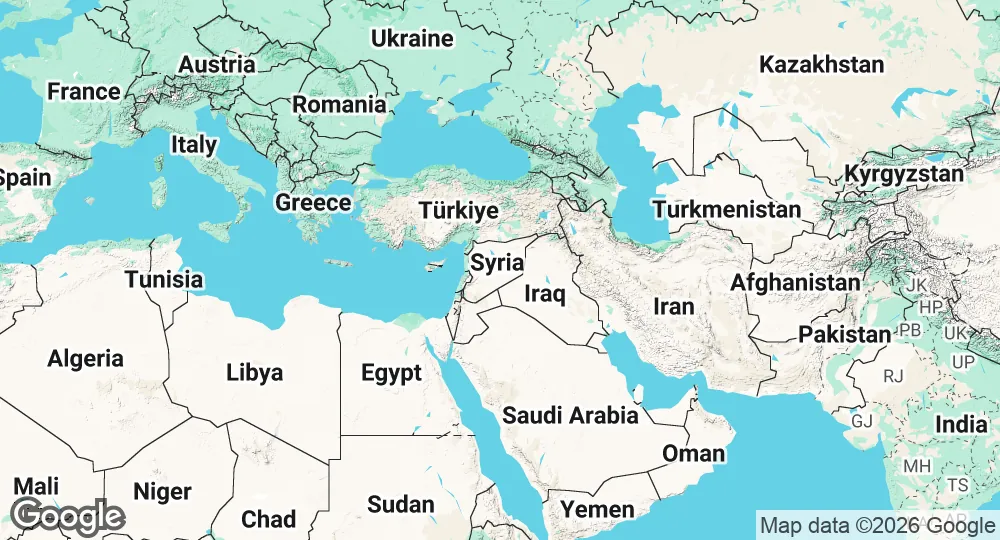
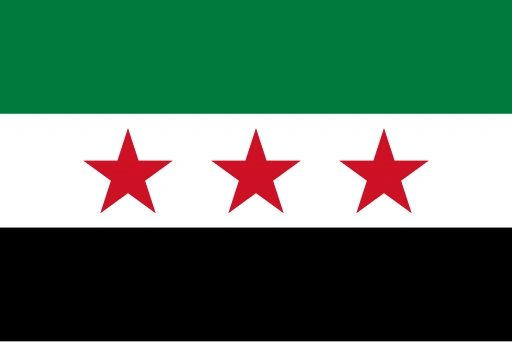
The Syrian defense posture is currently defined by the transition following the collapse of the Ba'athist government in December 2024. Under the interim administration led by Ahmed al-Sharaa, Syria has shifted away from the "Axis of Resistance" and its historical military alliances with Iran and Russia. Strategic priorities have pivoted toward internal consolidation, the integration of fragmented armed factions into a national structure, and the restoration of territorial integrity.
Primary security concerns in 2026 involve the presence of foreign military forces and the unresolved status of the Syrian Democratic Forces (SDF) in the northeast. While the interim government has pursued de-escalation with regional neighbors, tensions remain over the integration of Kurdish-led autonomous regions. A March 2025 agreement to merge the SDF into the national military remains partially unimplemented, leading to the designation of closed military zones in the Aleppo countryside in January 2026.
Regional relationships are undergoing a realignment. Syria has established a defense cooperation agreement with Turkey, which provides training and logistical support. Simultaneously, the government is engaged in United States-mediated talks in Paris as of January 2026 to establish a new security framework with Israel, focused on the 1974 Disengagement Agreement and the demarcation of the Golan Heights border.
Military Forces
The Syrian Arab Armed Forces (SAAF) are currently being reconstructed under the authority of the Ministry of Defense. The transitional government formally dissolved the previous military structure in early 2025, ousting officers loyal to the former regime and calling for all non-state militias to merge into a unified command.
Army: The ground forces form the core of the nascent military, with a recruitment target of approximately 200,000 to 300,000 personnel. Manpower is drawn from former insurgent groups, including Hayat Tahrir al-Sham (HTS) and the Turkish-backed Syrian National Army (SNA), as well as some former regime defectors. The Ministry of Defense has organized at least 23 divisions through a "reflagging" process that retains the internal structure of constituent factions while placing them under centralized oversight.
Air and Air Defense Forces: These branches were significantly degraded during the 2024-2025 transition by Israeli airstrikes targeting strategic assets to prevent their seizure by non-state actors. Current capabilities are limited to a small number of functional fighter aircraft and short-range air defense systems. The military increasingly relies on unmanned aerial vehicles (UAVs) for surveillance and strike operations.
Navy: The naval branch is minimal, following the destruction of major assets at Tartus and Latakia. It remains focused on coastal patrolling with light missile boats.
Key Equipment: The military operates a mix of salvaged Soviet-era hardware—including T-72 and T-62 tanks—and newly acquired equipment. Since 2025, Syria has received light armored vehicles from Jordan and Turkish-manufactured armored personnel carriers and UAVs. Turkish military academies have begun training the first cohorts of Syrian officers to professionalize the force.
Defense Industry
The domestic defense industry is in a state of rehabilitation. Prior state-run manufacturers, such as those under the Scientific Studies and Research Center (SSRC), faced significant disruption during the change in government. Current industrial activity is concentrated in the Aleppo region, where efforts are underway to restore facilities for the production of small arms, ammunition, and spare parts.
Syria remains heavily dependent on foreign imports for complex systems. While the government aims for greater self-sufficiency in basic ordnance, modernization is largely contingent on military-technical cooperation with Turkey and potentially Saudi Arabia. Agreements signed in 2025 include provisions for joint industrial projects and the establishment of specialized industrial zones to support military and civilian engineering needs.
Strategic Trends
The primary strategic trend is the professionalization and centralization of the military to move beyond its insurgent origins. Modernization efforts prioritize mobility, border security, and counter-insurgency capabilities rather than conventional regional power projection.
Defense spending is constrained by the requirements of national reconstruction. However, the government has received external financial support, including grants and investments from Gulf states and Turkey, to cover military salaries and infrastructure repairs. A major challenge remains the "Shadow Government" crisis, where ideological divisions between various military factions threaten the cohesion of the unified command. The future force structure depends on the successful conclusion of negotiations with the SDF and the establishment of a lasting security arrangement with Israel.