Turkmenistan Military Forces
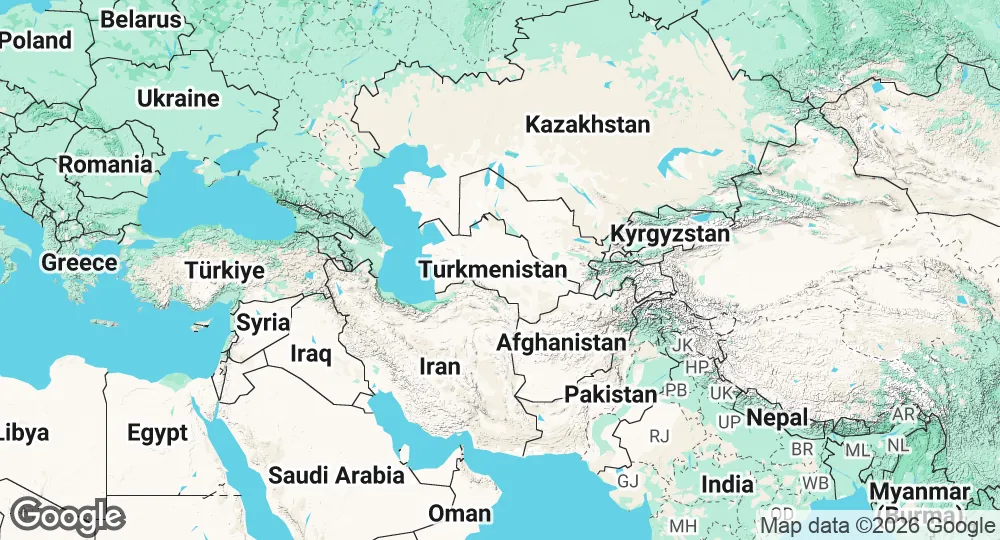
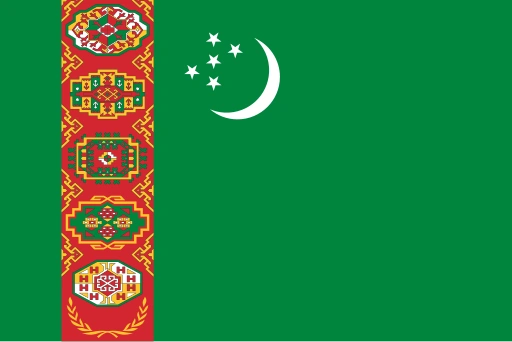
Turkmenistan ranks #71 of 170 militaries worldwide in 2026, with 36,500 active troops. The Turkmen Army fields 3,587 ground vehicles, including 654 main battle tanks; the Air Force flies 92 aircraft, including 54 combat aircraft; the Navy operates 45 warships. Landlocked, Turkmenistan has no navy and no nuclear weapons.
Armed Forces in 2026
| Domain | Strength | Composition |
|---|---|---|
| Air Force | 92 aircraft | 54 combat 26 helicopters +8 on order |
| Turkmen Naval Forces | 45 warships | |
| Ground Forces | 3,587 vehicles | 654 main battle tanks |
| Personnel | 36,500 active | 5,000 paramilitary |
ATLAS Index (Aggregate Total of Land, Air and Sea strength)
Full ranking →| Pillar | Weight | Score | Basis |
|---|---|---|---|
| Manpower | 10% | 31.4 | Active, reserve & paramilitary personnel |
| Ground forces | 20% | 39.2 | ARMS inventory power: armour & artillery by type and era, attack helicopters, armament |
| Naval power | 20% | 20.4 | SEAS inventory power: hulls by type, size and era, air wing, sustainment, armament |
| Air power | 25% | 23.4 | AIRS inventory power: aircraft by type and generation, enablers, armament |
| Nuclear deterrent | 10% | 0.0 | No declared nuclear capability |
| Defense budget | 15% | 10.5 | Annual spending, purchasing-power adjusted |
| Availability | modifier | ground ×0.80 · naval ×0.80 · air ×0.80 | Budget per point of each force, from the branch indexes |
Country File
| Population | 7.5M (2024) |
| GDP | $51.4 billion (2024) |
| GDP per capita | $6,857 |
| Military budget | $112M (1999) |
| Share of GDP | 2.9% (1999) |
| Share of govt spending | 15.0% (1999) |
| Military spending per capita | $25 (1999) |
| Capital | Ashgabat |
| Region | Asia |
| Land area | 469,930 km² |
| Land borders | 3,736 km |
| Bordering countries | 4 |
| Currency | TMT |
Strategic Overview in 2026
Strategic Position
Turkmenistan’s defense policy is defined by its status as a permanently neutral state, a position recognized by the United Nations. This doctrine prohibits membership in military-political alliances and the placement of foreign military bases on Turkmen soil. Consequently, the country is not a member of the Collective Security Treaty Organization (CSTO) or the Shanghai Cooperation Organisation (SCO).
Primary security concerns center on the 744-kilometer border with Afghanistan and the protection of energy infrastructure in the Caspian Sea. The government maintains a pragmatic relationship with the administration in Kabul to ensure the security of the Turkmenistan-Afghanistan-Pakistan-India (TAPI) pipeline project and to prevent the spillover of insurgent activity. In the Caspian region, Turkmenistan asserts its maritime sovereignty and protects offshore gas fields, occasionally leading to jurisdictional overlaps with neighboring littoral states. Defense priorities are focused on border territorial integrity and internal stability rather than power projection.
Military Forces
The Armed Forces of Turkmenistan comprise the Land Forces, the Air and Air Defense Forces, and the Naval Forces. These are supported by the State Border Service and the Internal Troops. The military relies on a conscription system with a service obligation of 24 months for most citizens.
The Land Forces are organized into several military districts and represent the largest branch of the military. The inventory consists of Soviet-era platforms supplemented by modern acquisitions from Russia and Turkey. The army operates T-72 and T-90S main battle tanks. For troop transport and reconnaissance, the force utilizes BMP-2 and BMP-3 infantry fighting vehicles, along with BTR-80 and BTR-82A armored personnel carriers. Specialized mobility is provided by Turkish-made Kirpi and Otokar Cobra vehicles. Artillery units field BM-21 Grad and BM-30 Smerch multiple rocket launchers.
The Air Force and Air Defense Forces maintain air superiority and ground attack capabilities. The combat fleet includes MiG-29 fighters and Su-25 ground-attack aircraft. Transport requirements are met by C-27J Spartan and An-74 aircraft. Turkmenistan has integrated unmanned aerial vehicles (UAVs) into its force structure, operating Turkish Bayraktar TB2 and Chinese-made WJ-600 systems. Air defense is provided by a layered network of surface-to-air missiles, including Soviet-origin systems and the Chinese FD-2000 long-range system.
The Naval Forces operate primarily out of the port of Turkmenbashi. The fleet includes the Deniz Han corvette, a Turkish-designed vessel equipped with anti-ship and surface-to-air missiles. The navy also operates fast attack craft, patrol boats, and specialized search-and-rescue vessels.
The State Border Service is a distinct entity responsible for frontier security. It maintains its own inventory of light armored vehicles and patrol craft, operating with a high degree of autonomy in the southern border regions.
Defense Industry
The domestic defense industry is limited and focuses primarily on the maintenance, repair, and overhaul (MRO) of existing equipment. There is no significant production of indigenous heavy weaponry or aerospace platforms. Turkmenistan relies on international procurement to modernize its inventory. Turkey has emerged as a partner for naval construction, with several vessels assembled or completed at the Balkan Shipyard in Turkmenbashi. Smaller-scale domestic initiatives include the production of uniforms, light gear, and basic maintenance of small arms.
Strategic Trends
Modernization programs emphasize the diversification of hardware suppliers to reduce historical reliance on Russian technology. Recent procurement cycles have favored Turkish aerospace and naval systems, Chinese air defense batteries, and European transport aircraft.
Force structure shifts are focused on enhancing the mobility and surveillance capabilities of units stationed along the Afghan border. In 2025, the military has prioritized the integration of electronic warfare (EW) systems and the expansion of its drone fleet for border reconnaissance. Naval modernization remains a priority to secure the Turkmen sector of the Caspian Sea against asymmetric threats and to protect maritime economic interests.
Constraints facing the military include the technical challenges of maintaining a diverse fleet of equipment from multiple countries and the ongoing requirement to replace aging Soviet-era stockpiles. Defense spending is estimated to remain consistent with previous cycles, though the lack of transparent public budgeting makes precise GDP percentages difficult to verify. Training exercises in 2025 and 2026 have focused on counter-terrorism and rapid deployment in arid environments.
Military Expenditure: information from the Stockholm International Peace Research Institute (SIPRI) Military Expenditure Database. Last updated on 4 August 2026. Suggest a change
Frequently Asked Questions
How large is Turkmenistan's military?
What is Turkmenistan's defense budget?
How does Turkmenistan rank militarily in the world?
Does Turkmenistan have nuclear weapons?
How many aircraft does Turkmenistan's air force have?
How large is Turkmenistan's navy?
How many tanks does Turkmenistan have?
What percentage of GDP does Turkmenistan spend on defense?
What is Turkmenistan's military personnel per capita?
Does Turkmenistan have paramilitary forces?
- AUG 42026 Updated Global Military Index updated in a site-wide editorial pass
- AUG 32026 Updated Global Military Index updated
- JUL 162026 Updated Global Military Index updated in a site-wide editorial pass
- JUN 162026 Updated Economic and demographic series refreshed (3 yearly records)
- JAN 172026 Updated Main battle tank count and Global Military Index updated
- JAN 132026 Updated Description updated
- JUN 212025 Updated Country data reviewed and updated